
Published on 16 April 2024

A&FS Newsletter - March 2024

The newsletter of the SDC Agriculture & Food Systems Network provides you with the latest news on projects, publications and events related to food systems and submitted by network members. It also informs about A&FS Network activities and portrays network members.
Editorial

After a very busy 2023, the A&FS Network focal team is in the process of turning its hand to new things. But we are continuing to run some of our activities, such as Thoughts for Food and our newsletters. Also, on 21st March we launched a new learning series on the Rio Conventions
with our colleagues over at the CDE network.

Meanwhile, our network members and their organisations have been extremely active too, and have submitted an impressive array of reports on their innovative engagement across the world.

Bruce Campbell
A&FS Network Focal Point
bruce.campbell@eda.admin.ch

Members' Articles: Markets

How to strengthen food system resilience in a fragile context? Learnings from Myanmar
The FOSTER project, implemented by HEKS/EPER in Myanmar, aims to strengthen food security and improve the incomes of smallholder producers by applying a market systems development (MSD) approach. In the highly fragile context stemming from the conflict, working with social businesses and the private sector proves highly adequate. Key lessons learned from the first two years of implementation include the need for flexibility and agile and adaptive programming, frequent and rapid market assessments, and a joint understanding with the donor.

Julien Brewster  
HEKS/EPER​
LinkedIn | julien.brewster@heks-eper.org​​

​​Francesco Melara
HEKS/EPER​
LinkedIn

Sweet success: How engagement of private sector boosts seedless watermelon production
In a private sector collaboration, the Swiss Increasing Market Employability Program (IME) has launched an initiative in North Macedonia’s sustainable agribusiness sector. This intervention sets out to achieve several critical goals, including implementing a contract farming model for planned production, strengthening the supply chain, increasing the number of watermelon producers, and providing training and mentorship from seasoned agronomists.

Ema Jakimovska  
Swiss Increasing Market Employability Program - IME
LinkedIn

​​​Gabriela Micevska
Swiss Increasing Market Employability Program - IME
gabriela.micevska@thepalladiumgroup.com

Sparking inclusive change through an innovative saving system for smallholders
Using the «Adopt, Adapt, Expand, and Respond» framework, the SDC funded PROMAS (Promoting Sustainable Agricultural Market Systems) project seeks to expand market systems inclusively in Mozambique. This article highlights the «Fundo Agricola» an innovative savings systems, that promotes access to inputs by smallholder farmers. Learn more on how facilitating greater systemic response will accelerate inclusive change.

Fauna Ibramogy
Swiss Agency for Development and Cooperation
fauna.ibramogy@eda.admin.ch

Members' Articles: Agroecology

New training material on transition to agroecology
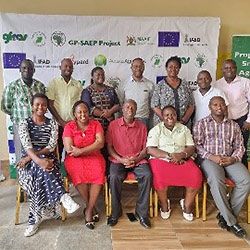
Looking for training material to empower farmers to transition towards agroecological practices? The Global Forum for Rural Advisory Services (GFRAS) is proud to introduce a set of comprehensive training materials, that were developed in line with the Global Programme for Small-Scale Agroecology Producers and Sustainable Food Systems Transformation (GP-SAEP). The material emphasizes key competencies essential for facilitating change effectively and is currently being tested. Read more to learn how you can join GFRAS to promote agroecological transitions globally.

Ingrid Oliveira Silva Kelle
Global Forum for Rural Advisory Services
LinkedIn​ | ingrid.oliveira@g-fras.org​

La gestion de la fertilité des sols à l’épreuve de la réalité
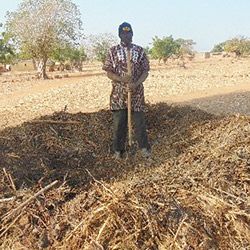
Dans l’Est du Burkina Faso, l’ONG belge Iles de Paix a mené de front avec l’association pour la recherche et la formation en agroécologie (AFRA) un projet visant à améliorer la production agricole via la gestion de la fertilité des sols. Il s’agit là d’une mise en pratique du principe agroécologique qui recommande de « garantir et améliorer la santé et le fonctionnement du sol » constituant un élément clé pour renforcer la résilience de l’agriculture familiale. Découvrez les apprentissages qui résultent de cette expérience.  

Oliver Genard
Iles de Paix – Belgique
olivier.genard@ilesdepaix.org​

From fragmented to coordinated seed interventions
Across the fragile and conflict-affected states in Africa, smallholder farming communities face persistent structural challenges to access and use quality seed of adapted varieties that farmers prefer. Compounding these challenges are increased climate stresses that drive uncertainty and seed insecurity. By investing in and supporting a Nexus of Humanitarian, Development and Peacebuilding interventions in Africa’s seed sector, SDC and partners are working to deliver more effective and sustainable, longer-term impact. Learn more about the Integrated Seed Sector Development in Africa Programme (ISSD Africa)

James Mulkerrins
Wageningen University & Research
LinkedIn | james.mulkerrins@wur.nl

2024, Year of Camelids – an underrated animal for climate resilience
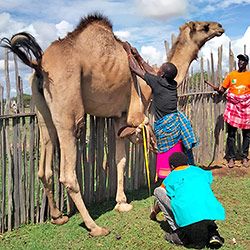
Why caring about camels when millions of people are going hungry? Contacted by FAO to produce a video on «local heroes», the result of this work is a testimonial on the multiple values of an often underestimated animal. Learn more how the animal contributes to strengthen equality, nutrition security and climate resilience of drylands by takinga glimpse at VSF-Suisse project work in Isiolo, Kenya. [Link to video on youtube]

Genevieve Owuor
Vétérinaires Sans Frontières Suisse (VSF-Suisse)
LinkedIn​ | genevieve.owuor@vsf-suisse.org

Members' Articles: Food systems

Enhancing governance and policy impact on food systems in Bangladesh
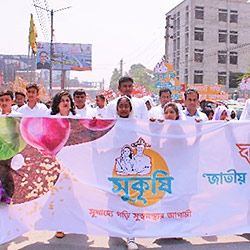
The NICE (Nutrition In City Ecosystems) project aims to improve food security and nutrition in urban areas of Bangladesh. Faced with the increasing prevalence of malnutrition and challenges posed by rapid and unplanned urbanization, NICE collaborates with local governments to integrate food security and nutrition into municipal agendas. Read more about how the project encourages multisectoral collaboration and promotes policies and programs to ensure equitable access to healthy diets for all urban inhabitants.

Helen Prytherc
Swiss TPH
helen.prytherch@swisstph.ch

Revolutionizing food systems through human rights and equity
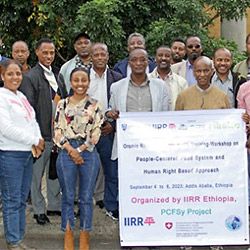
The People-Centered Food System (PCFSy) Project  led by Columbia University aims to integrate human rights into food policies. Across Cambodia, Ethiopia, Uganda, and Honduras, it enhances capacities, advocates for the inclusion of food rights in constitutions so that food systems transformation leave no one behind. While human rights provide legal frameworks and minimum standards, equity principles address deeper issues of inequality and power imbalancesDiscover how workshops, high-level consultations, and policy analysis reports are underway to foster equitable food transformations.

​​Myrtel Anne G. Valenzuela
International Institute of Rural Reconstruction (IIRR)
LinkedIn | myrtelanne.valenzuela@iirr.org

Systèmes alimentaires : pas sans les travailleurs agricoles
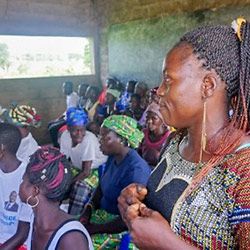
De nombreux projets se concentrent sur la formation des agriculteurs pour promouvoir la transition vers des systèmes de production agricole durables. Cependant, un acteur important est souvent oublié : les travailleurs agricoles.

​​Nicole Bolliger
Brücke Le Pont
LinkedIn | nicole.bolliger@bruecke-lepont.ch

Members' Articles: Digitalization

Global lessons in scaling up digital rural advisory solutions
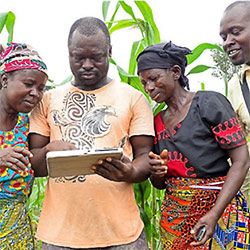
A newly published GFRAS report delves into the fusion of digital technologies and advisory services, highlighting potentials and challenges.. We navigate through diverse regions, adhering to the Principles for Digital Development, offering insights into public and private sector roles. Discover opportunities for public-private partnerships shaping the fortification of global food systems.

​​Ingrid Oliveira Silva Kelle
Global Forum for Rural Advisory Services
LinkedIn​ | ingrid.oliveira@g-fras.org

News

New FAO report: “The unjust climate"
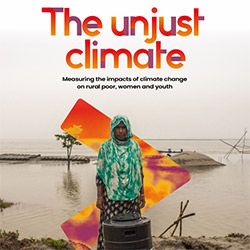
Developing measures to promote inclusive rural transformation processes requires better understanding of how climate change affects the livelihoods and economic behaviour of vulnerable rural populations, particularly women, young people and people living in poverty. This is the aim of the new FAO report entitled «The unjust climate», which brings together an impressive array of data from 24 low- and middle-income countries in five regions of the world. Read the full report to find out more about how climate stressors intersect with gender, age, and wealth.
read more

African perspectives on agroecology - new book published
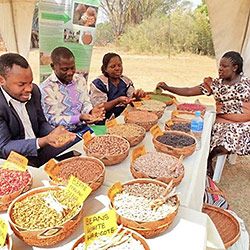
Despite minimal state and donor support, the ‹silent revolution› of agroecological practices is taking root across Africa. Farmers, NGOs, and research teams are innovating and organizing to fight climate change, inequality, and hunger. The recently published book entitled «African Perspectives on Agroecology» includes contributions from the frontlines, assembling an array of reflections on the possibilities and constraints facing the wider adoption of agroecology and farmer-led seed system. The collection is a rejoinder to Afro-pessimism, and an inspiring call to action.
read more

​​​Bulisani Ncube
Swiss Cooperation Office, Embassy of Switzerland, Harare
bulisani.ncube@eda.admin.ch

YPARD takes part in CEA-FIRST Inception Meeting
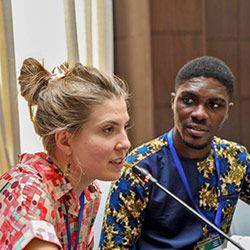
The Consortium Europe-Africa on Research and Innovation for Food Systems Transformation (CEA-FIRST) project comes under the AU-EU Research and Innovation Cooperation, and is funded by the European Union.
YPARD and CORAF, supported by CSIR Ghana, FARA, CIRAD, are leading the development of youth and gender specific strategies for this project. YPARD is strategically positioned in the fight against the shared challenges that are caused by imbalances in the world-particularly those with the food and agricultural systems.
read more

​​​Trisha Mandal
YPARD (Young Professionals for Agricultural Development)
LinkedIn​ |​trisha.mandal@ypard.net

Practical production guide for black soldier fly published (Spanish)
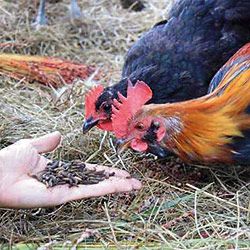
In recent years, black soldier flies have garnered increased attention as a valuable animal feed source. Their advantages lie in their ease of production, efficient utilization of waste, and rich nutritional content. This illustrative production guide, written in Spanish, specifically targets small livestock producers. The primary goal is to close the production cycle a bit more by reducing feed imports and maximizing usage of waste. This gives the chance to simultaneously improve economic, environmental, and social conditions.
read more

Ludovico Schorno
Comundo
ludovic.schorno@protonmail.com

Events

Trip around Rio: Tackling the triple planetary crisis – Solutions for sustainable development

Online | 24 April & 30 May 2024
The triple planetary crisis interlinking climate change, biodiversity loss, and pollution, forms an increasing burden for achieving the SDGs. The event series «Trip around Rio» will embark on a learning journey to gain a deeper understanding of the importance of biodiversity and ecosystem services for international cooperation beyond nature conservation. It seeks at providing an overview from global to local issues, including the most relevant global frameworks, sources of finances and good working practices on the ground. A special focus will be on discussing and developing innovative solutions & recommendations for SDC and its partners.
read more

Who is who
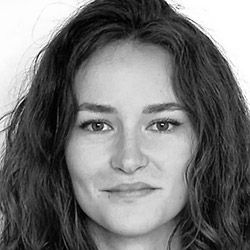
Héloïse Bellenot
Academic Trainee, SDC
heloise.bellenot@eda.admin.ch

What do you love, or what is special, about your work?

What I love about my work is the variety of tasks and themes I get to work on. I can apply my knowledge of agroecology from my previous experiences in India while continually learning about health and food systems. Additionally, issues related to agriculture, food, and health, are particularly close to my heart. Contributing, even in a small way, to the SDC’s work in these areas is a great source of motivation. Furthermore, my colleagues come from very diverse professional and academic backgrounds. Everyone brings a unique perspective to the table. As a young professional, I find their varied paths truly inspiring and enlightening.

What is your favourite quote and why?

I like this quote from Rousseau’s «Reveries of a Solitary Walker»: «Amidst the tranquility of nature, my thought find clarity, my soul finds peace, and my spirit finds renewal.» These words resonate with me because I spend a lot of time in nature outside of work to recharge. It helps me refocus and deal with the challenges of daily life. Furthermore, I find that it beautifully expresses the regenerative power of nature and the interconnectedness between humans and ecosystems.​

What is the most important lesson you have learned from your work?

The most valuable lesson I have learned from my experiences in India is the importance of designing solutions rooted in the realities of the ground. To effectively address the needs of populations, it is essential to remain attentive to the evolving local living conditions and to maintain constant dialogue between the ground and higher decision-making levels. This is an aspect that I appreciate in my work here at SDC, where we strive to maintain close contact and foster exchanges with local stakeholders.

Additionally, I have learned that sustainable changes often require a great deal of patience and perseverance. It is often preferable to opt for gradual but solid results rather than quick but superficial solutions.​

Héloïse has been working as an academic trainee for the SDC’s Food systems and Health sections since February 2024. She maintains the shareweb as well as the network and is responsible for the newsletter. During her Master’s degree in Asian studies (at the University of Geneva), she focused on agroecology. This included conducting field research in South India and completing an internship in an NGO in North India, where she gained valuable insights into the promotion of sustainable agricultural practices. She has also worked on multilateralism as a research assistant at the Graduate Institute of International and Development Studies
Comic