
Climate services boost agricultural resilience in the Andes
In the Andes region of South America, climate change threatens the livelihoods of smallholder farmers with unpredictable climate events. This article explores how co-produced climate services can help farmers adapt to the changing climate. Through the projects ENANDES and ENANDES+ the Colombian Institute of Hydrology, Meteorology, and Environmental Studies (IDEAM) are co-producing with farmers agroclimatic bulletins. These are produced during community agroclimatic roundtables and field schools that integrate scientific information with local observations and measurements. Together, IDEAM and the Bern University of Applied Sciences (BFH) studied the socioeconomic benefits of climate information services. The study showed how active collaboration with farmers builds resilience, strengthens trust in meteorological institutions, and supports decision-making to potentially reduce production losses.
AFS Newsletter - Article by


Instituto de Hidrología, Meteorología y Estudios Ambientales (IDEAM)
lbarreto@ideam.gov.co l LinkedIn

Instituto de Hidrología, Meteorología y Estudios Ambientales (IDEAM)
olgacadena@unicauca.edu.co

Instituto de Hidrología, Meteorología y Estudios Ambientales (IDEAM)
lpico@ideam.gov.co l LinkedIn
Luis Reinaldo Barreto Pedraza
Instituto de Hidrología, Meteorología y Estudios Ambientales (IDEAM)
lbarreto@ideam.gov.co l LinkedIn
For smallholder farmers in the Andes region of South America, events such as frosts, prolonged droughts, and heavy rains are no longer anomalies, but rather the new reality that threatens their production. In this scenario of increasing climate uncertainty, climate information services are emerging as a key tool to contribute to farmers' adaptation and resilience. These climate services provide targeted, specialized information designed for specific users, and can be applied in a variety of sectors, such as energy, health, and agriculture.
The concept of climate services, which has gained momentum during the last years, is now being implemented in projects such as ENANDES (Enhancing Adaptive Capacity of Andean Communities through Climate Services) and ENANDES+ (Building Regional Adaptive Capacity and Resilience to Climate Variability and Change in Vulnerable Sectors in the Andes, a Contribution to the Expansion of the ENANDES Project), led by the World Meteorological Organization (WMO) and funded by the Adaptation Fund and the Swiss Agency for Development and Cooperation (SDC). The projects include Swiss actors such as MeteoSwiss (Swiss Federal Office of Meteorology and Climatology) and the Bern University of Applied Sciences (BFH). There are also Andean actors are also involved, including DMC (Chilean Meteorological Directorate), IDEAM (Colombian Institute of Hydrology, Meteorology, and Environmental Studies), INAMHI (National Institute of Meteorology and Hydrology of Ecuador), SENAMHI (National Service of Meteorology and Hydrology of Bolivia), SENAMHI (National Service of Meteorology and Hydrology of Peru), and SMN (National Meteorological Service of Argentina). In addition, regional centres such as CIIFEN (International Center for Research on the El Niño Phenomenon) and CRC-SAS (Regional Climate Center for Southern South America) are also participating.
Switzerland's involvement in climate services and in the Andes is not new. In 2012, a bilateral project called CLIMANDES (Climate services with a focus on the Andes in support of decision-making) was launched between SENAMHI (Peru) and MeteoSwiss (Switzerland), financed by the SDC. The experience gained from this project has proven key to the development and implementation of the ENANDES and ENANDES+ projects.
The Bern University of Applied Sciences (BFH) has a clear role in ENANDES and ENANDES+: to support partner countries in analysing the socioeconomic benefits of climate information.
Colombia: a model for climate co-production
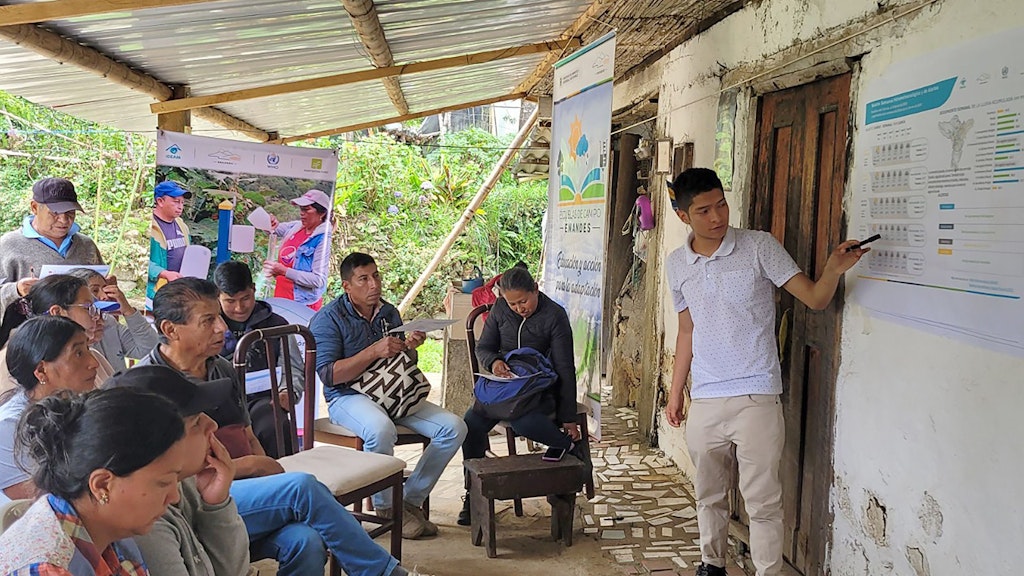
In collaboration with IDEAM (Colombia's Institute of Hydrology, Meteorology, and Environmental Studies), ENANDES has studied the impact of co-producing climate information with small coffee, corn, and potato farmers in the municipalities of Popayán, Totoró, and Puracé, in the department of Cauca. Co-producing agroclimatic knowledge means creating forecasts and alerts with farmers, not for them. IDEAM provides technical hydrometeorological data, and farmers contribute by monitoring bioindicators and measuring precipitation using rain gauges provided as part of the project, endorsed by the WMO and IDEAM.
This space is conceived as a living, collaborative, and transformative platform, in which technical knowledge and local expertise are brought together to build collective responses to climate change. Its goal is to jointly understand clear, timely, and accurate information about the local climate, its variability, climate prediction, and forecasts, which is validated with information collected locally by the community, so that informed decisions can be made in production.
This generates a dialogue of knowledge around adaptation strategies and the territorialization of climate services — materialized in ENANDES community agroclimatic roundtables and ENANDES field schools — and generates climate information products in the form of local bulletins that farmers validate and actually use because they trust their joint origin.
This ongoing process not only strengthens trust between farmers and the meteorological institute but also allows climate services to be tailored to specific needs, maximizing their usefulness. Tangible results include the ENANDES community agroclimatic bulletin and the jointly produced hydrometeorological and alert bulletin, which translate forecasts and enable practical recommendations to be developed jointly. This stage — known as the “last mile” — is crucial: without effective implementation, the information does not generate benefits.
Socioeconomic benefits: beyond the data
Based on the expertise of each partner and the recommendations of the World Meteorological Organization, the socioeconomic benefit studies developed in the project use a triple bottom line approach (including economic, social, and environmental aspects) and mixed methods (quantitative and qualitative) to assess climate services. This means understanding the importance, or value, of climate services beyond monetary valuation, comprehending their importance in a comprehensive manner. In addition, the benefits are considered as a whole, including the use and application of the service and how to improve it. In Colombia, the analysis of socioeconomic benefits revealed:
1.Co-production of knowledge:
- ENANDES community agroclimatic tables combine meteorological and hydrological science with local knowledge, improving resilience, food security, confidence in information, and income in vulnerable communities.
- In 2022, 87% of farmers used climate information. After the ENANDES project was implemented, 98% of farmers in the study areas used agroclimatic bulletins to define agricultural adaptation strategies.
2.Trust and local participation:
- An actor analysis was conducted, examining the relationship and proximity of each institution to the community and the resulting trust of the farmers in the information given by each actor. The results of the study indicate that physical proximity and direct work determine the credibility given by farmers to the institution.
- At the beginning of the project, there was low trust in IDEAM; it remains to be seen whether this position has changed after the project, due to IDEAM’s involvement in field schools and community agroclimatic roundtables.
- NGOs such as the Río Piedras Foundation were key for reaching communities.
- The focus on gender and youth was strengthened, promoting scenarios for social appropriation of knowledge about the socioeconomic benefits derived from the use of climate services.
3. Monetary value:
The analysis of agricultural production between 2017 and 2023 in Popayán, Totoró, and Puracé (Cauca, Colombia) made it possible to quantify the “avoided damages” thanks to the use of agroclimatic bulletins. In other words, applying the adaptation recommendations (such as adjusting planting dates) discussed during the ENANDES community agroclimatic roundtables and field schools, and crystallized in the bulletins, could reduce crop losses due to climate. This concept - avoided damages - reflects the economic value of climate information: it quantifies the loss of production due to climate issues and, therefore, the potential value of informed decision-making.
- The analysis of climate-related losses among coffee farmers revealed an average economic impact of USD 174/ha/year. For a producer with 10 hectares, this means an annual loss of USD 1740, equivalent to five minimum monthly wages in Colombia.
- Potato producers faced a similar situation, with USD 186 lost per hectare per year, reaching USD 1860 (≈ 5.3 minimum wages) for those who cultivate 10 hectares.
- In the case of corn, losses were lower (USD 54/ha/year): USD 540 per year for a producer with 10 hectares, equivalent to 1.5 minimum wages.
- Simply put: decisions such as adjusting planting dates and protecting crops from climate variations could reduce damage to agricultural production caused by extreme events. However, given the high socioeconomic vulnerability of the communities studied, structural social factors are essential to have the basic conditions to address an extreme climate threat in its entireness.
4. Sustainability of the climate service:
- The participation of the students of the University of Cauca and local NGOs ensures that climate information will transcend the duration of the project through continued research and training in the region.
- IDEAM now has staff with practical experience and technical training in conducting socioeconomic benefit studies, which can be extended to different regions of the country.
Lessons for the Andean region
The successes of ENANDES, which began in 2021, led to its expansion into ENANDES+. This extension of the project enabled various synergies and support between Andean countries through South-South links. In this context, Colombia stands out as a thematic leader in community agroclimatic roundtables, providing support to partners based on its experiences, as well as learning from new case studies in partner countries. As such, Colombia stands out as a leader in:
- Co-production model: effective integration between science from the meteorological service and local knowledge.
- Spaces for dialogue: the establishment of ENANDES community agroclimatic roundtables facilitates socioeconomic studies through surveys and focus groups.
Countries such as Argentina, Bolivia, Ecuador, Chile, and Peru intend to replicate or are already replicating these practices, strengthening links between meteorological services and users of climate information.
Conclusion
Climate services are a tangible investment in agricultural resilience. As demonstrated in Colombia, their value lies on how climate services are constructed, co-produced, shared, and applied in decision-making. Collaboration between technicians, scientists, farmers, and local institutions to produce information is the basis for addressing climate change and the resilience of farmers.
Resources:
- https://crc-osa.ciifen.org/en/quienes-somos-enandes/
- https://wmo.int/activities/projects/project-portfolio/enhancing-adaptive-capacity-of-andean-communities-through-climate-services-enandes
- https://wmo.int/activities/projects/project-portfolio/enandes-building-regional-adaptive-capacity-and-resilience-climate-variability-and-change-vulnerable