
Farmer Innovation Groups co-create knowledge in Armenia
Rural Advisory Services don’t exist anymore in Armenia. With innovation groups based on the interactive innovation model, farmers co-create with partners solutions to their needs and boost their productivity. Agricultural college teachers could facilitate these groups if a shift in the job profile is made. This would also improve their competencies in providing up-to-date VET training to their apprentices. Such a form of mutual support and further development is often just as effective as a RAS, but much cheaper. Of course, this also requires farmers who understand their trade and can continue to build on it.
AFS Newsletter - Member Article by
Monique Frey, HEKS / Johannes Brunner, BFH-HAFL / Lilit Hovhannisyan SDA
monique.frey@heks.ch
Background of MAVETA
Although agriculture and the food sector employ most people in the Armenian economy, they do not make a corresponding contribution to the gross domestic product. Compared to the urban population, incomes in rural areas are much lower. Accordingly, the pull of the Yerevan metropolitan region, where more than a third of Armenians live, is huge. Various efforts are being made to overcome the economic stagnation in rural Armenia.
MAVETA (Modernizing Vocational Education and Training in Agriculture in Armenia), started in September 2022, focuses on vocational training programs for 6 professions in the agricultural and food sector (farmer, veterinary assistant, dairy technologists, dairy farmer, agricultural machinery mechanic, fruit and nut orchardist) which, according to the recommendations of an external evaluation, are based on a dual model and are oriented towards the needs of the private sector. The aim is to improve knowledge and skills in agricultural value chains, to increase productivity and thus also income. This will offer interesting jobs for apprentices, create new jobs in the long term and promote the launch of additional SMEs. One partial success of the project is that since May 2024 a new vocational training law has been passed at national level, which defines dual principles in vocational training where learning alternates between school and companies as the standard.
MAVETA works together with 6 vocational schools (State Agricultural Colleges) and the surrounding private employers in the relevant sectors. Together, new dual curricula have been developed in which at least 50% of the learning time is spent working on farms or companies respectively. The project continues to invest in the training of teachers and instructors. Knowledge exchange and knowledge creation are to be promoted through networks between the various farms and companies. This should help the actors to try out and reflect on innovations.
Apprenticeships and trainings in agriculture
To enable farmers to offer good apprenticeships in which apprentices can complete their training successfully, the project also offers further training for farmers. On the one hand in the soft-skill area for the supervision and guidance of apprentices, on the other hand a wide range of agro-ecological topics in the broad sense of agricultural practice: forage production, feeding, conservation agriculture through to potato and wheat seed production. The apprentices will mainly work on the farms during the spring and summer seasons. The aim is therefore a seasonal dual model.
Inexistent Rural Advisory Service
In order to be able to continue offering these training courses and knowledge exchange and creation in the long term, the ideal scenario would be that rural advisory services (RAS) or State Agricultural College teachers support farmers in increasing their productivity and making their production more and more environmentally friendly. However, the Armenian state abolished RAS some time ago. There are no private RAS financed by the farmers. And in the job description of agricultural college teacher is at the moment not foreseen to offer advice to farmers. Larger farms have their own agronomists and veterinarians. The smaller farms do their work as they always have or are supported by international projects to improve their working methods.
Operational groups (Europe) or working groups (Arbeitskreise) in Switzerland co-create practical solutions for agriculture
One objective of MAVETA is to show how the lack of RAS can be filled with operational groups. Operational groups are based on the interactive innovation model. It focuses on actual needs from farmers, brings partner with relevant complementary knowledge together for co-creating activities and solutions to these needs. The results of these groups, as we know them in Switzerland, are diverse and range from increasing productivity through benchmarking, improvements in work processes, to reducing the use of antibiotics, to developing new products such as a sausage made from soup chickens or trying out new additives to eliminate curing salt from sausage products. The overall aim, however, is ultimately to improve the economic yield and reduce ecological emissions. Working groups in Switzerland are led by teachers or advisors from agricultural schools, others are self-organized and led by seconded farmers who have completed facilitator trainings.
Innovation groups for lifelong learning and capacity development of State Agricultural Colleges in Armenia will lead to improved VET delivery.
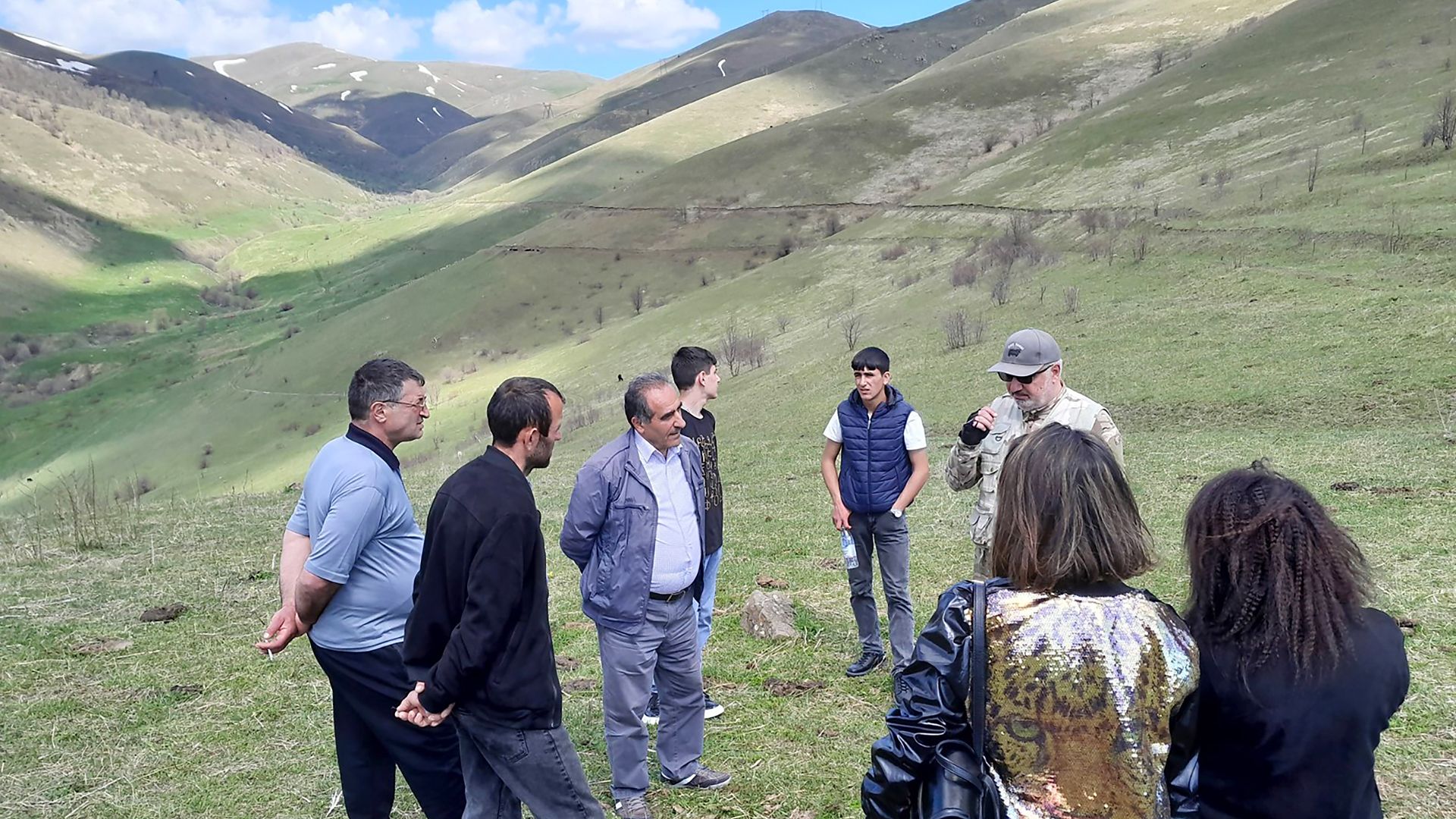
Since the public extension service in Armenia is not existent MAVETA has initiated two innovation groups with the objective to co-create innovative solutions for farmers with the interactive innovation model and strengthening at the same time the competences of State Agricultural Colleges for delivering up-to-date knowledge to their apprentices. Around Stepanavan, farmers want to improve their seed production for potatoes, cereals and legumes. Farmer in Goris want to improve their productivity in milk production. Teachers from the colleges and lead farmers were trained in group facilitation and they were supported in their first meetings to find topics for exchange and goal setting. Together with external experts, college teachers and apprentices it is planned that farmer will set up different field trials to learn more about virus-free seed potato multiplication to reduce the dependency from seed potato import from Europe, the adaptation of Swiss wheat varieties in the region and the possibility to improve crop rotation with adapted intermediate feed cultivation, cover crops or green manure. Other topics for further exploration are summer pasture management, dairy cow feeding, silage production, management of diseases in potatoes and wheat, use of drones for pest and disease management. These trials initiate at the same time activity-, practice- and competence-oriented teaching at the agricultural colleges.
Initial results and assessment
There is a lively exchange between farmers in the regions. They know each other and exchange ideas. However, institutionalized cooperation is alien to them and, as a former part of the Soviet Union, they have a strong aversion to any form of association or cooperative. So they mainly exchange ideas within their own family structures, also because they have little trust in other structures. They are afraid of giving too much, being exploited and not being able to benefit enough themselves. This is why a strong facilitator from outside is needed.
The Innovation Group is still led by MAVETA implementors. College teachers are motivated to lead and facilitate innovation groups but a shift in the job profile of the teachers is necessary so that they are paid for extracurricular and advisory activities. Incidentally, this situation is also difficult in the implementation of dual vocational training, as they rarely take on the supervision of apprentices outside of the classroom, as they are not paid for these activities. For this reason, as part of the implementation of the new law, the teachers' job description is being revised and new salary guidelines are being drawn up. This will take some time as, in addition to the paper, the necessary financial resources must of course also be made available in the state's long-term financial plan.
However, the Innovation Groups would be a good alternative to compensate for the lack of RAS. The farmers are interested and participate in invitations made by the project. They communicate openly and are willing to include apprentices as well in their knowledge exchange.
Ultimately, solutions must be found to the challenges faced by farmers in order to improve their productivity and ultimately increase their income. The interactive innovation model stimulates cooperation and innovation between farmers and suitable public and private experts which enables lifelong learning for all stakeholders involved. Only in this way will it be possible to make agriculture in Armenia more competitive in the long term, which is completely exposed to the world market. However, Armenian farmers can find niches in this market thanks to its rich cultural heritage, which Armenians cherish like the apple of their eye, and the diverse landscape chambers with their different products.
References:
- Christinck A, Kaufmann B, 2018. Facilitating change – methodologies for collaborative learning with stakeholders. Pp. 171-190. In: Padmanabhan M. (ed.). Transdisciplinary Research and Sustainability: Collaboration, Innovation and Transformation. Routledge, Abingdon/New York.
- Eelke W, Sjoerd R, 2020. Energising networks. Tools for co-creation. Wageningen
- EU CAP Network, Operational Groups (accessed on 07.08.2024)
The MAVETA project is funded by a broad coalition of international and local organizations led by the Swiss Agency for Development and Cooperation (SDC), including the Austrian Development Agency, the German Ministry for Economic Cooperation and Development (BMZ), the Government of Armenia, the Swiss Church Aid (HEKS/EPER) NGO, Izmirlian Foundation, the Strategic Development Agency (SDA) NGO and Vanand Agro CJSC.
The project’s implementing partners are the GIZ and HEKS/EPER with the involvement of SDA and the School of Agricultural, Forest and Food Sciences at the Bern University of Applied Sciences (BFH-HAFL).