
Farming insects: an emerging technology contributing to a sustainable food system
The world needs a sustainable food cycle to feed a growing population. The farming of insects like the black soldier fly (BSF), offers a profitable solution by converting organic waste into valuable nutrients. BSF consumes various organic wastes, including food waste and farm manure, turning them into quality animal feed and organic fertilizer. Recently, SDC supported the International Centre of Insect Physiology and Ecology (icipe) to pilot BSF production with local partners in Ethiopia and to create an enabling environment for insect-based animal feed production and marketing. This article provides an overview of what the project has achieved and what the future outlook is.
AFS Newsletter - Member Article by

International Centre of Insect Physiology and Ecology (icipe)
LinkedIn | ttefera@icipe.org
The world demands a more sustainable food cycle to feed a growing population. Insect farming such as black soldier fly (BSF) has emerged as a profitable solution, as this insect can turn organic wastes into valuable nutrients. Poor waste management has adverse impacts on the environment and human health. BSF feeds voraciously on various types of municipality organic waste, including food wastes, agro-industrial by-products, and chicken and dairy farm manure. Bioconversion of organic wastes using BSF is cost-effective and emits less pollution. BSF converts organic waste into quality animal feed and organic fertilizer. Insect farming is considered as an alternative feed due to its low land and water requirements, its low ecological footprint, and circular economy contribution by converting biowaste into high-quality feed ingredients.
Recently, SDC supported the International Centre of Insect Physiology and Ecology (icipe) to pilot the production BSF in partnerships with local partners and to create an enabling environment for producing and marketing insect-based animal feeds in Ethiopia. The project achieved the following:
Creating an enabling policy environment: In Ethiopia, standards and regulations on insect farming don’t exist. icipe in partnership with the Institute of Ethiopian Standards and Ethiopia Agriculture Authority, and relevant regulatory bodies, developed policy documents on product quality standards and guidelines on the development and commercialization of dried insects for animal feed in Ethiopia. The two policy documents that enable the inclusion of dried insect meal into animal feed were approved in June 2023 by the Council of Ministers for the first time. This creates an enabling environment for private sectors to venture into producing and marketing insect-based animal feeds.
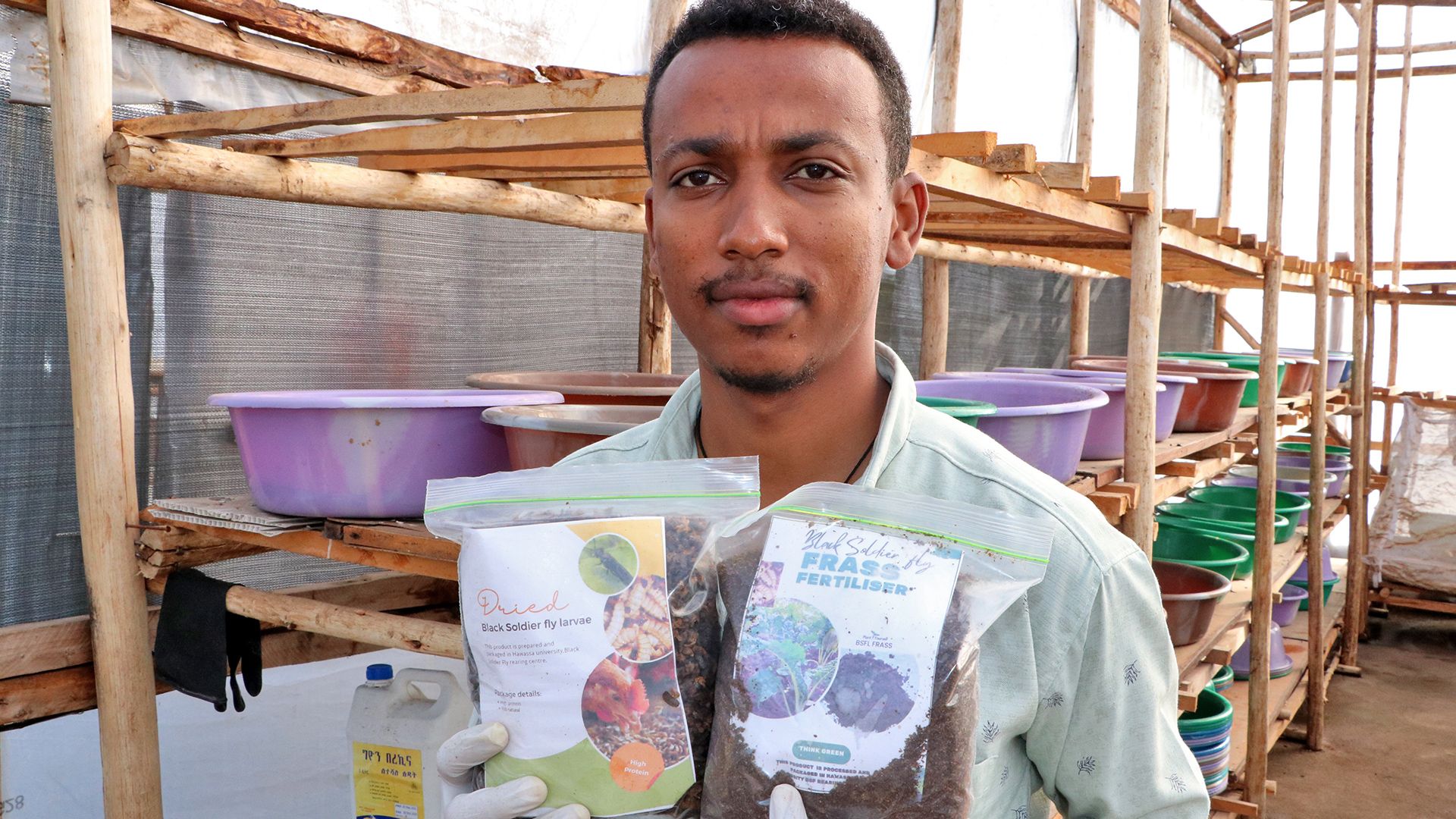
Pilot BSF mass production: Two BSF mass production pilot facilities were established in Adama and Bahir Dar with two private young entrepreneurs called Debo Farm and Loko Farm, respectively. The two farms are using BSF-derived feed for their poultry farms. One BSF mass production pilot facility was established at Hawassa University as a training center. The project identified and tested 5 cheap, locally available BSF-rearing organic substrates.
Perceptions and willingness to pay: Factors influencing farmers’ perception and willingness to pay (WTP) for insect-formulated feed were conducted in 5 selected cities/towns: Addis Ababa, Adama, Bahir Dar, Bishoftu, and Hawassa. The study involved 700 poultry farmers (300 female and 400 male farmers). Overall, the preference for the BSF larvae meal as poultry feed was confirmed by 97.8% of the study participants due to the unavailability and expensiveness of conventional feed, and the nutrient richness of insect-based feed than the conventional feeds. Besides, this study elicited WTP for the BSF benefit to the environment as an attribute and recorded an 87.8% response on preference among willing farmers of BSF larvae meal.
Economic Benefit Analysis: Abro et al 2020 assessed the potential socio-economic benefits of black soldier fly larvae meal (BSFLM) to the Kenyan poultry sector. They found that replacing 5–50% of the conventional feed sources (fishmeal, maize, and soya bean meal) by BSFLM can generate a potential economic benefit of 69–687 million USD (0.1–1% of the total GDP) and 16–159 million USD (0.02–0.24% of the GDP) if the entire poultry sector (the commercial poultry sector) adopts BSFLM. These could translate to reducing poverty by 0.32–3.19 million (0.07–0.74 million) people, increasing employment by 25,000–252,000 (3300–33,000) people, and recycling of 2–18 million (0.24–2 million) tonnes of biowaste. Further, the findings show that replacing the conventional feeds by 5–50% BSFLM in the commercial poultry sector would increase the availability of fish and maize that can feed 0.47–4.8 million people at the current per capita of fish and maize consumption in Kenya. Similarly, the foreign currency savings can increase by 1–10 million USD by reducing feed and inorganic fertilizer importation. These findings suggest that greater investment to promote BSFLM could boost economic, environmental and social sustainability.
Potential areas for future investments
- Demonstrations of organic waste conversion in major towns and cities using black soldier fly farming and contribution of insect farming to the circular economy. This could be demonstrated through engaging women and youth entrepreneurs, feed formulators, and poultry and fish farmers in BSF production. BSF provides employment and business opportunities for unemployed young men and women in urban and semi-urban areas by providing sustainable and affordable waste management services to communities and an increased supply of affordable protein feed and environmentally friendly biofertilizer alternatives to farmers at affordable prices.
- On-farm testing of novel organic fertilizer: Assessing black soldier fly frass as novel organic fertilizer for improved growth, yield, and nitrogen use efficiency of selected crops under field conditions with local partners. BSF frass could potentially substitute conventional nitrogen and inorganic fertilizers, which would reduce the potential for global warming associated with their use.
- Assess BSF-derived feed as an alternative source of animal protein feed: Determining the optimal inclusion level of black soldier fly larvae meal as a substitute for chicken and fish diets and evaluate the impact on growth and egg production of chicken and fish-fed insect-based feed.
- Capacity building and awareness creation: Building capacity of extension workers, public and private sector partners on the socio-economic and ecological benefits, safe and effective use of insect-based feed as poultry and fishery feed.
- Socio-economic analysis: Conducting cost-benefit analysis and environmental implications of replacing conventional poultry and fish feed with insect-based feed in Ethiopia.