
Innovative intercropping using nanobiotechnology in Egyptian farms
As climate change continues to heavily impact local Egyptian farmers, more innovative and sustainable farming techniques must be applied to adapt to these changing conditions. Additionally, the invasive Fall Armyworm (FAW) is infesting Egyptian farms. BioPyramids Biotech and Royal Green Technologies invest in organic and sustainable farming practices and implement them with local farmers. The most recent success story highlights how innovative intercropping using nanobiotechnology can control FAW, improve production, increase protein content in fodder and reduce pesticides application to ensure feed safety.
AFS Newsletter - Member Article by
BioPyramids Biotech and Royal Green Technologies (RGT)
LinkedIn | mohamed.salem@gebri.usc.edu.eg
As climate change continues to heavily impact local Egyptian farmers, more innovative and sustainable farming techniques must be applied to adapt to these changing conditions. Additionally, the invasive Fall Armyworm (FAW) is infesting Egyptian farms. BioPyramids Biotech and Royal Green Technologies invest in organic and sustainable farming practices and implement them with local farmers. The most recent success story highlights how innovative intercropping using Nanobiotechnology can control FAW, improve production, increase protein content in fodder and reduce pesticides application to ensure feed safety.
The majority of farms in Egypt are small and fragmented, leading to variable yields and potential uncertainties for farm owners. To enhance security for these farmers, agronomists from BioPyramids Biotech and Royal Green Technologies sought to implement new and innovative intercropping principles on these small farms. This innovative intercropping involves cultivating two or more crops together in the same field simultaneously after treating the soil with special types of biofertilizers. This technique boosts the resilience of agricultural ecosystems, enhances farm biodiversity, and mitigates risks linked to monoculture systems. By diversifying the types of crops grown together, farmers can improve soil health and optimize resources usage, such as water and nutrients. For instance, legumes can be intercropped with cereals to naturally enrich the soil with nitrogen, reducing the need for chemical fertilizers. Additionally, the varied root systems of different crops can prevent soil erosion and improve water retention, making the land more resilient to drought and protect maize crops from the new invasive Fall Army Worm (FAW) that infect the solely cultivated corn up to 90% losses.
BioPyramids Biotech and Royal Green Technologies, an agri-biotech manufacturing enterprise located in Menofyia governorate, Egypt, is grounded in organic farming research. The company specializes in providing organic solutions for crops and soils, animal health and nutrition, as well as environmental solutions. The technical support team travels to different farmers in Egypt, aiding in the adoption of organic farming practices. Farmers across Egypt widely utilize the Biofertilizer «NovaPlus» due to its cost-effectiveness and positive impact on crops once it is applied. Royal Green Technologies also provides freely training and resources to farmers, teaching them the best practices for selecting compatible crops and managing intercropped fields. This technical support helps farmers maximize their yields and secure their livelihoods, even in the face of climatic and economic challenges.
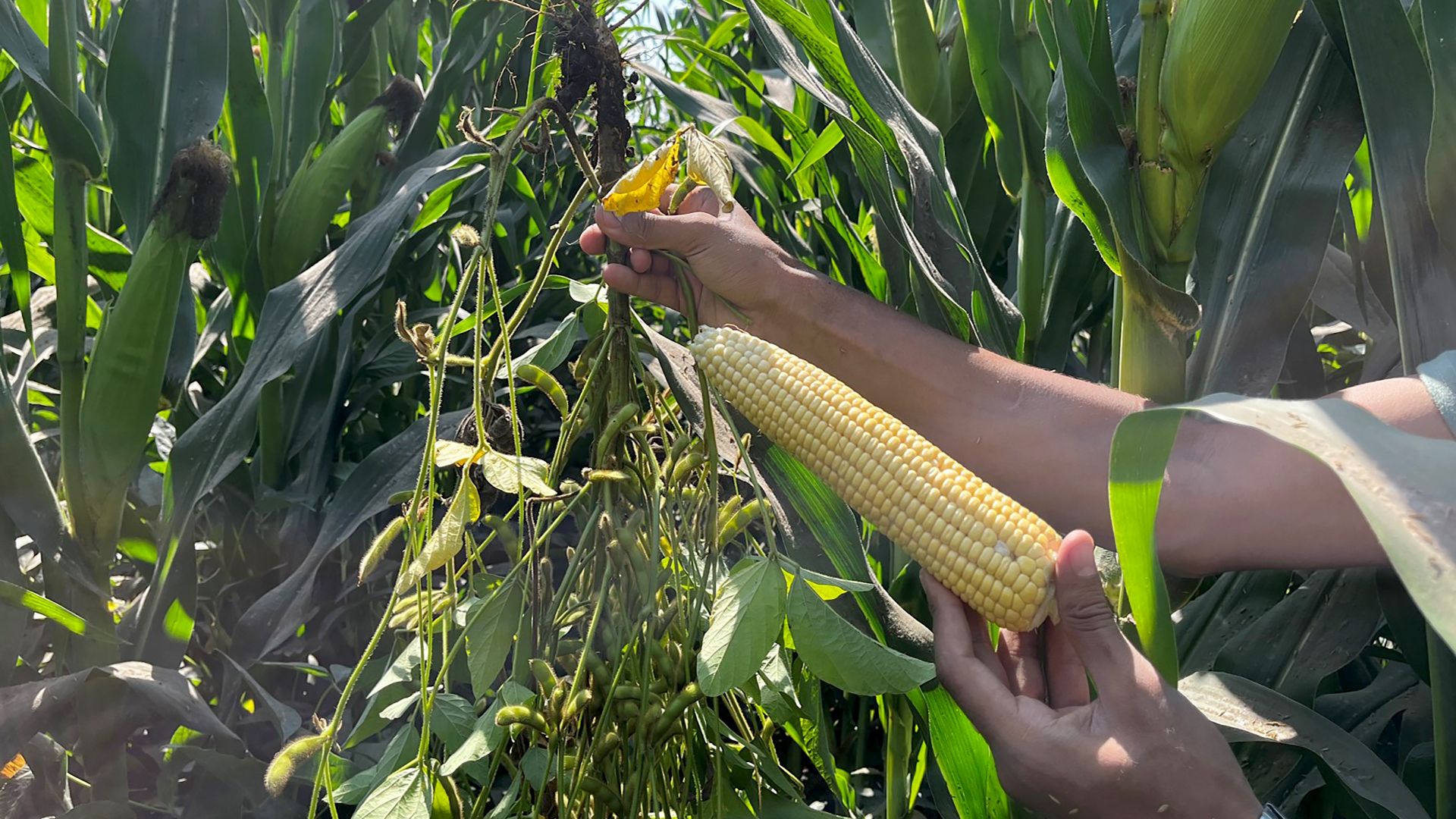
Egyptian farms often face challenges like fragmentation and lack of coordination, resulting in insufficient high-quality fodder for livestock. This shortage impacts small farmers' profits as they struggle to cultivate and sell low-quality fodder. Soybean crops can fix nitrogen and enhance the soil's nitrogen content. Moreover, soybeans are protein-rich and serve as an excellent ingredient in fodder to elevate its protein levels. The field trial commenced at a Jamal Mohamed’s small farm in Beni Suef, Egypt, where maize and soybean were intercropped together. Jamal used to grow in monocrop pattern, and intercropping was a new technique to implement. The farm’s total area was one Feddan (4200 m2), so it was rather relatively small. The primary goal was to boost the farm's yield and produce fodder with higher protein content than conventional methods. Maize (rich in carbohydrates) and soybean (rich in protein up to 44%) were a perfect pair to intercrop as they produced a well-balanced and nutrient-rich fodder. The cropping system, as illustrated in figure 1, involved planting maize along the furrow edges with a 10 cm spacing between each crop. The furrow width measured 140 cm. Soybeans were planted in rows with a 25 cm gap between each line, and the gap between each plant was 20 cm. The planting density for maize was 28,600 plant/feddan, while the planting density for soybean was 60,000 plant/feddan. In order to decrease the amount of synthetic fertilizers needed, the biofertilizers «NovaPlus» and «NovaQ» were used
As the season progressed, initial results were promising. The intercropped fields showed a noticeable improvement in soil fertility and crop health compared to monoculture plots. Intercropping ensures that each crop receives sufficient sunlight to grow optimally without being shaded. Moreover, intercropping can improve soil health by enhancing nutrient cycling. Different crops have varying nutrient requirements and root structures, which can help in preventing soil depletion and erosion, while giving soil a chance to restore its nutrients. Additionally, intercropping has notably decreased and reduced completely the presence of fall armyworms (Spodoptera frugiperda) on the farm that threaten other farms and cause great losses. This reduction has led to eliminate the pesticide usage, protect the feed safety and lowered maintenance costs for the farmer, all while maintaining the yield. Intercropping promotes soil biodiversity within the agricultural ecosystem. By diversifying the plant species in a given area, farmers can create a more resilient environment that is better equipped to withstand pests and diseases. This method also encourages beneficial insects, such as pollinators and natural predators of pests, to thrive, further reducing the need for chemical interventions.
Jamal reported enhanced fodder quality, with higher protein content that significantly benefitted their livestock's nutrition and productivity. In fact, the protein content from the fodder increased on average from 6-8% up to 16-22%. This sustainable farming practice is proving to be a transformative approach, ensuring food security and promoting environmental stewardship in Egypt's agricultural sector. This remarkable improvement not only boosted the overall health of the animals but also translated into higher yields of milk and meat, greatly enhancing the farm's profitability. The farmers noticed that their livestock were more energetic. In addition to these benefits, intercropping can also offer economic advantages. Farmers can harvest multiple crops from the same plot of land, potentially increasing overall productivity and profitability. This diversification of produce can also open new market opportunities and reduce financial risks associated with crop failure. Regarding the yield, the feddan yielded around 46 tons of fodder, much higher than the average 20 tons per feddan in monocrop systems. The trial's success could potentially revolutionize fodder production in the region, providing a sustainable solution to the challenges faced by local farmers. By embracing intercropping and other sustainable farming methods, small-scale farmers can overcome the challenges of fragmentation and resource limitations. This not only enhances their economic stability but also contributes to the broader goal of food security and environmental conservation in the region.
After Jamal’s success, the company created videos regarding his story and a small animation video to simplify the method of intercropping for other local farmers. Various farmers have contacted the company to apply the same idea in their own farms. Overall, intercropping is a holistic approach that not only boosts agricultural efficiency but also supports ecological balance and economic stability for farmers. By adopting such sustainable practices, we pave the way for a healthier planet and a more secure food future.
Futher links:
Animated video explaining the technology [in Arabic].
Video explaining the technology [in Arabic]