
Innovative mushroom cultivation preserving Manipuri cuisine
Split gill mushroom, or kanglayen in Manipuri, is a key ingredient of mouth-watering delicacies such as kanglayen paknam (flat spicy baked dish), kanglayen eromba (with fermented fish and other ingredients) or simply fried on its own as kanghou. Deforestation, climate change, and rapid urbanisation are making it hard to forage for this mushroom in the wild. Puina Sukham, a young AgriEntrepreneur based in Manipur, is addressing this scarcity by developing an innovative solution to growing the mushroom in simple controlled chambers.
AFS Newsletter - Member Article by

First of all, where is Manipur?
Manipur is a small state in the north-eastern corner of India as shown in the extract from Google Maps on the right. It is primarily an agrarian state and most of its population of ~3m people rely on agriculture for their sustenance. Out of 2.2m hectares of land, comprising of a central valley surrounded by multiple hill ranges, Manipur has an approximate net cropping area of 230,000ha with a cropping intensity of 157%, according to state government figures.
With very limited infrastructure and access to outside markets, agricultural productivity remains low (rice, a staple crop, averages ~2t/ha in yield) with little processing of local raw materials. Add to this the fact that unemployment in Manipur is as high as 30% and thus, agribusiness could play a transformative role. Once called ‹Switzerland of the East› because of its natural beauty, Manipur was developing rapidly with one of the highest concentrations of start-ups in India but, unfortunately, it was engulfed in an ethnic crisis in May 2023 resulting in tens of thousands of Internally Displaced Persons (IDPs). MaolKeki Foundation has been actively involved in supporting the IDPs.
Kanglayen, everyone’s choice!
Kanglayen is the Manipuri name for split gill mushroom (Schizophyllum commune). This fungus usually grows on dead or rotting wood in the wild and is found on every continent except Antarctica. It is believed to have many health benefits and its ability to shrivel during prolonged dry periods and then ‹bloom› again by rehydrating once the rain comes enables it to thrive in harsh conditions.
Since ancient times, it has grown in the wild in Manipur from where people foraged it to add to a range of delicious traditional dishes. These dishes include kanglayen paknam, a flat spicy dish baked on a pan wrapped in turmeric and banana leaves, kanglayen eromba, prepared with fermented fish, mashed potato, chillies and other ingredients, or simply fried on its own or with peas, onions, chillies, etc. as kanghou. These mouth-watering dishes are served at most Manipuri homes, especially amongst the Meitei ethnic community as part of a meal or as snacks with tea and coffee. Hungry? Check out the plethora of recipes available online to try out for yourself!
Climate Change, Deforestation and Urbanisation
In recent years, Manipur has not been spared the effects of climate change with those old enough to remember lamenting the warming summers, winters without much frost or snow anymore, and weather so variable now that Manipur experienced one of its worst hailstorms in recent decades with hails larger than golf balls!
Deforestation, especially in the hills, and rapid urbanisation in the valley and smaller towns that are scattered across the hills have also made kanglayen even harder to find in the wild. Due to this shortage of supply, it is one of the most expensive mushrooms in the local market costing consumers between Rs1,000/ kg to Rs1,500/ kg, or CHF11/ kg to CHF17/ kg, making many people drop this beloved mushroom from their regular diet. Many have started refraining from consuming it despite split gill mushroom being a quintessential part of the indigenous Manipuri diet resulting in a great loss of our culinary culture.
In steps Puina Sukham, the AgriEntrepreneur
Puina Sukham is an agriculture graduate from the South Asian Institute of Rural and Agricultural Management (SAIRAM), Manipur. Since his college days, he has shown a keen interest in growing mushroom of different varieties and learnt to produce spawn in the SAIRAM lab.
Born and raised in Sagolband, Imphal West district, Puina started out on his entrepreneurial journey in his college trying out his hands on various small projects. He formalized it by participating in the Agri Entrepreneur Development Program supported by Agri Entrepreneur Growth Foundation (AEGF), Anaha Trust, Sattva Consulting and MaolKeki Foundation in 2022. He was among the top performers in the Program and piloted the production of Split Gill Mushroom in a low-cost mushroom shed.
It is worth noting that MaolKeki Foundation is a philanthropic organisation established to catalyse positive development in Manipur by Dr. Shachi Gurumayum, a Manipuri Director of Switzerland-based AgriMayum GmbH. AEGF is an organisation established by Syngenta Foundation India in partnership with TATA Trusts and IDH The Sustainable Trade Initiative.
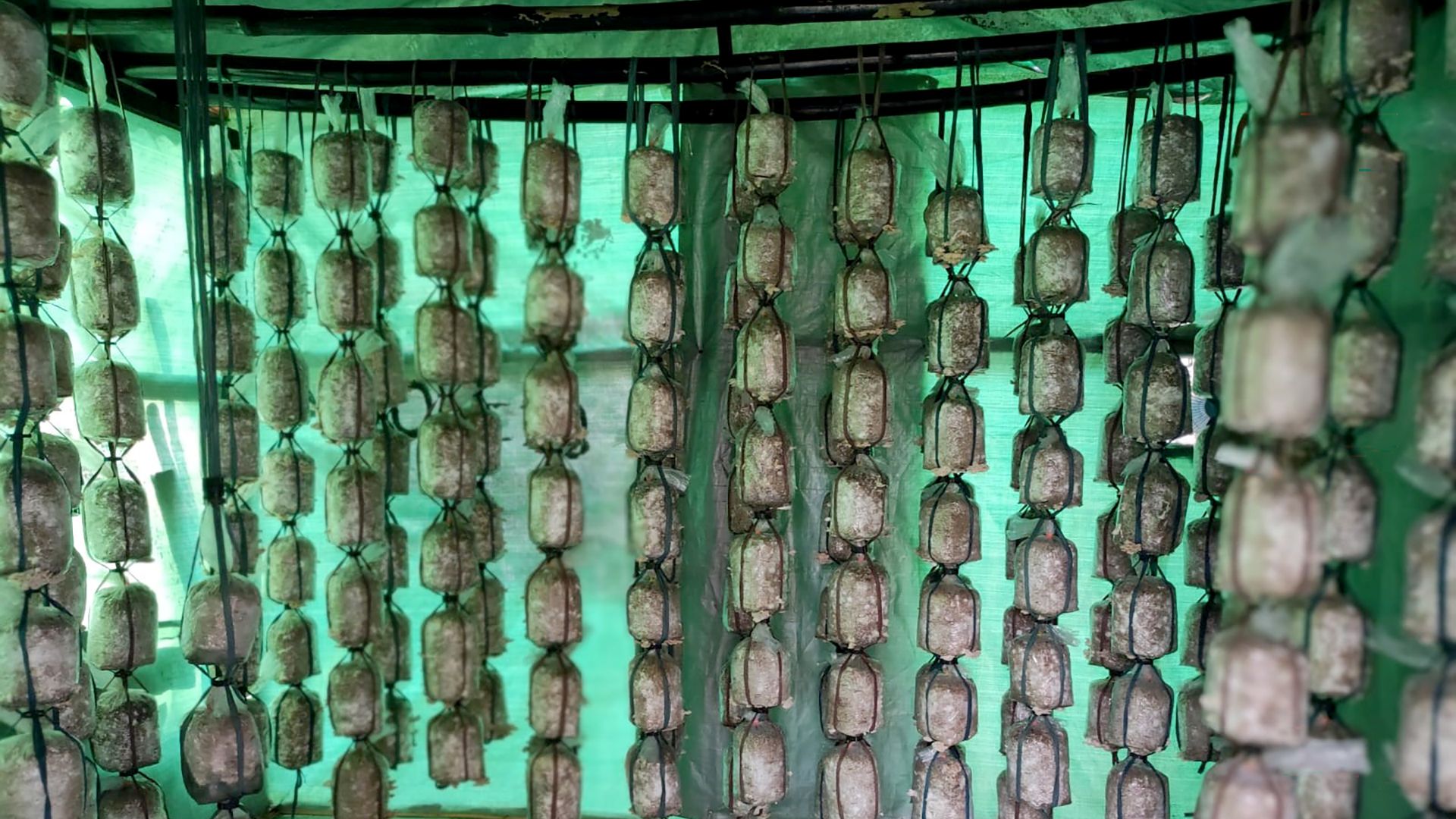
Under the mentorship and guidance of MaolKeki Foundation, and funding from Anaha Trust managed by Sattva Consulting, Puina piloted the production of split gill mushroom in a small shed in his backyard. Very cleverly, Puina was able to simulate the environment in which the mushroom used to grow in the wild. He prepared grow bags using a mixture of saw dust, rice husk, etc. to simulate the wood trunks on which the mushroom grows in the wild. The growing medium was then sterilised in an autoclave before being seeded with spawns of the highest quality and left to grow in the growth chamber with controlled humidity and a managed temperature range.
Within a few weeks, Puina was harvesting his first crop of kanglayen. Word spread through his neighbourhood and beyond such that he has been selling out his stock ever since embarking on this entrepreneurial journey.
Scaling up to meet demand
Puina is now working on scaling up his pilot to a full-scale commercial production. The aim is to decrease the cost of production, shorten the production time, make split gill mushroom available throughout the season and bring back people’s interest in kanglayen. This is a great opportunity in growing split gill mushroom as the cultivation technology is quite effective and addresses all the key challenges of foraging in the wild.
This project also has many technical advantages:
- It is environmentally friendly.
- Controlled growth environment is set up with proper scientific knowledge.
- It is a highly effective and to operate model.
- The cultivation method is a new process.
- The procedure followed is scientifically proven.
It also offers multiple additional benefits as the raw material used in the cultivation is a waste product from wood and timber processing mills. After the production cycle is over, the grow bags can be utilized in the preparation of compost. This project can also influence many youths to come up with new ideas. Further research can be conducted possibly by researchers, scientists and conservationists on kanglayen for its uniqueness and medicinal quality. Finally, primary level of processing such as drying and packaging can be done for the products to be stored and sold during off-season periods.
Want to get involved?
Manipur is a very remote place however it does offer pristine views with the beautiful Loktak Lake, the world’s only floating national park and a marketplace run entirely by women right in the heart of Imphal, the capital city. If you are a subject matter expert on AgriEntreprenership, mushroom cultivation, agroforestry or just want to come and explore this majestic land and the work we do, please drop us a note on contact@maolkekifoundation.org. We would be delighted to hear from you!