
Food systems: definition and significance for SDC
Key approaches and how SDC works with the concept of food systems

K-HUB > Design a Project > Food Systems > Definition and significance for SDC
Why a food system approach?
Food systems – from farm to fork and beyond – significantly impact human well-being (livelihoods, health) and the environment (natural resources, biodiversity, climate change). Therefore, transforming food systems offers an opportunity to simultaneously address several sustainable development goals, including poverty reduction, improved food security, decreased malnutrition and non-communicable diseases, reduced degradation of natural resources and biodiversity loss, and contributions to climate change mitigation and resilience.
Many development projects relate directly or indirectly to food systems. Framing projects within a food systems perspective encourages systems-thinking, which involves understanding the relationships and dynamics between different components of the system. Systems-thinking is essential to understanding the characteristics of root causes (“drivers”) of the problems that projects seek to address. It also helps identify the most promising leverage points for interventions and think about how impulses can ripple through the entirety of the system, often leading to unintended or even unforeseen results. Therefore, system-thinking and analysis should be integral to project design and approval.
Because of these features, systems-thinking and systems approaches are particularly useful for addressing ‘wicked’ and ‘super wicked’ problems1 where direct causal links and ultimate solutions cannot be reached. Systems-thinking also bridges traditional disciplinary and sectoral boundaries and incorporates multiple perspectives on situations and problems when developing interventions. It therefore facilitates working with the multiple stakeholders across the food system and integrating their different interests when planning for longer-term and system-wide benefit.
[1] A ‘wicked’ problem is a problem that is difficult or impossible to solve because of incomplete, contradictory, and changing requirements that are often difficult to recognise. A ‘super wicked’ problem is where time is running out, there is no central authority, those seeking to solve the problem are also causing it, and policies discount the future irrationally.
SDC’s Food System approach
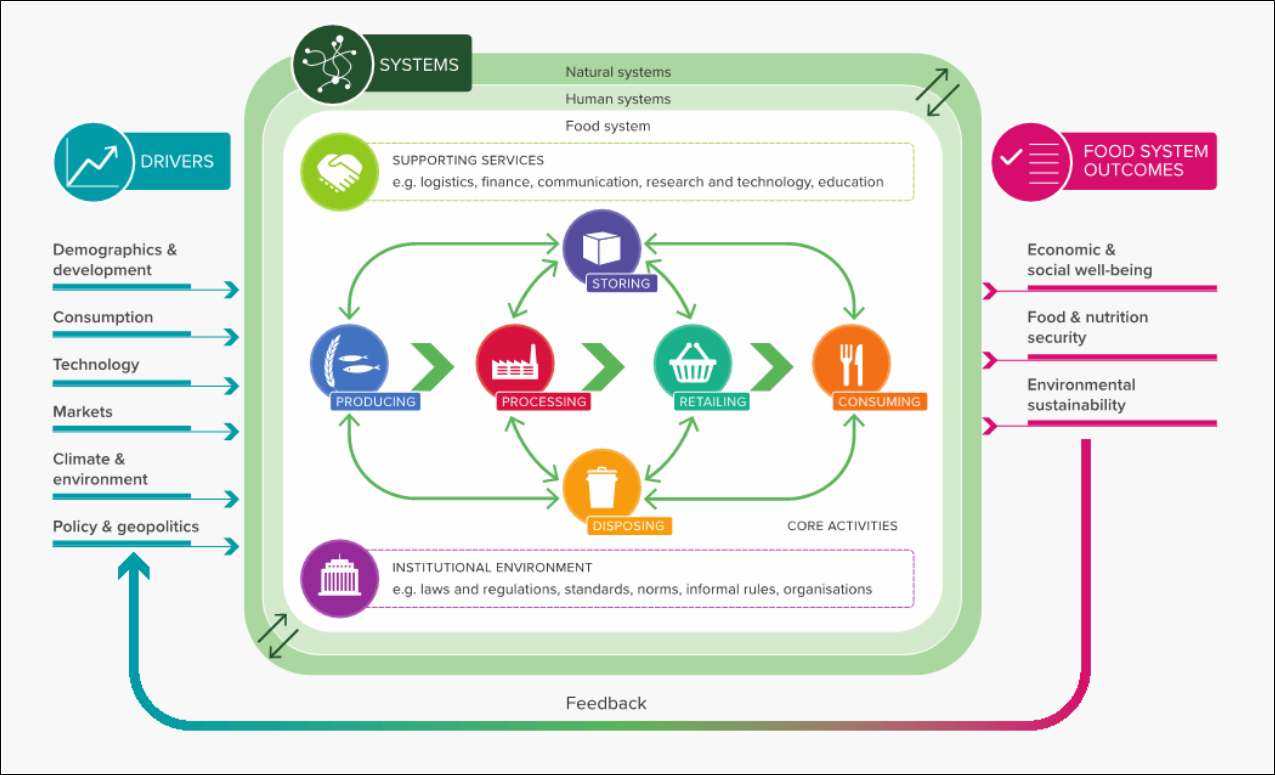
SDC’s work on food systems is based on the Food System Model developed by Foresight4Food (see below). This model is designed to describe the relationships between the key entities and processes within a food system and their connections with society and the environment. It includes activities carried out by different actors, such as food production, processing, distribution, and consumption, all of which collectively influence the system's functioning and outcomes. The model also highlights the role of supporting services – like infrastructure, transportation, finance, information, and technology – in shaping these activities. Furthermore, the institutional environment, including relevant policies, regulations, and organisations, affects the behaviour of actors within the food system. For more detailed explanations on SDC’s Food System Approach, please refer to the Knowledge Tool (hyperlink).
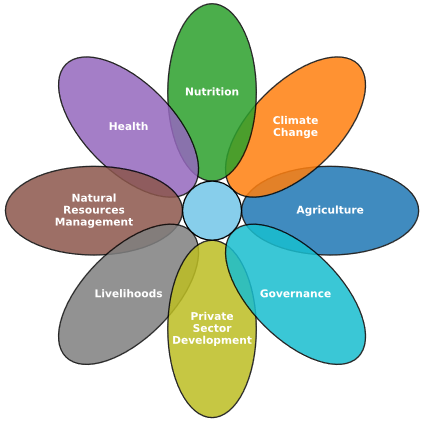
Food system lenses
Index
K-HUB > Design a Project > Food Systems > Definition and significance for SDC