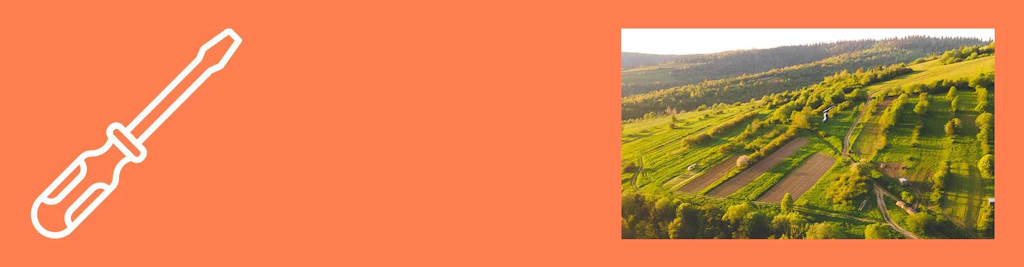
Recognising the importance of SLM for long-term food security, this guide charts a pathway to its implementation in food-systems-related interventions.
This guide provides practical guidance for integrating Sustainable Land Management (SLM) into development programmes. It introduces the key concepts and policy frameworks, explains why SLM matters for resilient food systems, and proposes a seven-step approach to designing, implementing and scaling SLM interventions that balance environmental, social and economic objectives.
Why adopt Sustainable Land Management?
Healthy land underpins food security, livelihoods, biodiversity and climate resilience. Yet around 40% of the world's land is degraded, reducing the capacity of ecosystems to provide food, water and other essential services. SLM offers practical approaches to avoid, reduce and reverse land degradation while balancing environmental, economic and social objectives.
Beyond restoring soils, SLM contributes to more resilient food systems by improving productivity, conserving water resources, strengthening biodiversity, increasing resilience to climate change and reducing disaster risks. It also provides an important pathway for implementing the objectives of the UNCCD, CBD and UNFCCC, while contributing directly to SDG 15 and supporting many other Sustainable Development Goals.
Sustainable Land Management is as such not a set of technical practices. It is an integrated development approach that combines sustainable land stewardship, enabling policies, stakeholder engagement and long-term landscape management.
.
Sustainable Land Management (SLM) The use of land resources to meet human needs while maintaining or enhancing the long-term productivity, ecological functions and resilience of land and its resources.
Land degradation The reduction or loss of the biological, physical, social or economic productivity and ecological integrity of land.
Land Degradation Neutrality (LDN) A state whereby the amount and quality of land resources necessary to support ecosystem functions and services and enhance food security remain stable or increase within specified temporal and spatial scales.
Land Tenure System of rights, rules and arrangements governing how people access, use, manage and transfer land and its natural resources.
Landscape approach A collaborative governance approach that coordinates land-use decisions across multiple stakeholders, sectors and land uses to balance environmental, social and economic objectives.
Land-use planning The process of determining how land should be allocated among different uses and users.
SLM technologies and approaches Field-level practices and broader management approaches that prevent, reduce or reverse land degradation.
Land degradation often results from interacting environmental, economic, social and institutional drivers that require integrated responses. Development practitioners frequently face challenges such as:
balancing agricultural production with environmental sustainability,
addressing insecure land tenure and weak governance,
coordinating multiple stakeholders and competing land uses,
selecting SLM practices adapted to local ecological and socio-economic conditions,
ensuring long-term financing, policy support and local ownership,
monitoring impacts and scaling successful interventions beyond individual projects.
Starting with solutions instead of understanding the landscape Don't: introduce SLM practices before analysing the causes and drivers of land degradation. Do: Begin with a thorough assessment of the landscape, its degradation processes and local context.
Treating SLM as a stand-alone activity Don't: implement isolated field-level activities without considering the wider landscape. Do: Combine practices into landscape-scale solutions.
Treating SLM as a technical package Don't: focus only on soil and water conservation measures. Do: Combine technical, social, economic and institutional interventions that address the underlying drivers of degradation.
Neglecting stakeholders and local ownership Don't: design interventions without engaging land users, local authorities and other stakeholders. Do: Build participatory processes that strengthen ownership, coordination and long-term stewardship.
Ignoring the enabling environment Don't: assume technical solutions alone will succeed. Do: Address land tenure, governance, financing, extension services and supportive policies alongside field interventions.
Landscape assessment and planning
Analyse land degradation, ecosystem functions and competing land uses.
Identify degradation hotspots and opportunities for restoration.
Integrate SLM into land-use planning and landscape management.
Sustainable land management practices
Promote integrated soil, water, vegetation and biodiversity management.
Combine complementary SLM technologies into landscape-scale intervention bundles.
Strengthen climate resilience through ecosystem-based approaches.
Governance and stakeholder engagement
Support inclusive multi-stakeholder platforms.
Strengthen local ownership and community participation.
Improve coordination across sectors and administrative levels.
Policies and institutions
Promote coherent land, agriculture, environment and climate policies.
Strengthen land tenure security and institutional capacities.
Integrate SLM into national and sub-national planning frameworks.
Knowledge, innovation and finance
Strengthen research, extension and advisory services.
Promote evidence-based decision-making and adaptive management.
Mobilise public and private investment for long-term SLM implementation.
Monitoring, learning and scaling
Measure environmental, social and economic outcomes.
Capture lessons learned and adapt interventions over time.
Scale successful approaches through policy dialogue, partnerships and knowledge exchange.
Questions?
If you have any question, or wish to call upon resources or expertise, don’t hesitate to reach out to us – or contact members through the MS Teams channel !