Sustainable land management (SLM) is crucial for healthy food production and for food security, at least for most of the world’s population. Whilst food derived from aquatic sources (fish, seafood, seaweed – even food produced hydroponically) may form part of a healthy human diet, most of us depend primarily on land-based food production. Land, furthermore, is a finite resource. Once eroded, degraded, or polluted, returning it to productivity is difficult, costly, and sometimes impossible.
This page outlines:
what is sustainable, and what is unsustainable land management
the relevance of SLM to UNCCD, UNFCC and the CBD and to the SDGs.
Definition
According to the FAO “Sustainable land management (SLM) comprises measures and practices adapted to biophysical and socio-economic conditions aimed at the protection, conservation and sustainable use of resources (soil, water and biodiversity) and the restoration of degraded natural resources and their ecosystem functions.”
The IPCC (2022) defines SLM as: “The stewardship and use of land resources, including soils, water, animals and plants, to meet changing human needs, while simultaneously ensuring the long-term productive potential of these resources and the maintenance of their environmental functions”.
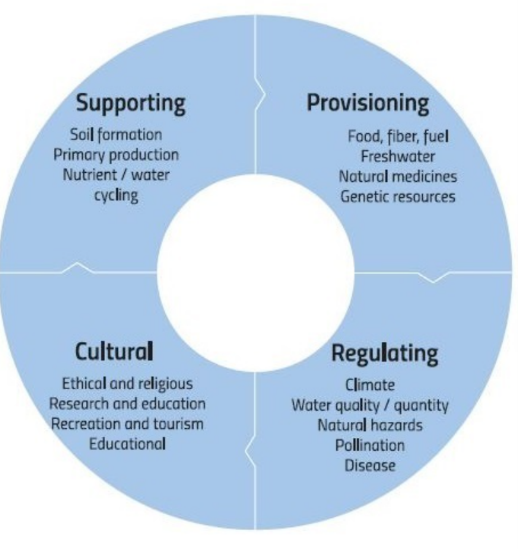
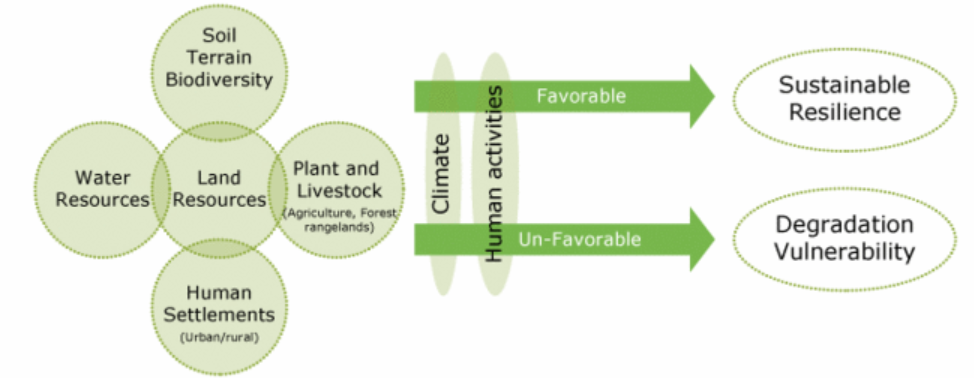
Both definitions acknowledge the role of people in taking care of the land; the second also recognises (at least tacitly) the potential tension between ensuring productivity and maintaining ecosystem services. Productivity here covers all material benefits from the land - crops, livestock, and forest products ranging from timber to mushrooms and much in-between. Ecosystem services, meanwhile, are all the less immediately tangible benefits to human beings provided by the natural environment – such as the regulation of water flow within a catchment, insect pollination, carbon sequestration by peatlands and forests, cultural identity, recreation opportunities, and more. The UNCCD groups such services as supporting, provisioning, regulating and cultural (see figure 1). SLM can be seen as a balancing act between production and ecosystem services; because “joined up thinking” is required, considering the landscape overall, it is common these days to view SLM as part of a landscape approach (see: "Seeing the landscape as a whole" on the page "How to apply SLM in food system interventions").
At its most simple, a working definition of SLM is: The use of the soil, water and biodiversity occurring on land, and the ecosystem services that they provide, in a manner that meets the needs of both present and future generations.
SLM has become such a key global topic today due to past and present unsustainable practices that have led to land degradation and soil loss. As the FAO definition makes clear, SLM includes the restoration of such degraded lands. According to the UNCCD (see section 1.3), soils worldwide are being eroded up to 100 times faster than natural processes replenish them. Key mechanisms causing land degradation are outlined below.
Typically, soil exhaustion is caused by a combination of excessive agro-chemical use and over-mechanisation; the result is a hardening and compaction of the soil, depleting it of organic matter and rendering it prone to wind or water erosion. Soil fertility may also be destroyed simply by using locally inappropriate agricultural practices. The so-called “Green Revolution” of the 1960s – 70s brought an enormous increase in the yields of key food crops (especially of rice, wheat and maize), through a combination of improved varieties, the heavy use of agro-chemicals, and (often) irrigation. This undoubtedly saved many lives. However, as such high input - high output agriculture has continued over the years, problems have amassed to the point that some soils have simply been exhausted.
💡 Example
Perhaps the most famous example of land degradation is the “dust bowl” created in the mid-west of the USA in the 1930s. At this time, the extensive ploughing of grasslands to sow wheat in an area prone to drought and windstorms resulted in a massive loss of topsoil – which literally blew away. Land degradation through inappropriate land management is thus not a new phenomenon – but unfortunately, it has been repeated in many other countries and continues to occur. Modern farming practices using large tractors and chemical fertilisers are often still seen by governments as the modern way to increase agricultural productivity. However, agricultural practices must always be tailored to the local context – to the specificities of the soil, water regime and micro-climate, also considering climate change projections.
Salinisation is the process by which natural salts in the ground become concentrated in the soil. It can be exacerbated by poor irrigation practices such as inadequate drainage and periodic excessive evaporation. This is a well-known risk in arid and semi-arid areas; poor irrigation practices are reported to be responsible for the salinisation of 33% of irrigated land worldwide.
Excess numbers of livestock in an area leads to a loss of vegetative cover, a change in pasture composition, trampling, soil compaction and, during rainfall, excess runoff leading to soil erosion. Overstocking generally occurs not through a lack of knowledge, but because animals are forced into one place for reasons such as limited drinking water points, drought (often linked to climate change), restrictions on pasture use, or a breakdown in pastoralists’ community rules.
There is a wealth of scientific and traditional knowledge regarding how many animals can be maintained on an area of land. This of course varies according to the type of animal (cattle, goats, sheep, horses, camels, llamas, etc) and the nature of the pasture. An example of this is documented through an SDC project working with the Borana pastoralists of Southern Ethiopia, whose traditional practices have been eroded by well-intended government interventions as well as by increasingly frequent droughts linked to climate change.
Typically, soil exhaustion is caused by a combination of excessive agro-chemical use and over-mechanisation; the result is a hardening and compaction of the soil, depleting it of organic matter and rendering it prone to wind or water erosion. Soil fertility may also be destroyed simply by using locally inappropriate agricultural practices. The so-called “Green Revolution” of the 1960s – 70s brought an enormous increase in the yields of key food crops (especially of rice, wheat and maize), through a combination of improved varieties, the heavy use of agro-chemicals, and (often) irrigation. This undoubtedly saved many lives. However, as such high input - high output agriculture has continued over the years, problems have amassed to the point that some soils have simply been exhausted.
💡 Example
There is a wealth of scientific and traditional knowledge regarding how many animals can be maintained on an area of land. This of course varies according to the type of animal (cattle, goats, sheep, horses, camels, llamas, etc) and the nature of the pasture. An example of this is documented through an SDC project working with the Borana pastoralists of Southern Ethiopia, whose traditional practices have been eroded by well-intended government interventions as well as by increasingly frequent droughts linked to climate change.
Forests still cover almost one third of the world’s land area, but their conversion to another use (in most cases, directly or indirectly by humans) is on-going. In a global assessment dated 2020, FAO found that the world’s forested area declined by 178 million ha (an area approximately the size of Libya) from 1990 to 2020. Significant areas were converted to crops such as oil palm or soya bean. Forest fires are also an increasingly worrying global phenomenon.
Opencast mining or underground mining that produces slag heaps and/or toxic water is a significant cause of land loss. In some cases, it may be possible to restore abandoned mines to at least some ecosystem functions; however, this is a specialised task and is not generally considered within the realm of SLM.
Current trends
A detailed satellite mapping study published in 2022 has showed that human demand for food, animal feed and biofuel has led to the conversion of some 102 million hectares of land to crops since the start of the 21st century. This represents an expansion of the global area of cropland by 10% over a mere 20 years. It is an underestimate as it does not include land used as pastures and rangelands, shifting cultivation and tree crops (such as oil palm, cocoa and coffee). According to the World Resources Institute (WRI), the gross expansion of cropland over the first two decades of the 21st century is some 218 million hectares - primarily in Africa and South America.
For every one hectare of land in the world that becomes productive cropland, on average two hectares are converted from other uses. Thus, according to the World Resources Institute (WRI), the gross expansion of cropland over the first two decades of the 21st century is calculated as being some 218 million hectares. Rates are especially high in Tanzania, the Democratic Republic of Congo, and Angola. Half of the global cropland expansion has been at the expense of natural vegetation and tree cover – thus conflicting with the preservation of ecosystem functions. This is the prevalent mechanism in Africa and South America; in Africa, 79% of cropland expansion during this century took place on such land. The other half of the recent global cropland expansion has entailed converting pastures, drylands and previously abandoned arable land – a more common pathway in Australia, Europe, North America and parts of South America, where much agricultural expansion took place in earlier times.
Globally, cropping is focused on relatively few species. Ten major crops - maize (corn), wheat, rice, soybean, oil palm, sugar cane, barley, sorghum, rapeseed and cassava - cover 63% of global crop harvested areas. More and more cropland is being cultivated not to feed people directly, but for other uses such as animal feed and biofuels, textiles and pharmaceuticals, soap, alcohol, or seed. This raises concerns for global food security; if current trends continue, it is likely that SDG 2 on zero hunger will not be met.
International conventions and agreements
“Healthy land is central to the wellbeing of the planet’s ecosystems and biodiversity; it feeds us, shelters us, and provides the backbone to a thriving global economy.” Convention | UNCCD
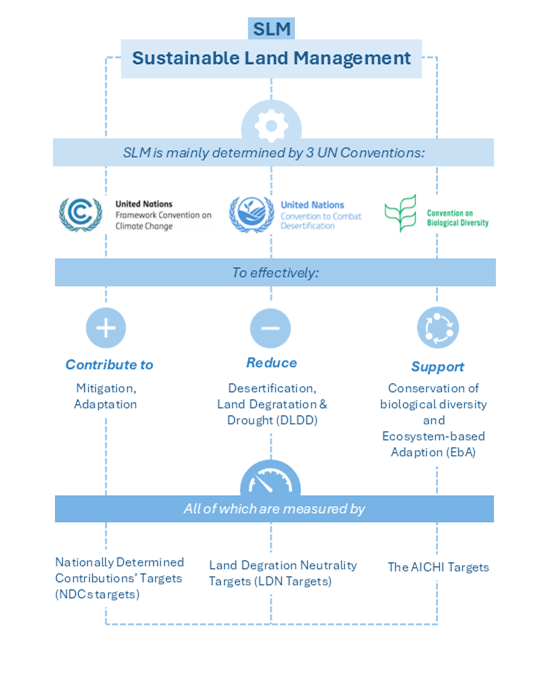
SLM is implicated in at least three United Nations (UN) conventions as well as many of the Sustainable Development Goals (SDGs). These conventions all date back to the Rio Earth summit in 1992; they are the UN Convention to Combat Desertification (UNCCD); the UN Framework Convention on Climate Change (UNFCCC) and the Convention on Biological Diversity (CBD) – of which the latest update is the Global Biodiversity Framework. Switzerland is signatory to all three.
Figure 3: Sustainable Land Management and three UN conventions
Life on land: SLM is central to SDG 15, which aims to promote healthy terrestrial ecosystems and sustainable forest management whilst combatting land conversion, degradation, desertification, and biodiversity loss.
Human well-being: By enhancing food security, SLM contributes to combatting poverty (SDG 1), ending hunger (SDG 2), and promoting good health and well-being (SDG 3).
Sustainable water management: By supporting the sustainable use of water on and below land, SLM contributes to SDG 6 on clean water and sanitation.
Climate action: By increasing resilience to climate change of both land and the people who are dependent upon it, SLM contributes to SDG 13. This encompasses adaptation and mitigation actions, sometimes working synergistically – such as through increasing soil carbon (organic matter).
Building resilient infrastructure: SLM also has potential relevance to SDG 9, in that it should always be considered in the construction of new roads, dams and similar infrstructure – minimising the loss of productive land and of ecosystem services. At the same time, if SLM is integrated into the planning and maintenance of such structures, it can support their long-term resilience.
Disaster risk reduction is an important aspect of SLM with reference to many of these SDGs – building resilience to climatic disasters such as floods, drought, and heat waves and, where possible, minimising their likely impact.
Key Principles
The FAO defines four principles for practical interventions supporting SLM. For the purposes of this paper, these have been slightly re-worked to the following principles to be followed in food system interventions supported by SDC:
Understanding the primary stakeholders in the land
Engaging with the wider stakeholders – adopting a landscape approach
Addressing technical aspects
Facilitating an appropriate policy and institutional environment.
The next page outlines how these principles may be implemented in practice.