
Biodiversity and Sustainable Development
This page provide an overview of the risks that biodiversity loss and ecosystem degradation pose to sustainable development, and on how development cooperation and humanitarian aid may negatively impact biodiversity and ecosystems.

K-HUB > Thematic Interfaces > Food Systems and Biodiversity > Biodiversity and Sustainable Development
Risks of biodiversity loss for sustainable development
Direct risks
Biodiversity loss and ecosystem degradation affect all lives and livelihoods, but those most affected are communities highly dependent on ecosystem services. These are primarily countries of the Global South.1 Furthermore, a disproportional share of the impact is carried by already disadvantaged groups, including poor and vulnerable communities, women and girls, indigenous communities and displaced people,2 as well as people with disabilities and people with chronic diseases. Many of these people are dependent on ecosystem services, an important component of which is biodiversity. In rural areas, for instance, women often collect water and fire- wood. When biodiversity loss reduces an ecosystem’s ability to purify water, they must walk longer distances, leaving less time for paid work and increasing their risk of experiencing sexual harassment.3
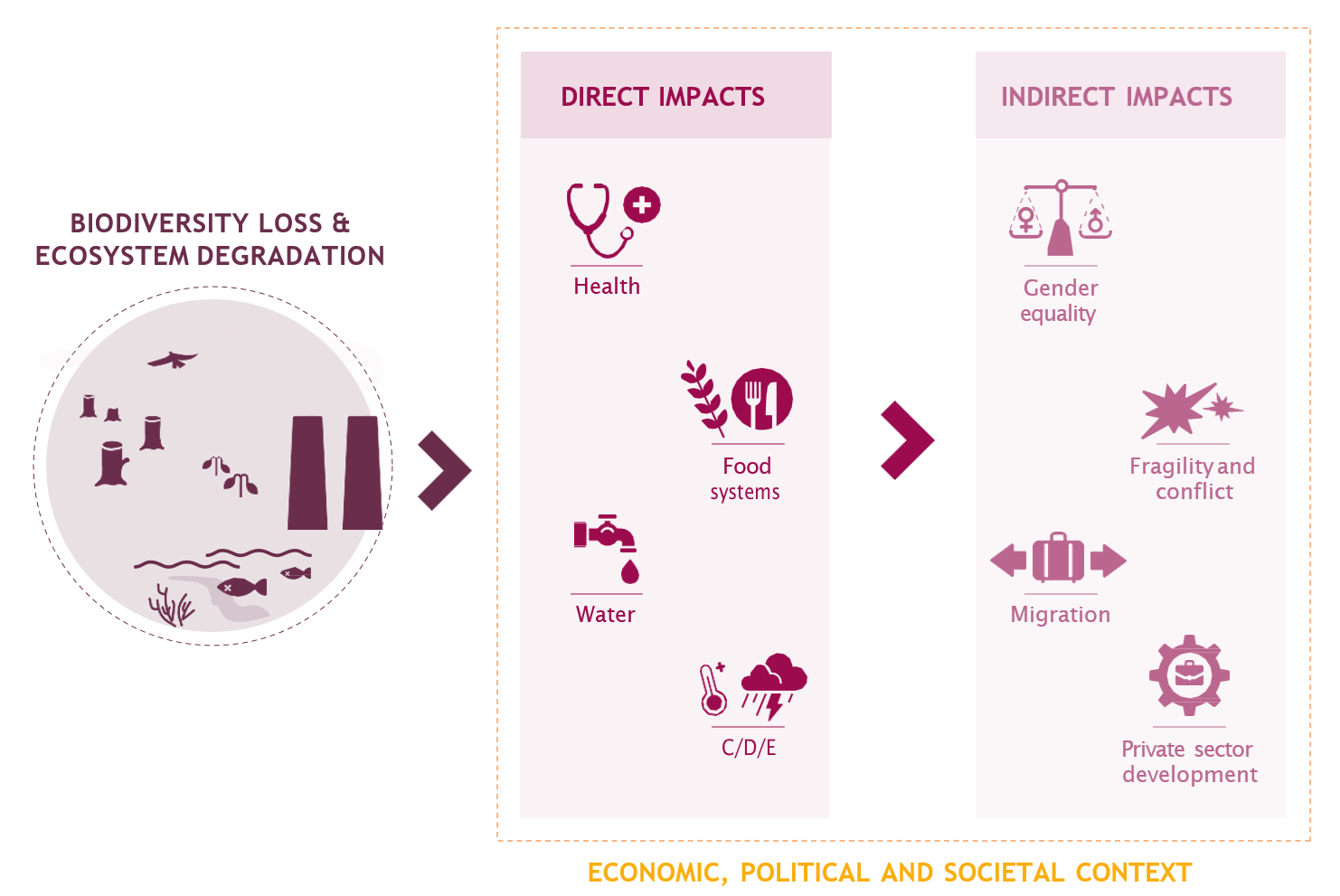
Biodiversity loss and ecosystem degradation can directly affect the following development sectors.4 Importantly, however, the relative risk of biodiversity loss is shaped by the economic, political and societal context.
Health
Biodiversity loss reduces the availability of traditional medicines and the opportunities for drug development,5 weakens the buffer zones that ecosystems provide in isolating zoonotic viruses from humans, and can change the composition of ecosystems to favour species that more frequently spread dis- eases to humans.6 The degradation of ecosystems includes the loss of the ecosystem services related to air quality, such as the capacity of forests to remove air pollution.7 Losing access to natural environments can have negative effects on mental health.8
Water
Biodiversity loss contributes to the degradation of freshwater ecosystems, affecting both quantity and quality. The
1.1 billion people who lack access to freshwater face an in- creased effort required to collect water and huge economic losses annually.9 Freshwater scarcity results in inadequate sanitation for 2.4 billion people, and increases their exposure to diseases and waterborne illnesses and, consequently, their health care expenses.10 Water scarcity and pollution also reduce agricultural productivity impacting livelihoods, in particular for economies relying heavily on water-intensive crops such as rice and cotton.11
Food systems
Food and nutrition security depends on a variety of crops and animals, which in turn depend on healthy ecosystems for pollination, clean water, and healthy soils. The decline of the ecosystem service of pollination, for example, puts at risk up to USD 577 billion in annual crop production at risk.12 Reduced biodiversity leads to fewer species in agriculture and increases the vulnerability of agroecosystems to pests, dis- eases, and extreme weather events.13
Over 3 billion people, mainly in the Global South, rely directly or indirectly on healthy oceans.14 Reduced fish diversity, along with marine plastic pollution, threaten food security and health.15 Furthermore, 70% of global fish catch comes from small-scale fisheries, and marine fisheries directly or indirectly employ over 200 million people worldwide. The loss of marine biodiversity is a risk to the livelihoods of those people.16
Climate, DRR, and Environment
Biodiversity is highly relevant for climate mitigation. The global land and ocean ecosystems absorb more than 50% of all carbon emissions. The destruction of these ecosystems, such as through deforestation, not only destroys these natural carbon sinks but might even turn carbon sinks into carbon sources.17 When tipping points are crossed, ecosystems de- grade beyond a critical threshold triggering abrupt and often irreversible changes. The dieback of the Amazon rainforest, for example, could cause the release of vast amounts of CO2, impacting global temperature rise by up to 0.2°C.
Degraded ecosystems decrease the opportunities to protect people from the consequences of climate change through ecosystem-based approaches, nature-based solutions and similar approaches. For instance, biodiversity loss has weakened the storm protection of coastal ecosystems like mangroves and the flood control provided by lakes and swamps.18
Indirect risks
Biodiversity loss and ecosystem degradation may indirectly put development gains in the following areas at risk.19
Gender equality
Biodiversity loss and ecosystem degradation can exacerbate gender inequalities. Of employed women, for example, 26% work in agriculture, with many others informally relying on ecosystem services for household tasks, such as collecting water and fodder, or producing charcoal. Furthermore, women engaging in fisheries are less likely to own boats or sophisticated fishing gear and are therefore dependent on coastal ecosystems. As these ecosystems degrade, women often experience increased amounts of unpaid labour and income loss. This may alter economic and societal structures in ways that impact gender equality.20
Studies show that rising aridity correlates with higher rates of child marriage, as families marry off their daughters to save income. The same studies show that in times of food scarcity, women tend to reduce their own food intake in favour of other household members.21
Migration
Biodiversity loss and ecosystem degradation add another layer to the complex interaction of factors contributing to migration.22 The loss of ecosystem services, for example in the form of available freshwater or productive soils, threatens livelihoods that are already under pressure. This might con- tribute to the decision to migrate as an adaptation strategy in search of better livelihoods.23
Fragility and conflict
Biodiversity loss may indirectly contribute to conflict and fragility, particularly in situations already facing tensions. Biodiversity loss reduces the availability of ecosystem services, and puts pressure on people’s livelihoods. In stable societies, a reduced availability of resources might be dealt with in a constructive and peaceful way, whereas in conflict-prone areas, it may contribute to escalation.24
Private sector development and financial services
According to the World Economic Forum, over 50% of the world’s GDP – USD 44 trillion – is highly or moderately de- pendent on nature and therefore at risk with regard to biodiversity loss.25 This is true not only for resource-based sectors such as construction or agriculture, but also for most other sectors because they depend on ecosystem services through their supply chains.26 Heavy rainfall and flooding, for example, can cause severe damage to transportation infrastructure and interrupt supply chains. Or the drying out of large waters, such as the Aral Sea, along with significantly reducing numbers of fish, have led to the collapse of a large fishing industry and the leaving of many people from attached cities.27
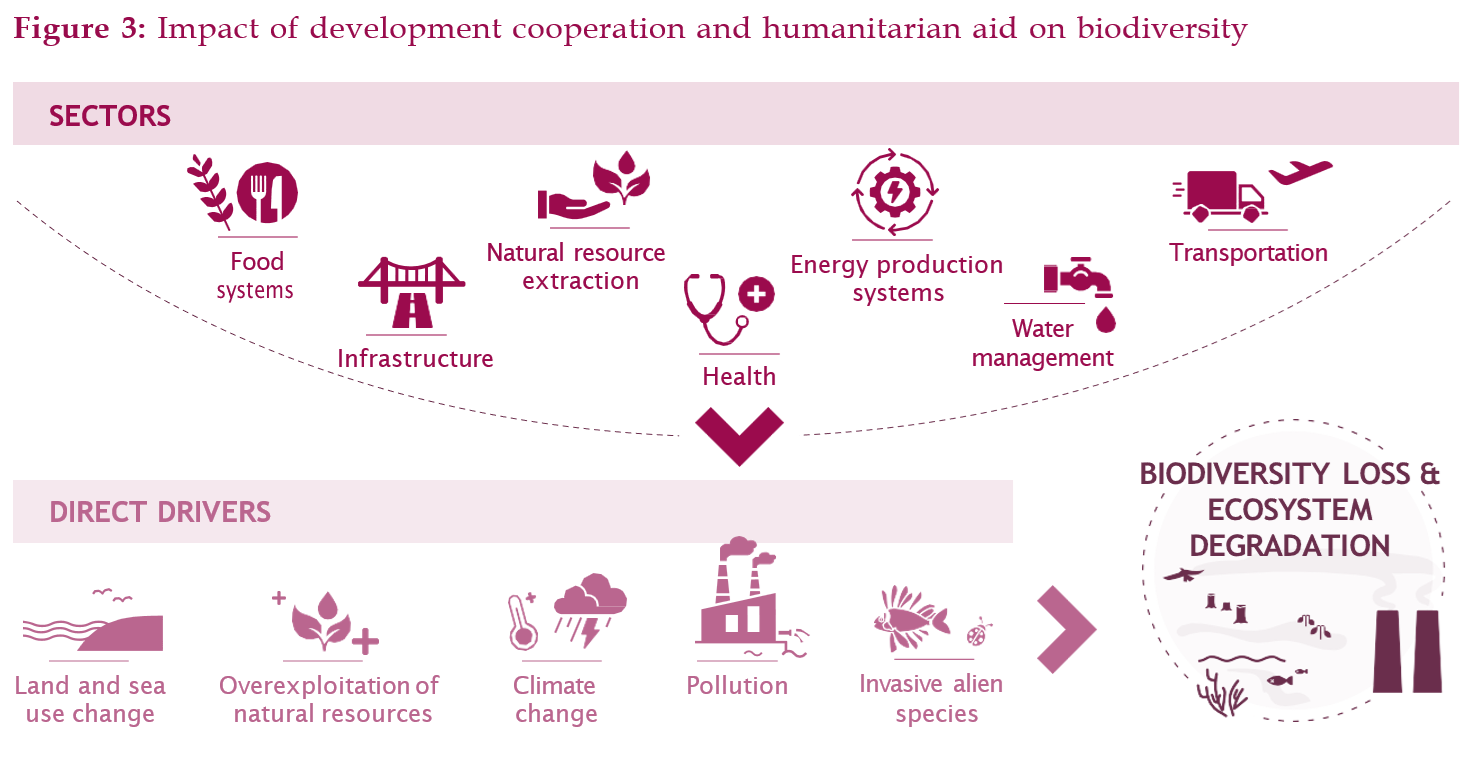
Impact of development cooperation and humanitarian aid on biodiversity and ecosystems
According to the United Nations Environment Programme,28 the five main threats to biodiversity are the following:
- Changes in land and sea use, including conversion of forests, wetlands and other natural habitats for human use – more than 40% of the world’s deforestation, for example, is driven by the expansion of pastures for beef production.29
- Overexploitation of natural resources – overuse of water resources, logging, unsustainable hunting and overfishing threaten the survival of one million species around the world.30
- Rising temperatures due to climate change, mainly caused by burning fossil fuels, deforestation, increasing live- stock farming, nitrogen-containing fertilisers and the emission of fluorinated gases,31 affect species and ecosystems such as coral reefs, mountains and polar ecosystems.
- Pollution, including from chemicals and waste, has particularly bad effects on marine and freshwater habitats, but also on plant and insect populations, and more often than not ends up in the food chain.32
- Invasive alien species that establish themselves in environments outside their natural habitat, threaten native species and bring ecosystems out of their natural equilibria. Development cooperation and humanitarian aid can unintentionally affect these drivers and thereby contribute to biodiversity loss and ecosystem degradation.
The following overview discusses the sectors that are most relevant regarding such potentially negative impacts.
Food systems
The growth of industrial agriculture with large-scale monocultures and yield maximisation increases farming intensity and contributes to global food security, but at the same time, decreases biodiversity.33 Agriculture directly affects biodiversity and ecosystems through land use change, pollution and unsustainable exploitation of natural resources. Tropical regions are generally more affected than other regions.34
Fish farming is a crucial element of the response to increasing demand for food due to global population growth,35 but the high risk of overfishing and taking large quantities of by- catch threatens marine organisms and ecosystems.36
Activities related to food systems – land use, crop pro- duction, livestock and fisheries management, global supply chains, and transport systems37 – account for 31% of the world’s greenhouse gas emissions. These emissions contribute to climate change and accelerate biodiversity loss.38 A significant amount of food waste along the supply chain and in households also contributes to emissions.39
Millions of tonnes of plastics are used in food systems each year – for packaging or fishing gear, for example. These do not de- grade quickly or, in some cases, at all, ending up as litter in natural environments. Chemicals from the packaging materials, including inks and dyes from labelling, can leach into groundwater and soil, negatively affecting human health and the environment.40
Natural resource extraction
The extraction of natural resources, such as timber, oil, gas, or minerals, is about 50% higher than it was 30 years ago. With the global expansion of renewable energy, the exploitation of minerals such as cobalt or tantalum is becoming increasingly important for the economies of the Global South.41 While this expansion and exploitation can help re- duce poverty, they also threaten biodiversity if poorly man- aged. Beyond causing carbon emissions, resource extraction contributes to land-use change through deforestation and mining, pollution through oil leakage or the release of hazardous chemicals into air and soil, and overexploitation.42
Health
The large amounts of medical waste produced each year can contain hazardous substances and have a polluting effect if they are not disposed of properly as is often the case in countries that lack consistent regulations on waste disposal.43 The health sector – health care delivery, facilities, operations and supply chains – accounts for 4.4% of global greenhouse gas emissions.44
Water management
If not done wisely, water management can negatively affect biodiversity.45 The construction of water and sanitation infrastructure can disrupt habitats and ecosystems. The over-extraction of groundwater for irrigation in arid regions can deplete aquifers, affect water availability, cause seawater intrusion, and increase the likelihood of natural hazards, such as sinkholes and flooding. Finally, the use of chemicals can negatively affect aquatic ecosystems.46
Energy
Strengthening energy production systems supports development goals by improving livelihoods, and can help developing countries diversify their economies, but energy production still relies heavily on fossil fuels, driving climate change and biodiversity loss. Renewable energy does not emit any greenhouse gas during production, but can still have negative impacts on biodiversity if not carefully planned. The construction of a hydropower dam, for example, can change land use and destroy natural habitats.47 The actual impact of renewable energy on biodiversity, however, depends on the specific technologies and on the environmental and political context – unlike fossil fuels, which always have negative environmental effects.48
Infrastructure
Infrastructure development, if not thought through from an ecosystems point of view, can destroy natural habitats, disrupt migration routes, isolate human and animal populations, and alter landscapes.49 The construction of roads might interrupt natural habitats, the expansion of urban areas sometimes results in deforestation or the draining of wetlands, and the existence of some infrastructure increases light pollution from streetlamps or air pollution from traffic.
Transportation
The operation of road, marine or air transportation systems can negatively impact biodiversity. The anchors of marine vessels, for example, can create physical damage to coral reef or seagrass, and the transfer of ballast water increases the risk of releasing invasive species.50
Further reading
- IPBES, Summary for policymakers of the global assessment report on biodiversity and ecosystem services (summary for policy makers), 2019.
- SDC, Biodiversity and Sustainable Development. Nexus Brief, Nr. 9, February 2022.
- WEF, The Global Risks Report, 16th Edition. Insight Report, 2021.
- WWF, Living Planet Report 2020 - Bending the curve of biodiversity loss. Almond, R.E.A., Grooten, M. and Petersen, T. (Eds). WWF, Gland, Switzerland, 2020.
Sources
- Swiss Re, A fifth of countries worldwide at risk from ecosystem collapse as biodiversity declines, reveals pioneering Swiss Re index, 2020.
- IPBES, Summary for policymakers of the global assessment report on biodiversity and ecosystem services, 2019; UNEP, Becoming #GenerationRestoration: Ecosystem restoration for people, nature and climate, 2021; IIED, Biodiversity loss is a development issue, 2019.
- UN Women, Gender and Biodiversity Data Brief, 2024; IIED, Biodiversity loss is a development issue, 2019.
- Analysis focusing on the following domains: Agriculture and food security, Health, Fragility, conflict and human rights, Migration/forced displacement, Governance, Gender equality, Climate, disaster risk reduction and environment, Water, Basic education and vocational skills development, Private sector development and financial services.
- IPBES, Summary for policymakers of the global assessment report on biodiversity and ecosystem services, 2019.
- Bedenham, G et al., The importance of biodiversity risks: Link to zoonotic diseases, 2022.
- Nowak, G J et al., Forest ecosystem services: Carbon and air quality, 2017.
- UNESCO, Why is biodiversity important for human mental health and emotional well-being?, 2024.
- WWF, Water Scarcity: Impacts, 2024; water.org, An Economic Crisis, 2024.
- WWF, Water Scarcity: Impacts, 2024; European Climate and Health Observators, Drought and water scarcity, 2024
- FAO, Water Scarcity – One of the greatest challenges of our time, 2019; World Bank Group, Quality Unknown: The Invisible Water Crisis, 2019.
- IPBES, Summary for policymakers of the global assessment report on biodiversity and ecosystem services, p.11, 2019.
- IPBES, Summary for policymakers of the global assessment report on biodiversity and ecosystem services, p.12, 2019.
- CBD, People Depend on Marine and Coastal Biodiversity for their Livelihoods, 2018.
- Talukder B. et al., Climate change-accelerated ocean biodiversity loss & associated planetary health impacts, 2022. The Journal of Climate Change and Health, 6, 2022; IPBES, Summary for policymakers of the global assessment report on biodiversity and ecosystem services, 2019.
- Talukder B. et al., Climate change-accelerated ocean biodiversity loss & associated planetary health impacts, 2022. The Journal of Climate Change and Health, 6, 2022; CBD, People Depend on Marine and Coastal Biodiversity for their Livelihoods, 2018.
- UN, Biodiversity - our strongest natural defense against climate change, 2024.
- Talukder B. et al., Climate change-accelerated ocean biodiversity loss & associated planetary health impacts, 2022. The Journal of Climate Change and Health, 6, 2022; Convention on Biological Diversity: Biodiversity: Our Natural Safety Net.
- Here as well, it is crucial to recognise that biodiversity loss is one of many factors affecting these aspects of sustainable development.
- UN Women, Gender and Biodiversity: a Data Brief.
- UN Women, Gender and Biodiversity: a Data Brief.
- For more information, see the Shareweb page on Migration and the forthcoming TIB Migration.
- Caritas Switzerland, Migration and Climate Change: Caritas’ holistic understanding and approach, 2023; IDMC, No matter of choice: Displacement in a changing climate, 2018.
- SIPRI, Biosphere Security: Understanding the connections between conflict and biodiversity, 2023; United Nations Peacekeeping, Conflict and natural resourc- es, 2024.
- World Economic Forum, Nature Risk Rising: Why the Crisis Engulfing Nature Matters for Business and the Economy, 2020.
- GIZ, Integrating Ecosystem Services into Development Planning. A stepwise approach for practitioners, 2018; Mirabaud, Biodiversity loss is also a risk for businesses, 2023.
- United Nations Convention to Combat Desertification, Witnessing an environmental catastrophe: Reflections from the dried-up Aral sea. Zhursin (2023): No Water, No Fish, No Future: The Disappearing Little Aral Sea, 2024.
- UNEP, Five drivers of the nature crisis, 2023.
- Our World in Data, Drivers of Deforestation, 2024.
- UNEP, Five drivers of the nature crisis, 2023.
- European Commission, Causes of climate change, 2024.
- UNEP, Five drivers of the nature crisis, 2023.
- FiBL, Agriculture and biodiversity. Impacts of different farming systems on biodiversity, 2023.
- Zhao et al., Biodiversity responses to agricultural practices in cropland and natural habitats, 2024.
- UNEP, Mainstreaming of biodiversity across sectors including agriculture, forests and fisheries, 2016.
- Biovision, Food Waste & Biodiversity, 2020.
- Global food-miles are responsible for almost 20% of total food system emissions: Li, M., Jia, N., Lenzen, M. et al. 2022: Global food-miles account for nearly 20% of total food-systems emissions. Nat Food 3, 445–453, 2022.
- FAO, Greenhouse gas emissions from agrifood systems. Global, regional and country trends, 2000-2020, 2022.
- United Nations, Food Loss and Waste Reduction, 2024.
- Yates and Deeney, Policy Brief: Impact of plastics across the food systems, 2024.
- Nature Fund, Natural Resources.; SDC 2021: Natural Resources and Development, 2024.
- OECD, Natural resources and development, 2024.
- WHO, Healthcare Waste, 2024.
- TIB Health
- See also TIB Water
- TIB Water.
- SLR Consulting, Offshore wind turbines and underwater noise: Impacts and mitigation for marine fauna, 2024.
- Gasparatos et al., Renewable energy and biodiversity: Implications for transitioning to a Green Economy, 2017. Renewable and Sus-tainable Energy Reviews 70: 161-184, 2017.
- WWF, Biodiversity and Infrastructure: A better nexus?, 2017
- European Commission, Maritime transport & Marine protection and restoration, 2024.
Index
K-HUB > Thematic Interfaces > Food Systems and Biodiversity > Biodiversity and Sustainable Development