
Interconnections at a glance (Climate, DRR & Environment)
A brief overview of the main interconnections between the thematic fields of food systems and Climate/DRR/Environment.

K-HUB > Thematic Interfaces > Food Systems and Climate, DRR & Environment > Interconnections at a glace
Agriculture and food systems are crucial for the food and nutritional security of populations, and play a key economic role in many countries. They are, however, highly sensitive and highly exposed to climate change, disaster risks and environmental degradation. Additionally, they are leading contributors to environmental degradation, deforestation, and biodiversity loss. Nevertheless, food can be one of the biggest levers to mitigate biodiversity loss and contribute to habitat and species protection.
Climate risks for food systems
Current climate trends – rising global temperatures, more heatwaves, disrupted precipitation patterns, and more droughts – are reducing agricultural yields, diminishing agrobiodiversity and livestock productivity, and affecting fisheries and agroforestry in areas already vulnerable.
- Warmer air contains more moisture, resulting in heavier and more frequent rainfall, which can lead to soil erosion, increased risk of landslides and mudslides, and loss or damage to farmland and infrastructure.
- More and longer droughts contribute to the loss of biodiversity and accelerate desertification, leading to the loss of productive agricultural areas.
- High-latitude areas are increasingly exposed to the risk of permafrost thawing, which affects hydrology and biodiversity, and generates erosion and landslides.
- Unstable and unpredictable yields can create volatility in food prices and disruptions in global food value chains. The consequences – diminished quality, quantity and diversity of food consumed – can lead to food and nutrition crises.
- Climate change-induced reductions in yields and land productivity are likely to increase pressure on land and natural resources.
Other human-related risks, such as armed conflict and political, economic and health crises, and the influence of global politics can have an impact on food systems and amplify the environmental and climate risks.
Climate change opportunities
Although the effects of climate change on food systems are primarily negative, certain climatic zones may experience changes that could increase farm and forest productivity due to longer growing seasons, more or less rainfall, changes in pest and disease pressures, and increased carbon sink capacity.
- High-latitude continental areas, such as parts of Canada, Russia, and Scandinavia, could benefit from longer growing seasons.
- Temperate zones in the northern hemisphere, notably parts of Europe, the United States, and East Asia, could benefit from longer and more intense vegetation periods, higher carbon sink capacities, and positive changes in biodiversity.
- Semi-arid and arid regions, such as parts of the south- western United States and the Mediterranean, could benefit from new rainfall patterns that could affect water availability and pest and disease pressures, and could influence agricultural productivity and biodiversity.
- The expansion of shipping routes in polar regions may reduce food transportation costs between the Eastern and Western Hemispheres and increase economic opportunities.
Negative food system impacts on climate and the environment
Food systems are responsible for significant environmental impacts, including a third of global greenhouse gas emissions, 90% of deforestation, and 60% of biodiversity loss. However, they received only 3.4% of the USD 115.9 billion in climate finance mobilised in 2022. Agricultural production, including livestock farming, is responsible for 40% of the emissions related to food systems, and land use for 32%, mainly as a result of carbon losses from deforestation and soil degradation. Food systems account for about 35% of the anthropogenic sources of methane emissions. And about 8–10% of global GHG emissions are attributable to food waste. 14% of food is lost before reaching consumers and 17% is wasted at the retail or consumer level.
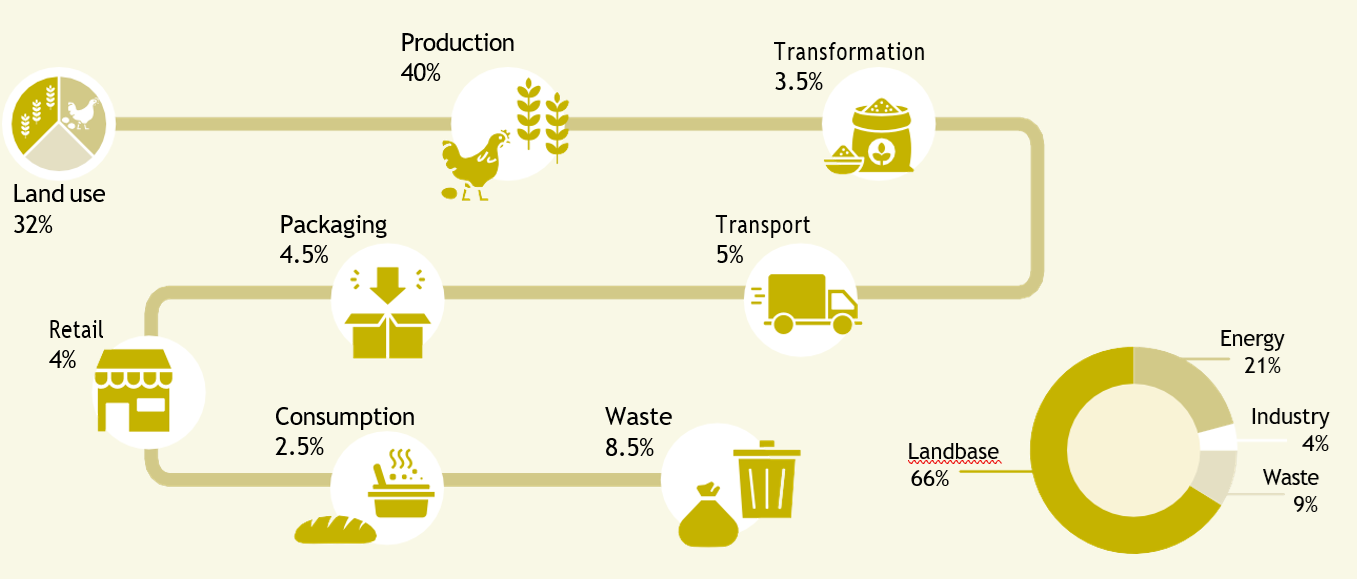
The loss of arable land leads to the intensification of activities on the remaining land and over-exploitation of natural resources, with a negative impact on biodiversity, water quality, and soil health.
The agricultural expansion into areas of high-value biodiversity – forests, pastures, and wetlands – is likely to increase.
- Intensive farming practices damage the soil structure and the microbial soil environment, leading to the release of carbon dioxide and nitrous oxide and to the reduction of the quality of the soil.
- The excessive use of pesticides is killing natural pollinators, leading to a reduction of biodiversity.
- Intensive livestock-rearing practices on an industrial scale do not respect the carrying capacity of the land and depend on major external inputs such as intensively grown fodder, concentrated feed, and antibiotics.
- Climate change can have a negative effect on biodiversity, which, in all its complexity, is important for soil health, crop pollination, and pest control.
Positive impacts of food systems on climate and the environment
Soils represent the largest reservoir of terrestrial organic carbon. The carbon sequestration capacity is highly dependent on geophysical conditions, climate, and land use and agricultural practices. Large quantities of soil carbon stock have accumulated over the years, and sustainably managed land can maintain and increase terrestrial carbon stocks.
Perennial plant cover, such as forests, pastures, and wet- lands have the potential to be carbon sinks, as do systems, such as crop rotation, agroforestry, sylvo-pastoralism, and low- or no-till practices.
Index
K-HUB > Thematic Interfaces > Food Systems and Climate, DRR & Environment > Interconnections at a glace