
Interconnections between water and food systems
A brief overview of the main interconnections between the thematic fields of food systems and water.

K-HUB > Thematic Interfaces > Food Systems and Water > Interconnections between water and food systems
Why is water critical for food systems?
‘No Blue - No Green: Without Water, No Food’
- Freshwater is essential throughout the food value chain, the central axis of food systems: from production (growing plants, rearing animals, farming fish, crustaceans and algae) to processing, retailing, storing and consuming, including for nutrition and health.
- Food systems use different types of freshwater resources at the surface of land and under the ground: blue water (from rivers, lakes, aquifers), green water (from soil moisture, plants and trees), and brown water (from untreated wastewater). Food systems also use virtual water, i.e. water embedded in food products, throughout the value chain (see Figure below).
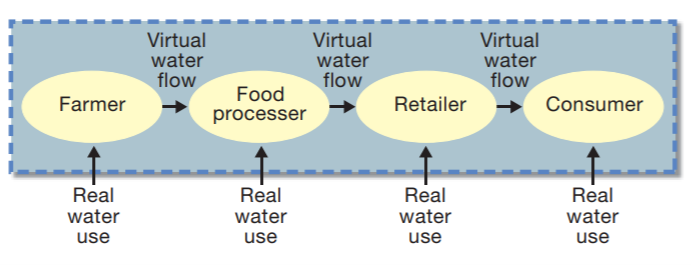
- While irrigated agriculture is the largest user of freshwater globally (in average 70% worldwide, up to 95% in some countries), it has allowed dramatic increases in crop yields (more than double) compared to rainfed agriculture that covers 80% of cultivated land and contributes to more than 60% of the global food production.
- While high variations exist depending on geoclimatic conditions and food produced, approximately 80% of diverted water? is used for production and 20% for the rest of the supply chain, before (e.g. fertiliser and seed generation) and after (e.g. processing, distribution and food preparation) production.
- Each step of the food value chain contributes to water pollution to a different extent and level of toxicity.
- Food systems emit greenhouse gas (GHG) and contribute to climate change, accelerating water cycles and leading to more frequent and intense extreme weather events such as droughts and floods (see also TIB Food Systems and Climate, DRR & Environment).
- Feedback loops resulting from various interconnections with water may, in turn, aggravate or accelerate impacts and vulnerability of food systems (see 1.2).
‘Water, the game changer for food systems’
- In 2021, the Food Systems Summit called for a major transformation of food systems to address a triple challenge: ensuring food and nutrition security, environmental sustainability and prosperous livelihoods of food system actors.
- The critical role of water was underscored given that ‘restoring degraded and protecting natural ecosystems, making food safer, increasing access to more nutritious food, and strengthening the climate resilience of food systems depend on better use of water in food systems.’
- Transforming food systems cannot happen without considering and managing their multiple interconnections with water, the various water resources used by a range of sectors and people (see Figure 3), and the complex management and governance of water.
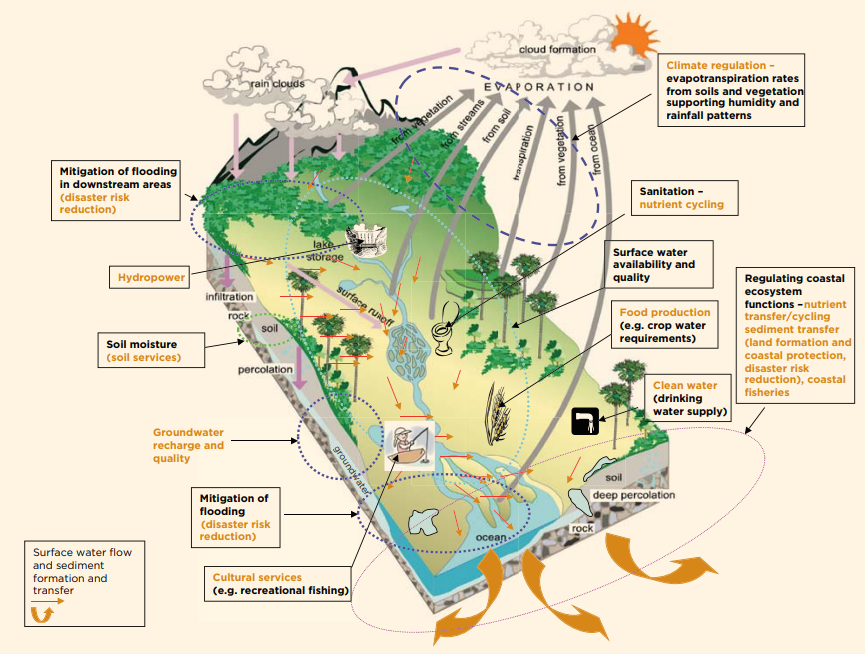
The figure shows some of the water-related benefits to people that ecosystem functioning provides, including soil moisture and food production. The various services illustrated are, in reality, more dispersed, interconnected and affected by land- and water-use activities.
Impact and vulnerability of food systems through water
Food systems impact all key attributes of water: natural ecosystems providing and regulating water resources; availability, accessibility and affordability of water supply; and water management and governance. In turn, these attributes are sources of vulnerability and risks for food systems
Nature at the basis of food production
- Surface water and groundwater can be depleted by irrigated agriculture (e.g. shrinking of Aral Sea resulting from cotton production in the Amu Darya and Syr Darya basins).
- Point-source and diffuse pollution degrades water quality due to the use of chemicals (especially fertilisers and pesticides in agriculture) and salinisation, often resulting from intensive and long-term irrigation of soils.
- The functioning, biodiversity and services delivered by ecosystems are affected by the loss of natural vegetation cover (e.g. rainforest in the Amazon or in Indonesia for corn, palm oil, orange plantations) and the overuse of surface water and groundwater.
Competing demands from multiple water users
- Sectors and activities other than food systems also need water, including energy, industry and the environment. Even within food systems, competing demand may arise among different farming activities (i.e. crop cultivation, fisheries, livestock and aquaculture) and beyond farming.
- Access to safe water supply and sanitation is a human right and should be given priority, noting that this does not include the right to water for food production. Safe WASH (water, sanitation and hygiene) also supports nutrition and reduces water-related diseases, such as diarrhea and cholera.
- While water contributes to the production of energy, especially through hydropower, energy is required to pump up groundwater, supply and treat water, and to desalinate seawater and brackish water.
- Globally, water demands grow while water scarcity, variability and pollution intensify. Competing demands within and across river basins may conflict over water allocation between users and sectors, as well as between nations in the case of transboundary river basins.
Feedback loops between impact and vulnerability
In addition, interconnections between water and food systems are subject to feedback loops across the water cycle. For example:
- Wastewater from food processing pollutes rivers, in turn affecting the farm production of healthy food and the supply of safe drinking water downstream of the watershed.
- Soils degraded through long-term overirrigation have limited capacity for infiltration of rain and irrigation water, which reduces crop water productivity, i.e. the amount of crop produced per unit of water consumed.
- Floods and droughts may (with increasing evidence) increase waterborne diseases of human-beings and livestock, decreasing the capacity of farmers to produce food.
- Unfit policies or water management strategies for food systems may exclude vulnerable people (e.g. due to remoteness, gender, ethnicity, and poverty) and negatively impact subsistence activities (e.g. capture fisheries in open-access rivers) aggravating food and nutrition insecurity.
Opportunities to simultaneously enhance water and food systems
Developing agroecosystems
- Agroecology aims ‘to ensure the regenerative use of natural resources while fostering socially equitable food systems by considering the intricate interplay of biological, ecological, social, economic, and cultural elements.’ (SDC How-to: Agroecology, 2024).
- This involves managing the soil-plant-water interface, such as covering soils with crop residues to retain soil moisture and reduce plant evapotranspiration, and/or protect against intense rainfall.
- Such agroecological practices will often result in more diversified food crops and provision of nutrients, thereby contributing to building the climate resilience of farming systems.
Moving beyond agricultural water use efficiency and water productivity
- The potential for water savings remains the largest in the irrigation sector, hence the wide range of agricultural water management interventions, including the development and rehabilitation of irrigation infrastructure, improved drainage and water storage, water-saving farming practices, crop breeding (e.g. for efficient evapotranspiration), and water recycling.
- Interventions have traditionally aimed at increasing water use efficiency and water productivity. However, most water savings at the farm level and in irrigation systems did not translate into enhanced cross-sectoral water allocation, and instead, led to agricultural expansion and increase of water use. This is called the rebound effect.
- Improved understanding of food systems further emphasises the fact that aiming at efficient and productive use of water is necessary but not sufficient, for example to avoid growing high-water consuming crops in water scarce areas. Rethinking towards the effective use and the full value of water is necessary, to encompass all economic, social, cultural and political dimensions of water.
Water for nutrition and health
- Reliable access to water in sufficient quantities and quality is also critical for nutrition security, health and human well-being, as highlighted recently.
- This calls for coordination and collaboration between agriculture, WASH, nutrition and health to jointly act towards access to safe water, nutritious food and improved health, including for women, youth and vulnerable people. For example, managing irrigation reservoirs can reduce the prevalence of malaria that affects nutrients absorption and disproportionately impacts poor communities.
Applying water and food systems nexus thinking
- Quite recently (last decades), nexus approaches have developed to focus on the interconnections between water and other major water-dependent sectors, mainly Water-Energy-Food-Ecosystem (WEFE).
- The WEFE nexus approach focuses on the complex and dynamic interconnections between water, energy, food and ecosystems, and helps understand the impacts a sectoral decision may have on that sector and on the other connected sectors. For example, a subsidy on fossil fuels can incentivise groundwater extraction for irrigated food crops, yet overuse will lower aquifer levels threatening water supply for human use.
- How to apply WEFE nexus by water managers, DSS tools for water allocation.
Promoting water stewardship across food value chains
- Water stewardship. The dependence and increased vulnerability of the agri-food business on water resources and water-related risks have triggered global to local engagement in water stewardship, mostly at site and increasingly at catchment level through collective action. Private sector interventions are usually driven by certification of standards, including broader sustainability and CSG standards.
- Water recycling. Long promoted e.g. through the 3R principles (retention, recharge and reuse), water recycling has gained further attention through concepts such as Life Cycle Assessments. Recycling wastewater requires careful assessment of the scope of reuse and any long-term impact on health and productivity.
- Virtual water and water footprint. Despite their importance in food systems, virtual water and water footprint are not necessarily considered in water stewardship standards, due to the complexity of measuring virtual water through the full value chain, especially for global value chains.
Changing food consumption and diets
- ‘If global food consumption does not shift to healthy diets produced by sustainable food systems with lower water footprint, food and nutrition security for the expected population of almost 10 billion people in 2050 may not be achieved’ (Food Systems Summit, 2021).
- Awareness of food consumers on water consumption across food supply chains increases, with potential to exert pressure for reduced water footprints of the agri-food businesses. Reducing over-consumption, food loss and waste also means limiting overuse of real and virtual water.
Building climate and disaster resilient food systems
- Since climate impacts are mostly felt through water, water is also key for adaptation. Building climate-resilient food systems requires: systematic and systemic consideration of climate hazards and water-related risks (driven or not by climate change) in the diagnostic of food systems; enhanced consideration of potential feedback loops resulting from climate-water-food systems interactions; and selection of mitigation and adaptation measures.
- The vulnerability of food systems to climate change contributes to raising people’s awareness on the multiple roles and values of water (see 1.1), and the urgent need to foster water integration not only to sustainably increase food production, but also to build the climate resilience of food systems.
Index
K-HUB > Thematic Interfaces > Food Systems and Water > Interconnections between water and food systems