
Launch of the Max Planck-Korea-PSI Center for Quantum Emergent Spintronics (KOMQUEST)
Villigen, 18.09.2026 — An international research partnership uniting leading institutions from Germany, Korea and Switzerland to advance the frontiers of quantum spintronics
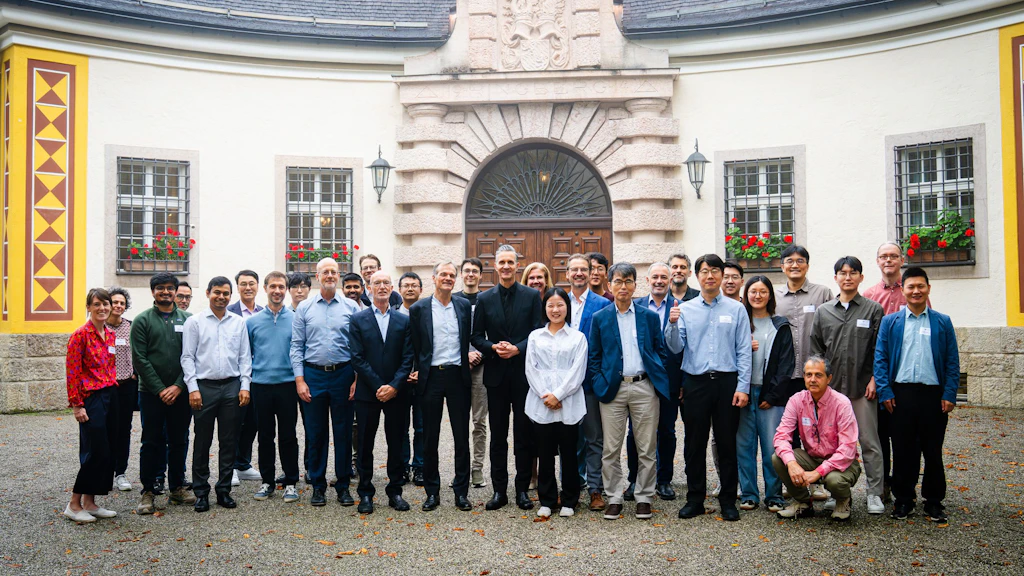
The Max Planck Institute of Microstructure Physics (MPI-MSP), Pohang University of Science and Technology (POSTECH), Seoul National University (SNU), the IBS Center for Quantum Nanoscience (QNS) at Ewha Womans University, and the Paul Scherrer Institute (PSI) are pleased to announce the official launch of the Max Planck-Korea-PSI Center for Quantum Emergent Spintronics (KOMQUEST), an International Max Planck Center dedicated to pioneering research at the frontiers of quantum materials and spin-based technologies. The Cooperation Agreement establishing KOMQUEST has been signed by all founding partners, and the Center held its inaugural kick-off meeting at Schloss Ringberg, the Max Planck Society's renowned conference venue in Bavaria, from 13 to 16 September 2026. Following the inaugural meeting in Germany, KOMQUEST will launch its broader scientific program in Korea at Seoul National University from 16 to 18 November 2026.
Scientific Vision: Exploring the Quantum Frontier of Spintronics
Spintronics, i.e., the science of harnessing the intrinsic spin of electrons alongside their charge, has already given rise to technologies that underpin modern information storage and sensing. KOMQUEST aims to push this field into fundamentally new territory by focusing on four interconnected research pillars: superconducting spintronics, chiral spintronics, topological spintronics, and spintronics for quantum-coherent control.
At the heart of these research thrusts lies a shared scientific philosophy: the conviction that the emergent properties of atomically engineered interfaces represent one of the richest frontiers in contemporary condensed matter physics, with enormous potential for future spin-based information technologies.
Synergies That Define the Center
The scientific power of KOMQUEST derives from the integration of complementary capabilities across its partner institutions. The MPI-MSP has developed over the past 10 years one of the world’s most sophisticated capabilities for the preparation of atomically engineered interfaces in complex multilayered thin films using a broad range of thin-film deposition techniques. SNU brings internationally recognized expertise in van der Waals magnetism and quantum materials, combining the growth of high-quality crystalline materials with advanced physical-property measurements under extreme conditions. POSTECH contributes complementary expertise in quantum materials growth and device fabrication. POSTECH and PSI host some of the world's most advanced synchrotron and free-electron laser facilities, providing an unparalleled suite of X-ray spectroscopy and imaging tools. The quantum nanoscience expertise at QNS, including world-leading ESR-STM, provides atomic-scale access to quantum states invisible to other probes, while advanced measurements under extreme conditions at SNU and MPI-MSP complete an experimental portfolio of exceptional breadth and depth.
“KOMQUEST represents a truly exceptional partnership,” said Prof. Dr. Stuart Parkin (MPI-MSP), Chairperson of the KOMQUEST Management Board. “By uniting world-class materials synthesis, unparalleled X-ray facilities, and pioneering quantum nanoscience expertise, we have created a center whose collective reach far exceeds what any single institution could achieve.”
“No single institution represented in KOMQUEST possesses the full range of capabilities that this scientific program demands,” noted Prof. Gabriel Aeppli (PSI / ETH Zürich / EPF Lausanne). “It is precisely the combination of our respective strengths that will allow us to address questions that are currently beyond reach.”
“KOMQUEST opens a remarkable new chapter for quantum materials research in Korea,” said Prof. Jun Sung Kim (POSTECH). “Together we will tackle some of the most profound open questions in quantum spintronics.”
“KOMQUEST gives us an extraordinary opportunity to bring together world experts in van der Waals magnetism and quantum materials with world-leading capabilities in interface engineering, advanced photon science, and atomic-scale quantum measurements,” said Prof. Je-Geun Park (SNU). “This combination will allow us to explore entirely new quantum states and functionalities, while giving our young scientists the opportunities to work across some of the world’s leading research institutions.”
Investing in the Next Generation of Scientists
KOMQUEST places the development of early-career researchers at the center of its mission. The Center will implement a Young Researcher Development Program encompassing doctoral training, postdoctoral leadership opportunities, and support for entrepreneurship. Competitively appointed Independent Group Leaders will lead distributed research groups spanning multiple partner institutions, while a Junior PI Advancement Program will provide co-leadership roles, prioritized infrastructure access, and strategic support for early-career funding schemes. The Center's Young Researcher Development Program draws on the distinctive strengths of its partners, including QNS's position at Ewha Womans University, which has awarded degrees exclusively to women since its founding in 1886 as Korea's first university for women.
“KOMQUEST is designed to give exceptional young researchers the international experience, the collaborative networks, and the intellectual freedom to challenge what some consider ‘impossible',” said Prof. Andreas J. Heinrich (QNS). “We want to inspire them to pursue ideas that others might consider too ambitious – and to demonstrate that they are not impossible at all.” QNS provides the consortium's atomic-scale endpoint, establishing whether the quantum states emerging at engineered interfaces can be individually addressed and coherently controlled.
The Center is chaired by Prof. Dr. Stuart Parkin, with Dr. Banabir Pal (MPI-MSP) serving as Deputy Director. KOMQUEST is funded for an initial period of five years, with each partner contributing €500,000 per year, and will maintain a vibrant international community through annual workshops, a bi-weekly seminar series, and a signature annual lecture on “Doing the Impossible.”
About the Partner Institutions
The Max Planck Institute of Microstructure Physics (MPI-MSP), Halle (Saale), Germany, is a leading research institution of the Max Planck Society with world-class capabilities in thin film deposition, electron microscopy, and quantum transport measurements.
Pohang University of Science and Technology (POSTECH), Pohang, Republic of Korea, is one of Asia's foremost research universities, hosting the Pohang Light Source II synchrotron and the PAL X-ray Free Electron Laser, and renowned for its expertise in quantum materials and advanced device fabrication.
Seoul National University (SNU), Seoul, Republic of Korea, is Korea's premier national research university, internationally recognized for pioneering research in van der Waals magnetism and with broad strengths in quantum and topological materials, crystal growth, and physical property measurements under extreme conditions.
The IBS Center for Quantum Nanoscience (QNS), hosted at Ewha Womans University, Seoul, Republic of Korea, is a world leader in scanning probe microscopy and electron spin resonance scanning tunneling microscopy, pioneering quantum-coherent control of atomic-scale spin systems.
The Paul Scherrer Institute (PSI), Villigen PSI, Switzerland, constitutes one of Europe's foremost centers for photon, neutron, and muon science, hosting the fourth-generation Swiss Light Source SLS and the X-ray free-electron laser SwissFEL, alongside deep expertise in quantum magnetism and superconductivity.
KOMQUEST is an International Max Planck Center established under the auspices of the Max Planck Society in partnership with POSTECH, SNU, QNS-IBS, and PSI.
Contact
KOMQUEST Administrative Coordinator: Max Planck Institute of Microstructure Physics, Weinberg 2, 06120 Halle (Saale), Germany
Press inquiries may also be directed to the communications offices of the respective partner institutions.