
Launch of Climate Solutions Hub within the ETH Domain: Overcoming the scaling challenge for climate solutions
Dübendorf, 15.10.2026 — The climate crisis demands rapid and effective solutions – yet many promising climate technologies remain stuck in pilot and demonstration projects. What is missing is the step towards a broad implementation. This is precisely where the new Climate Solutions Hub (CSH) by Empa and Eawag comes in: It investigates why transformative climate solutions fail to scale and, together with partners from research, industry, and the public sector, develops ways to overcome these barriers. As a result, the CSH is among the first research hubs worldwide to focus explicitly on the scaling of innovative climate solutions.

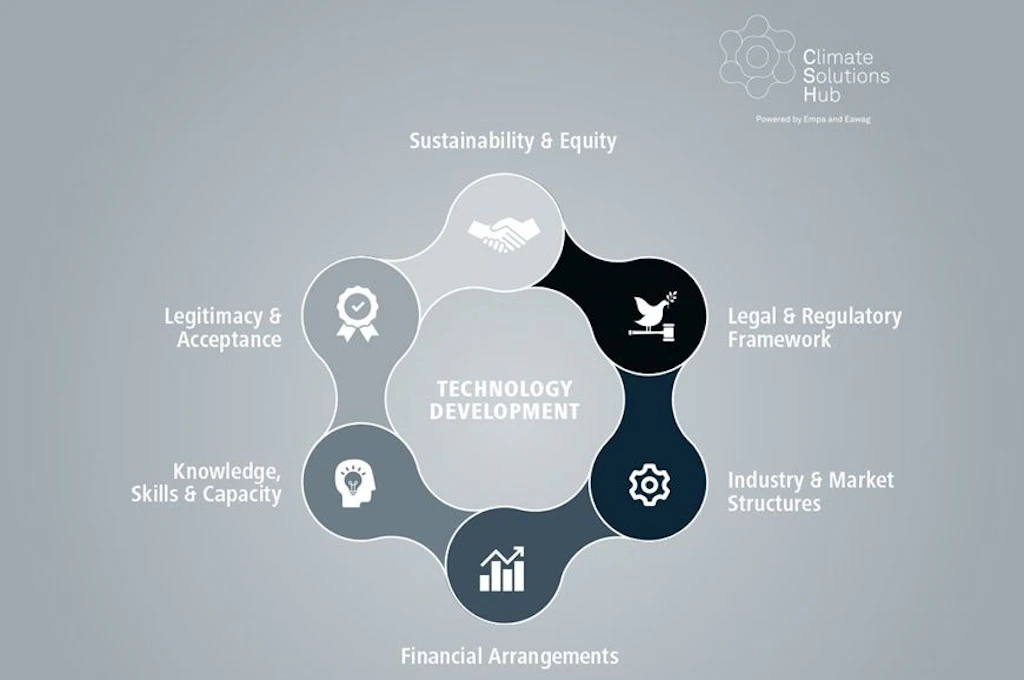
Pilot projects using CO₂-negative building materials, water reuse technologies, or blue-green infrastructures – i.e., interconnected urban water and vegetation areas – demonstrate that an increasing number of solutions exist to avoid greenhouse gas emissions or to adapt to climate change. However, between a technically sound solution and its broad implementation in real buildings, cities, or utility systems lies a decisive step: scaling. “This implementation gap rarely arises from insurmountable technical barriers,” says Christian Binz, co-head of the Climate Solutions Hub and group leader for Sustainability Transitions and Innovation Studies at Eawag. “Much more often, non-technological barriers are the reason: regulatory hurdles, lack of investment, insufficient knowledge, or missing acceptance.”
The importance of the interplay between these factors is illustrated by the example of decentralized water reuse in Bengaluru, India. In the WaterReuseLab project, Eawag researchers investigated how decentralized water reuse could be scaled in this water-scarce metropolis. In addition to the technology itself, the project focused on user acceptance, legal frameworks, and viable business models. The outcome: Alongside a low-cost, robust, and user-friendly technology, new legislation was introduced together with local partner organizations, and innovative business models were developed that created a local market for treated wastewater. The WaterReuseLab thus contributed to a profound shift in thinking about decentralized wastewater reuse in Bengaluru and laid the groundwork for large-scale implementation of such technologies – far beyond the city itself.
“Scaling is not a linear step from ‘small’ to ‘large,’ but a complex transformation process,” explains Peter Richner, co-head of the Climate Solutions Hub and Empa researcher. “A technology must be capable of being integrated into existing infrastructures, markets, institutions, and societal practices. Which factors are decisive in this process depends on the specific solution and its context.”
From single innovations to a scaling template
To help promising climate solutions make the leap to widespread application, the CSH – as a new structure within the ETH Domain – connects three pillars: technology development, demonstrators and Living Labs, and the integration of the social sciences. The centerpiece is the Innovation Scaling Platform. It examines scaling barriers from an integrated socio-technical perspective, focusing on climate solutions from the ETH Domain that have already been validated in pilot applications but have not yet achieved broad adoption. Together with experts from science and practice, projects are developed that address specific scaling barriers.
A key component involves demonstrators and Living Labs, where innovations can be tested under real-world conditions together with future users to identify specific scaling barriers and solve them jointly with research. These include Empa and Eawag’s NEST and PATH, the WaterHub, as well as urban test environments in Switzerland and Bengaluru.
The insights gained from individual projects are intended to be usable beyond the specific application case. The hub develops so-called Scaling Templates – practice-oriented guidelines with strategies and concrete tools to support the dissemination of a given solution. At the same time, actor coalitions are built and strengthened to support and drive the scaling process in the long term.
Climate-positive infrastructure solutions as a major lever
In its first phase, the CSH focuses on climate-positive infrastructures – an area with particularly high leverage for climate protection and adaptation. Three fields of action are in focus: CO₂-optimized construction, circular water and sanitation solutions, and blue-green infrastructure.
In the construction sector, the hub investigates, for instance, how CO₂-negative concrete, Net Zero roads, or climate-compatible bridges can move from pilot projects to established components of the built environment. In the water and sanitation sector, the focus includes reusing water within buildings or transforming human urine into high-quality fertilizer. For blue-green infrastructures, the emphasis is on adapting cities to heat, drought, and torrential rain. The portfolio is set to be continuously expanded in the coming years.
Further information
Dr. Peter Richner
Empa, Net-Zero Construction / Engineering Sciences
Phone +41 58 765 41 40
peter.richner@empa.ch
Dr. Christian Binz
Eawag, Environmental Social Sciences
Phone +41 58 765 50 30
christian.binz@eawag.ch