
People's land rights in the carbon rush
Years of advocacy have brought into being a very progressive land law in Sierra Leone. But a new case of land grabbing shows that the struggle is far from over.
AFS News - Article by

Research Monitoring & Evaluation Officer, Silnorf

Agriculture and land rights, HEKS/EPER
The Customary Land Rights Act
When Sierra Leone adopted the Customary Land Rights Act (CLRA) in 2022, it was the result of years of struggle by many people and groups. These struggles were fuelled by the injustices and problems that earlier investments had brought on the people. One such investment was the sugarcane plantation of a Geneva-based company. The project, promoted as a showcase project, eventually went bankrupt. But the land lease agreements, signed by the Paramount Chiefs without the free, prior and informed consent of the landowners, remained binding.
Such contracts would not be legal today. With the CLRA, the Paramount Chiefs—whose power in land matters was shaped by the British colonialists' need for land—can no longer decide on land unilaterally. Before land can be leased to an investor, at least 60% of all adult members of a land-owning family, including women and youth, must provide written, informed consent.
It is one of the most progressive land laws on the continent and a huge step towards more just land governance. But shortly after the CLRA came into being, the Sierra Leone Network on the Right to Food (Silnorf), a HEKS partner, received reports of a new investor failing to obtain people's consent. What followed showed that, without changing existing power structures, this law risks accelerating the commodification of land.
Carbon done wrong
It started when people from Sierra Leone's Port Loko District called Silnorf to express worry and confusion about a new investor interested in their land. Silnorf and HEKS began to investigate. An on-the-ground and desk research found that the project, led by a Canadian firm, has ambitious plans: to establish tree plantations on at least 25,000 hectares and sell carbon credits for 12 million tonnes of sequestered carbon dioxide over 50 years.
The investigation found evidence suggesting that the legal safeguards stipulated by the CLRA were systematically bypassed. 25 villages were visited, and dozens of stakeholders interviewed, showing that the local subsidiary of firm had begun surveying land and clearing areas well before any documents were signed. When signatures were finally sought, they were often obtained in hurried public events where many participants did not understand what they were signing. Some landowners believed they were signing receipts for small payments, unaware they were entering binding agreements that could forest-lock their land for up to 50 years.
The firm argued that the savannah land used in their project is unproductive and unused. Fieldwork, corroborated by an agronomist from the Ministry of Agriculture, told a different story. This land plays an important role in local food security. Women in particular use it to grow groundnuts, cassava, peppers, and cucumbers - yet they were very often unaware of what was happening, having been excluded from negotiations or relegated to the role of mere listeners.
Carbon as a commodity
Since 2009, people farming these lands have been targeted by large-scale commercial interests, namely oil palm plantations. The research found that the individuals involved in this new project are the same people who had been involved in those earlier, failed projects. For the local population, the transition from palm oil to carbon credits feels less like a shift toward sustainability and more like a rebranding of the same extractive model.
Carbon credits are a particular commodity: to hold commercial value, they must first be certified by an accredited body. Only then can they be traded and sold. To obtain certification, projects require extensive, technically sophisticated documents demonstrating how carbon will be sequestered, process typically supported by specialised consultancy firms hired by the applying company. Within this process, a consultation window for comments or objections is always provided.
Under the process engaged by the Canadian firm with a Swiss-based consultancy, HEKS and Silnorf submitted a public comment during the designated period. The application remains pending, with no current information as to any attempts to verify whether people's land rights have been respected.
Rights-based response
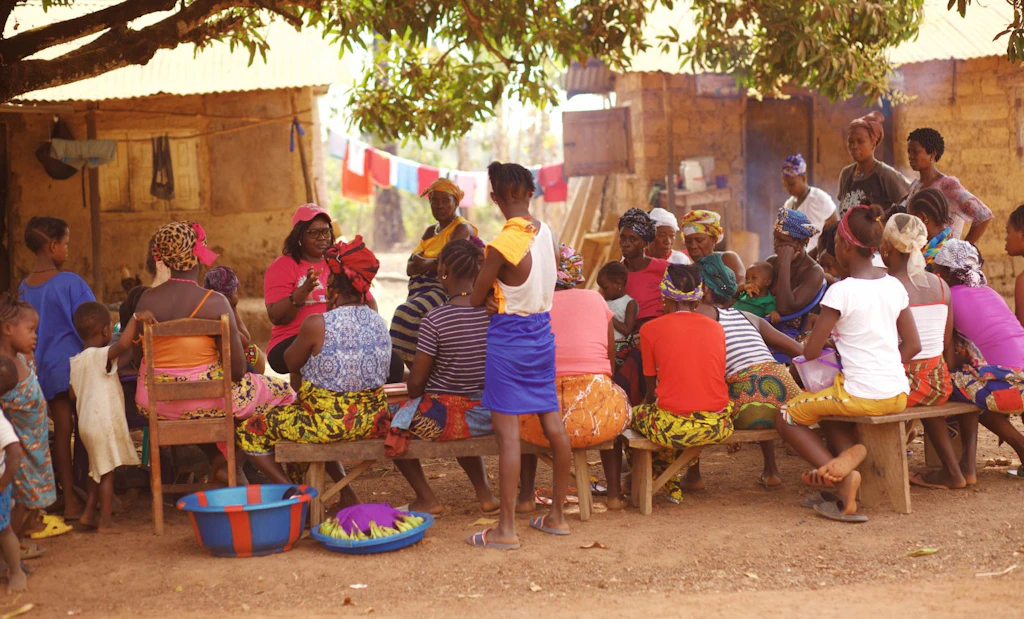
To support landowners and users, HEKS and Silnorf focus on community organising and legal empowerment. One strategy is building Affected Land Owners and Users Associations across the area, where women hold at least a third of leadership positions. Silnorf trains these leaders on their rights under the new law and demystifies carbon markets, supported by radio sensitisation programmes.
Among the most effective strategies are community exchange visits. Silnorf brings together representatives from communities currently facing carbon project investors with those who have previously dealt with large-scale tree plantation companies. This peer-to-peer sharing of lived experiences and negotiation tactics has fostered a powerful sense of solidarity across districts.
The communities demand that people have the knowledge and freedom to decide what happens on their land, as it is defined in the national legislation. Such work can come at heavy costs. Silnorf staff and community defenders, in the work on this case and others, have faced intimidation, including physical threats and death threats delivered to their families. It is an important part of a rights-based response that HEKS supports Silnorf and the community land defenders in such situations.
Climate justice
The story of Port Loko is a warning, not least because the project now sits in the pipeline for Artile 6 projects of the UNFCCC, the UN climate body. As this and many other cases reveal, carbon credits are at risk of becoming just another commodity leading to continued land dispossession for profit, should community engagement and rights not be ensured. Securing land rights and changing existing power structures is a prerequisite for any genuine climate justice.