
Monitoring and reporting
This section presents the different tools within SDC to monitor and report on A&FS activities.
Reference Indicators
A&FS activities within SDC are monitored through the use of Aggregated Reference Indicators (ARIs - output indicators allowing to communicate on selected achievements across a wide range of situations and countries) and Thematic Reference Indicators (TRIs – indicators for outcomes to which the SDC contributes), which constitute SDC's standardised indicators (complete list for all SDC themes in the RDM Indicator browser - internal access only).
These indicators should be used as much and as often as possible within projects and strategic programmes, to allow an aggregation and consolidation of SDC activities for thematic monitoring at the level of the institution.
SDC management has approved a set of reference indicators to monitor the implementation of Switzerland's International Cooperation Strategy 2025–28 (IC Strategy). The indicators relevant for the Agriculture and Food Systems domain are presented below.
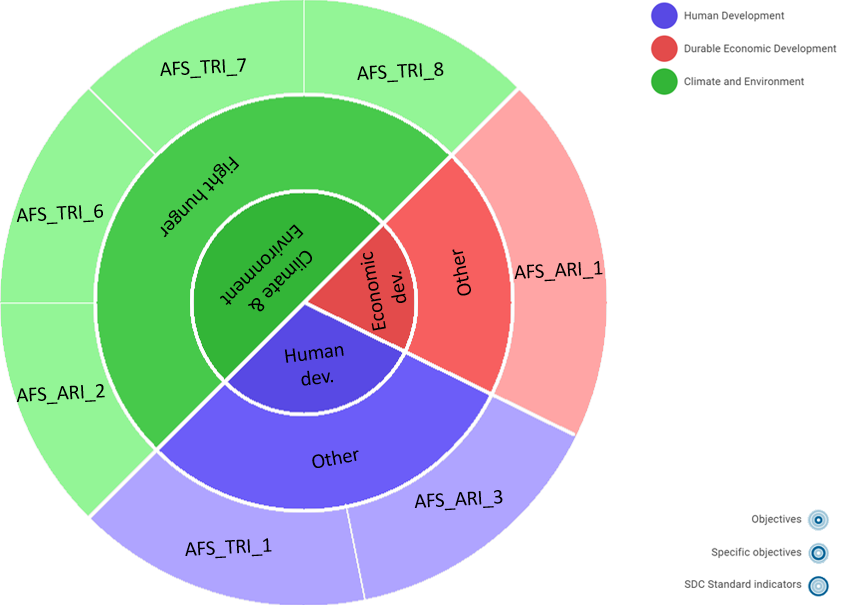
These goals and specific objectives contribute to the Sustainable Development Goals (SDGs), mainly SDG 2 (Zero hunger), but also SDGs 1 (No Poverty), 5 (Gender equality), 12 (Responsible consumption and production), 15 (Life on land), 16 (Peace, justice and strong institutions, and 17 (Partnerships).
Aggregated Reference Indicators (ARI)
AFS_ARI_1:
Number of smallholder farmers with increased incomes from agricultural production
IC Strategy Objective: Sustainable Economic Development
AFS_ARI_2:
Number of smallholder farmers applying more agroecological farming practices
IC Strategy Objective: Climate and Environment
AFS_ARI_3:
Number of smallholder farmers who have benefited from capacity building and/or training to improve their livelihoods
IC Strategy Objective: Human development
Thematic Reference Indicators (TRI)
AFS_TRI_1:
Percentage of food insecurity measured in the area (district, region, country) corresponding to SDC’s interventions
(similar to SDG indicator 2.1.2 Prevalence of moderate or severe food insecurity in the population, based on the Food Insecurity Experience Scale (FIES))
IC Strategy Objective: Human development
AFS_TRI_6:
Number of supported policies and/or legal frameworks on agriculture, food security, and/or nutrition for sustainable food systems which have been adopted, at the national, regional or global level
IC Strategy Objective: Climate and Environment
AFS_TRI_7:
Number of smallholder farmers who have gained increased secure access to natural resources (land, water, biodiversity, etc.)
IC Strategy Objective: Climate and Environment
AFS_TRI_8:
Number of civil society organisations supported that contribute to multi-stakeholder dialogue and/or policy advocacy, for more sustainable, resilient, equitable and healthy food systems
IC Strategy Objective: Climate and Environment
AFS_TRI_9:
Percentage of target population whose diet is healthy - measured by persons achieving all 7 criteria of the healthy diet checklist
IC Strategy Objective: Human development
Policy Markers
Policy Markers are used to monitor the integration of and track resources and financial flows allocated to specific themes or topics. Overall information on all Policy Markers can be found in the SAP Manual (internal SDC only).
The most relevant Policy Markers for the A&FS sector would be :
- PM Nutrition: An activity should be identified as nutrition-related with the policy marker (score Principal or Significant) when it is intended to address the immediate or underlying determinants of malnutrition. This can encompass a range of projects across a variety of sectors, including humanitarian interventions, maternal health, WASH and agriculture.
- PM Support Rio Biodiversity: An activity should be classified as biodiversity-related if it promotes at least one of the three objectives of the Convention: the conservation and/or restoration of biodiversity, sustainable use of its components (ecosystems, species or genetic resources), or fair and equitable sharing of the benefits of the utilisation of genetic resources.
- Other PMs of potential relevance: Climate Change Adaptation and/or Mitigation, Desertification, Governance, Gender.
These follow the OECD-DAC Guidances, and allow to report to the OECD-DAC processes.