
Restoring forests on degraded land at scale
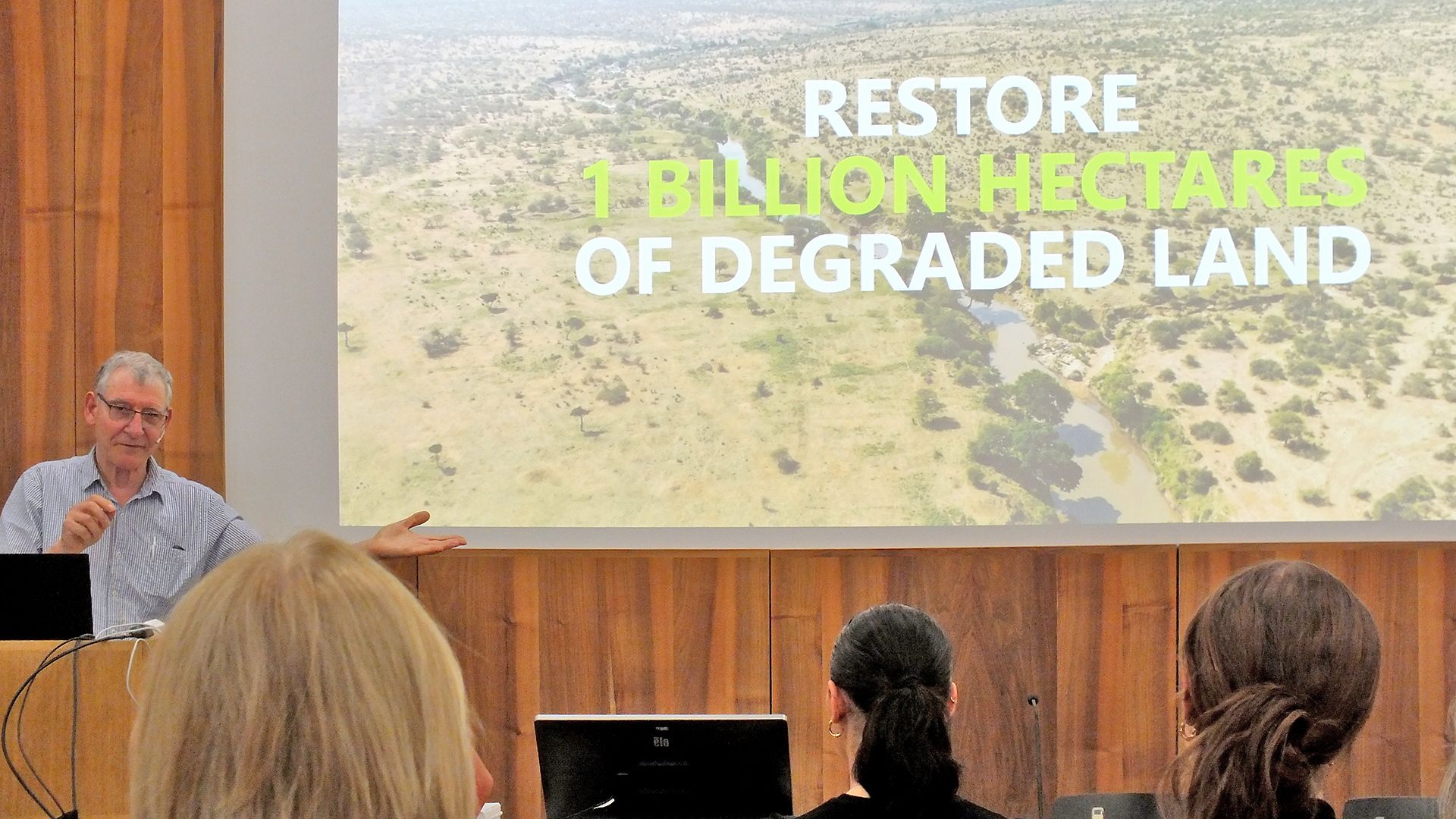
On the 21st of May 2024 ETHZ hosted an event organized by World Vision Switzerland & Liechtenstein with Tony Rinaudo as main speaker and in collaboration with the Crowther Lab, an interdisciplinary team of scientists studying ecosystems at global scale to understand the relationships between biodiversity and climate change. Tony’s key statement «Re-greening mindsets in order to re-green landscapes» formed the basis of his insightful speech, which held the attention of the entire audience for over 30 minutes and was interspersed with personal anecdotes and more than 40 years of experiences.
AFS Newsletter - Past event by
David Schwitter
World Vision Switzerland & Liechtenstein
Linkedin | david.schwitter@worldvision.ch
Land degradation is both a symptom and a cause of climate change, pushing the most vulnerable communities deeper into poverty. Amazingly, much of the world’s degraded land contains invisible forests - complex root systems hidden underground with the potential to rapidly regenerate, heal the environment and help slow climate change.
World Vision is leading the charge to bring these invisible forests back to life by building a movement of businesses, governments, institutions, and everyday people to unleash its powerful technique called Farmer Managed Natural Regeneration (FMNR) on an unprecedented scale.
Tony Rinaudo[1], who rediscovered FMNR[2] decades ago in Niger in 1984, is today’s World Vision Australia’s Principal Climate Action Advisor. Since then, Tony and his team have helped to introduce and spread FMNR in 29 countries across Africa and Asia, contributing to the regeneration of millions of hectares of land.
In his speech, he summarized his life story and highlighted the 10-year FMNR strategy that World Vision has taken to scale regreening in four catalytic countries in African including Uganda, where land degradation is estimated to be over 45%.
Th regreening Uganda Catalyst Project aims to restore > 500,000 hectares of land (WV programs), in the Northern and Easter region of Uganda, impacting more than 350,000 people, including 140,000 children, catalyzing partners and the wider community to restore 1.7 million hectares of degraded land.
World Vision Switzerland and Liechtenstein is thrilled to contribute to the overall FMNR catalyst movement by adding a regreening component towards their programming in Tanzania and Uganda
Read more:
- World visions «Farmer Managed Natural Regeneration» [in German and French]
- Youtube video: Programme 10 in the series on Sustainable Land Management in Africa
- Summary of «Farmer Managed Natural Regeneration» authored by Tony Rinaudo
- Documenary Tony Rinaudo
[1] Known as the «Forest Maker», Tony is widely acclaimed for his work. He’s a Right Livelihood (Alternative Nobel) award winner and subject of a 2022 documentary by Oscar-winning German director Volker Schlöndorff. He’s also recently authored an inspiring autobiography, The Forest Underground.
[2] Farmer Managed Natural Regeneration (FMNR) is a low-cost land restoration technique used to combat poverty and hunger amongst poor subsistence farmers by increasing food and timber production and resilience to climate extremes. In practice, FMNR involves the systematic regrowth and management of trees and shrubs from felled tree stumps, sprouting root systems or seeds. The regrown trees and shrubs – integrated into crops and grazing pastures – help restore soil structure and fertility, inhibit erosion and soil moisture evaporation, rehabilitate springs and the water table, and increase biodiversity. Some tree species also impart nutrients such as nitrogen into the soil. As a result, FMNR can double crop yields, provide building timber and firewood, fodder and shade for livestock, wild foods for nutrition and medication, and increased incomes and living standards for farming families and their communities.