
Farmers in Zimbabwe: turning minimal inputs into stable incomes
The Salvation Army Switzerland (Stiftung Heilsarmee Schweiz) and Salvation Army Zimbabwe are supporting rural communities to diversify income and strengthen their resilience against the negative impacts of climate change. A midterm review and field visits offer a chance to reflect on the next steps.
AFS Newsletter - Member Article by

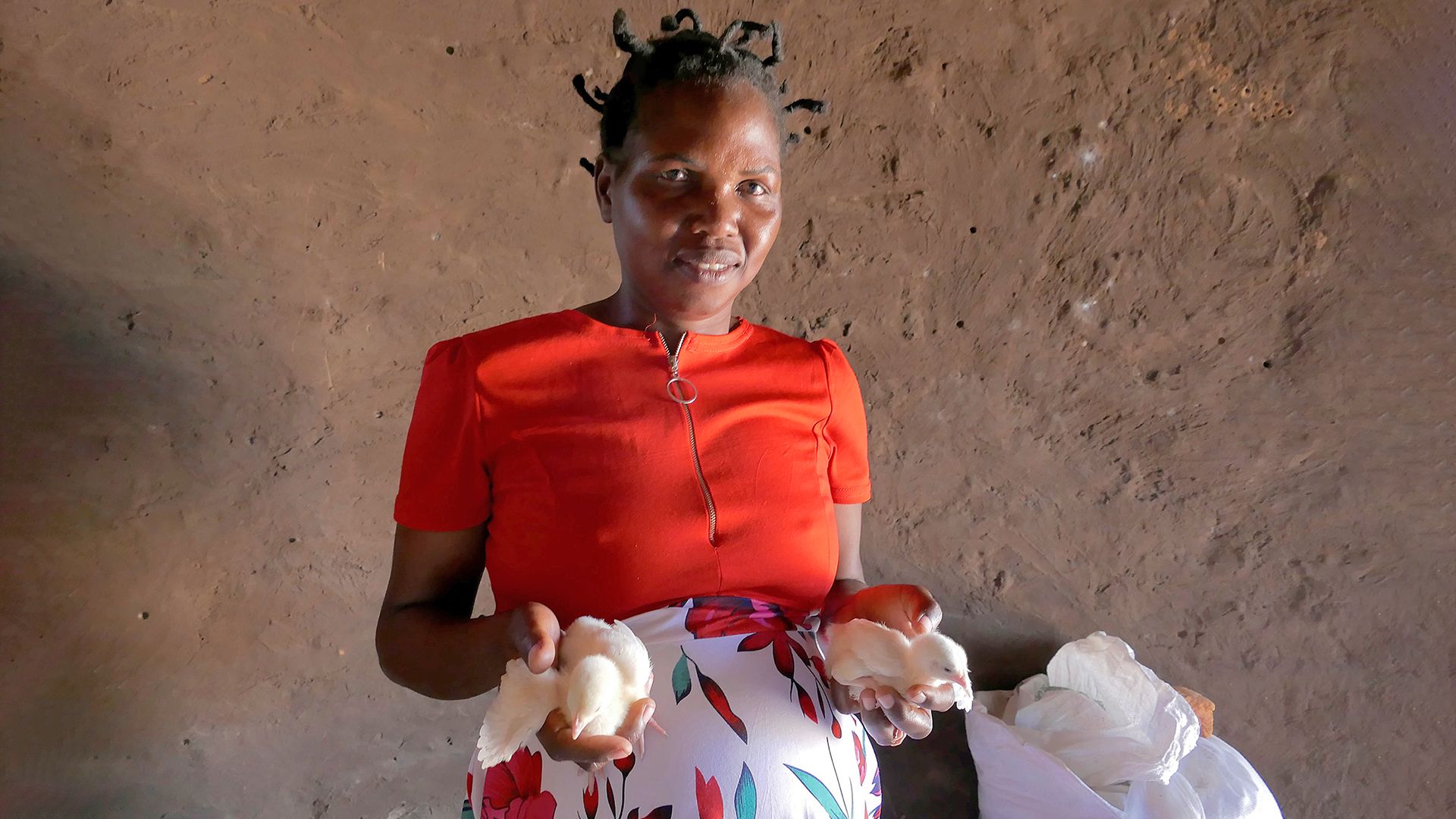
Babra Rutambo wants to show us the large chicken coop that she has built outside her house. ‹At the training they told us that the chickens need space and that the air needs to flow,› she explains, ‹so I used old wire mesh and grass for the roof.› She also added a corrugated iron sheet around the bottom, ‹to protect the chickens from predators›.
Babra lives with her husband and four small children in the rural village of Kunaka, in Mondhoro, one of four districts where the Salvation Army Zimbabwe is implementing the project ‹Scaling Up Resilient Livelihood for Smallholder Farmers› (SCARL), funded amongst others by SDC through the KOGE.
‹I got 3 improved breed chickens from the SCARL project›, she continues, ‹one died at the very beginning, but I managed to breed 24 more in 4 months.› Less than a year on, using income from the sales of eggs, which she can sell at 5USD for a tray of 30, and some of the adult improved chickens, which can fetch between 8 and 15USD, Babra branched out into broiler rearing. Broilers reach maturity at 6 weeks, compared to 16 weeks for the improved breed, and fetch 5 to 6USD. With the money from the sales she buys feed and some medicines for the chickens and after all that, ‹I still have about 60USD a month,› she says. The income is useful to pay for items such as school fees, cooking oil, or food items that are not readily available in the village. Having the chickens also means that the family now eats more eggs and meat compared to when they were only cultivating.
Babra is one of 2,800 project participants who have had access to a range of trainings - from conservation agriculture to small animal rearing, dairy production, fish farming, irrigated horticulture, beekeeping and financial literacy – which were delivered in conjunction with the national extension services, Agritex. SCARL staff has also supported participants to form Village Savings and Lending Associations (VSLAs), with the aim of funding income generating activities (IGAs) and meeting unexpected household expenses.
‹The overall aim of SCARL has been to support households in dealing with both the negative impact of climate change and the macroeconomic shocks affecting the economy in Zimbabwe,› explains Bothwell Mashu, SCARL project manager. ‹In the first two years, the IGAs in particular have produced very positive results. They have helped families to reduce their vulnerability, to be less dependent on climate sensitive agricultural practices and to diversify their income.›
When we combine the knowledge that 70% of Zimbabweans practice rainfed subsistence agriculture (FAO), with the fact that the latest El Niño induced drought led to more than half of the harvest in the country being destroyed (OCHA), the picture is dire: more than 7.6 million people possibly facing acute hunger until the next harvest, in April 2025 (OCHA). The impact of erratic weather patterns leaves smallholder famers and their communities reeling. In this sense, interventions that aim to quickly diversify income and improve nutrition - such as through IGAs including small animal rearing, irrigated horticulture or honey production – can offer some respite for farmers, who normally need a few agricultural cycles to fully adopt longer term solutions such as climate resilient farming practices and reap the rewards. In practice, availability of cash in a drought or other emergency, when food is maybe imported and available at a higher cost, can greatly help.
In SCARL, the benefit of the IGAs approach is backed by anecdotal evidence from interviews with participants and data from a small project survey, which highlighted that in the short term, successful uptake of small animal rearing best practices was slightly higher across the sample than adoption of conservation agriculture ones. IGAs are also an important disaster risk reduction (DRR) tactic that, since they bear fruit relatively quickly, can take the pressure off households and communities while they plan for longer-term solutions and higher level DRR strategies. Following the impact of the current drought, communities are asking for more support in this longer-term planning. In an intervention like SCARL, regular reviews are helping re-share the focus on the short and long term goals and ensure that communities do emerge at the other end of the project not just with an increased income but also more connected and with clear plans to mitigate the effects of the next El Niño phenomenon. ‹Having Agritex and local authorities on board, means we have a good level of continuity with this effort›, comments Bothwell.
IGAs have also proved a useful tool to secure women’s participation by weaving a network of support amongst participants and by creating opportunities for women’s affirmation of their rights and abilities in the socioeconomic sphere, which has the potential to affect the private one too. As dramatized by farmers groups in Mondhoro and Guruve during project visits, many women have faced challenges in convincing their husbands, brothers or fathers to allow them to participate in trainings, but the hope of an income, along with lobbying from other group participants, helped. So much so that 70% of SCARL VSLA members are currently women.
Back in her yard, Babra still has many wishes for her small enterprise and hopes that through her VSLA group, a solar incubator can be procured to achieve increased and consistent hatching. Thinking back on her life over the past year, she smiles and acknowledges that she has come a long way and overcome many challenges. ‹I didn’t know anything about chickens before the training, but I am doing it,› she says, picking up two chicks, ‹I like that I can earn money for my family›. Asked whether she will continue to do this once the project ends next year, she doesn’t pause, ‹yes,› she says, ‹I will continue, sure, I know there are people around here who have more knowledge than me and we can help each other.›