AFS within Swiss foreign policy
This page presents how Agriculture and Food Systems (AFS) are anchored within Switzerland’s foreign policy architecture, following the logic of the cascading foreign policy strategy. It explains how constitutional principles are translated into strategic priorities and, ultimately, into operational action.
Constitution and laws
Building on the Federal Constitution, Swiss foreign policy is structured according to the “cascading foreign policy strategy” method that contributes to its coherence.
- Level 1: Foreign Policy Strategy (adopted by the Federal Council)
- Level 2: Thematic and geographical follow-up strategies (adopted by the Federal Council)
- Level 3: Operational implementation frameworks (adopted by the Departments)
👉 More information: Foreign policy: strategies and key aspects
Food security is also anchored in the Swiss law on International Development and Humanitarian Assistance. In Switzerland’s effort to improve the living conditions of the populations in developing countries, it notes rural areas and with it, the improvement of the food situation, especially through agricultural production. Notably, the restoration and conservation of an ecological balance is also mentioned (Article 5).
👉 More information: FDFA Legal Basis and SDC Legal Basis
Level 1: Foreign policy strategy
Foreign policy aims to promote Switzerland's interests, including its values. The Foreign Policy Strategy 2024-27 is the overarching foreign policy document and occupies the highest level of the cascading strategy.
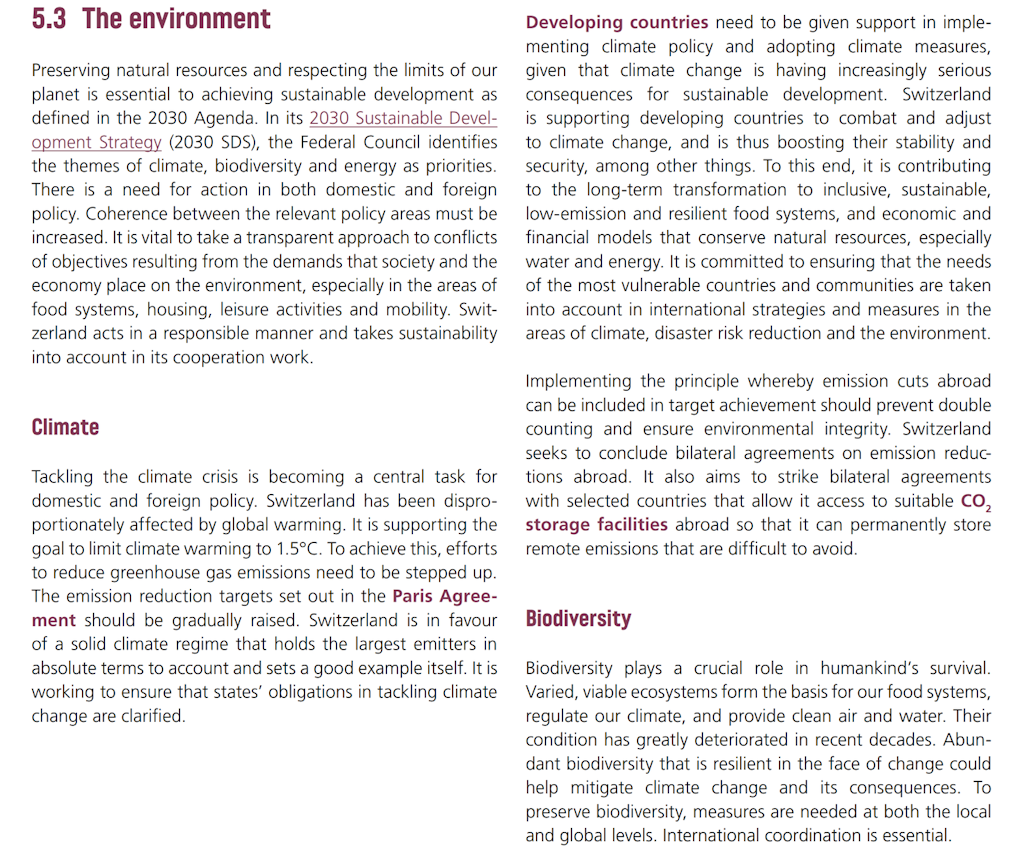
Foreign Policy Strategy 2024-27, page 35
👉 More information: Foreign Policy Strategy 2024-27
Level 2: International cooperation strategy
The various geographical and thematic follow-up strategies adopted by the Federal Council in line with its plans for the legislative period constitute the second level of the cascading strategy process. Under all these strategies, the Federal Council sets priorities and specifies the applicable policy objectives and measures over a four-year period.
The International Cooperation Strategy 2025-2028 adopted by Parliament in December 2024 sets out Switzerland’s priorities for development and economic cooperation, humanitarian aid and the promotion of peace and human rights. The overarching objective of international cooperation is to end poverty and support sustainable development worldwide.
👉 More information: Switzerland’s international cooperation strategy 2025-2028
Level 3: Implementation plan
At the third level of the process, the departments translate the Federal Council strategies into operational implementation plans. In particular, these may take the form of guidelines, action plans or cooperation programmes.
Global approach
Climate change, wars, food crises, water problems and population displacement affect the development prospects of the poorest countries and regions. Through its thematic approach, the SDC carries out coordinated action at various levels: global, national, regional and local.
The SDC takes action through global programmes that tackle various themes in an innovative way based on the scaling-up approach. Its global programmes in the fields of migration and forced displacement, health and food, water, climate, the environment and disaster risk reduction extend beyond its priority countries. It also supports actions and thematic expertise in other areas, such as the economy and education, peace, governance and gender equality. In doing so, it works together with other actors from the Federal Administration and external partners.
The SDC’s thematic work is based on four principles of action that enable it to have the greatest possible impact:
- Programmes and Strategic Partnerships
- Policy Dialogue and Advocacy
- Advisory
- Knowledge Management and Learning
👉 More information: SDC Global Approach
Health and Food section Programmatic Framework 2025-28
SDC’s commitment/objectives – focus areas/outcomes for 2025-28
Health and food security are priorities of the Switzerland’s Foreign Policy Strategy 2024-27 and the International Cooperation Strategy 2025-28 (ICS).
The Health and Food Section contributes to…
- Enhancing the thematic relevance, quality, credibility, innovation and impact of SDC’s interventions in health and food at global, regional, national and local levels.
- Positioning Switzerland in international policy and advocacy at the health-food interface through an evidence-based and whole-of-government approach.
- Setting norms and generating knowledge and robust evidence to feed into global thematic guidance and policies on health and food systems while leveraging SDC operations at country level.
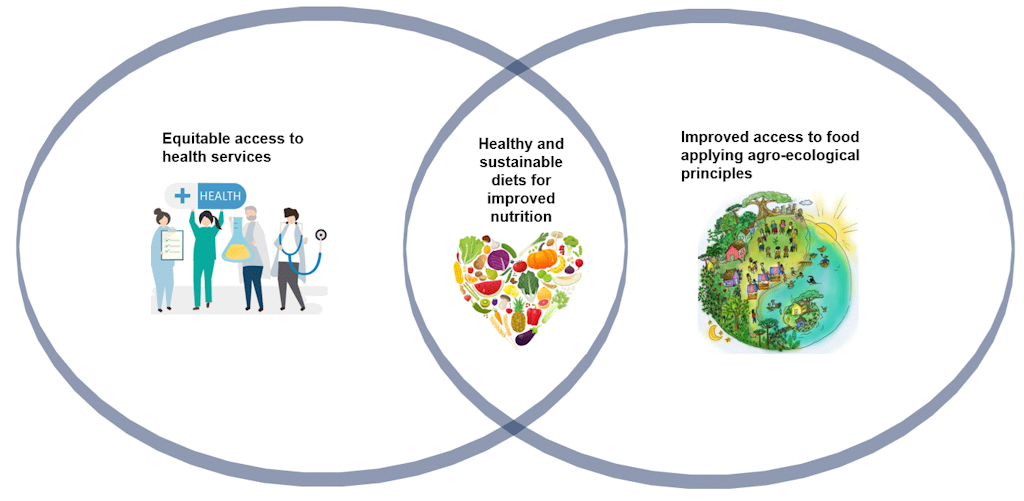
The main priorities are:
1. Healthy and sustainable diets for improved nutrition
Improve nutrition by strengthening global policies and frameworks, empowering vulnerable rural and urban consumers, and promoting food and nutrition security through a human rights-based approach, with a focus on women, children, and adolescents.
2. Equitable access to health services
Improve access to quality, equitable, efficient, and affordable health services for all, including in fragile contexts. This includes strengthening primary healthcare with a focus on essential nutrition, access to medicines and technologies, sexual and reproductive health, and communicable and non-communicable diseases. The section also contributes to optimising health financing and leveraging digital solutions to improve health outcomes.
3. Improved access to food applying agroecological principles
Improve food access and food systems by promoting agroecological practices that protect biodiversity, improve soil health, and conserve resources. Agroecology provides a holistic approach which empowers farmers, supports communities, and fosters sustainable livelihoods, while strengthening local food markets and encouraging inclusive land and seed governance.
4. Strengthened global health and food systems architecture
Improve global health and food systems by promoting sustainable financing, and ensuring better performance, transparency and compliance of health and food institutions.
The Section is committed to gender equality and the empowerment of women and girls. It continues to advocate for inclusive policies that address everyone's needs, especially those of young people.
Results & lessons learned in 2021-2024
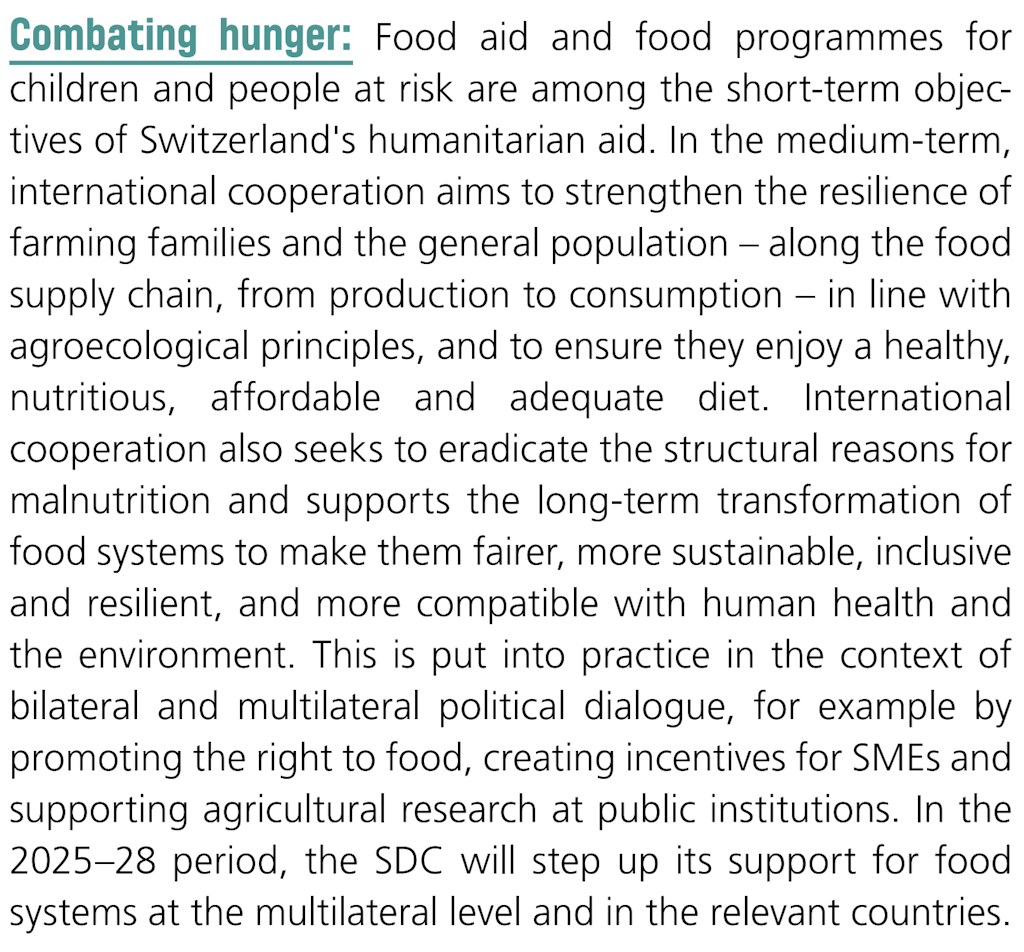
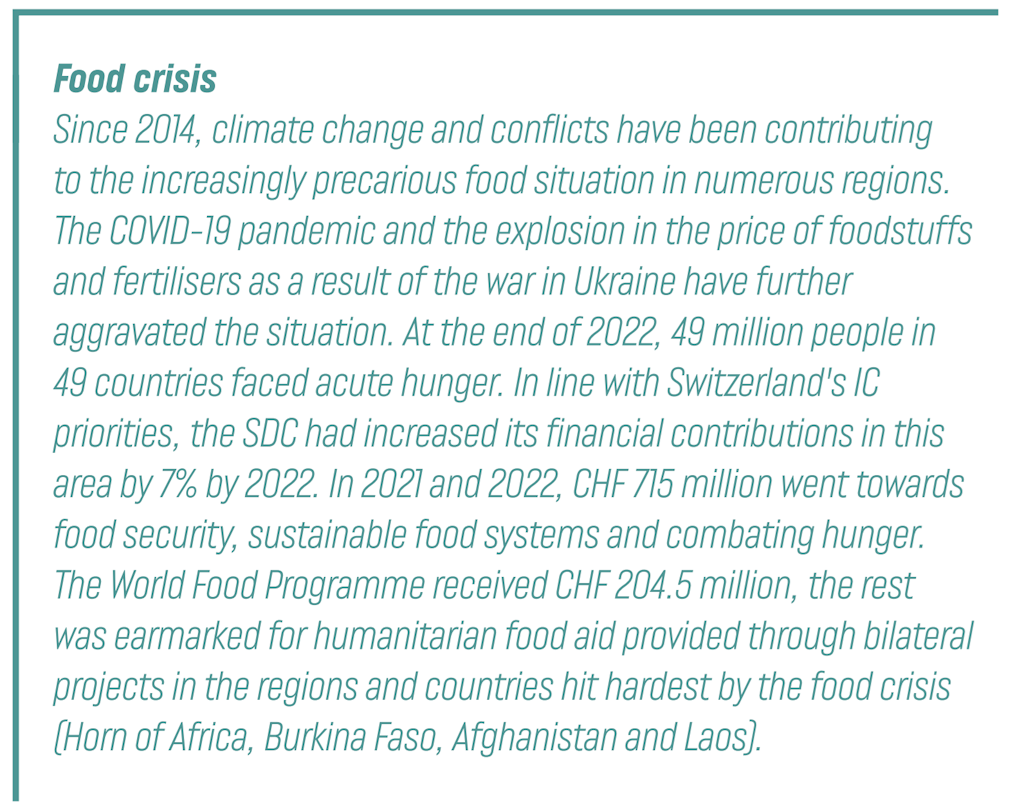
Between 2021 and 2024, SDC contributed to advance global health through bilateral projects and multilateral mechanisms, involving civil society and the private sector, and incorporating digital solutions. It supported the strengthening of health systems by developing innovative health products for poverty-related diseases, improving access to affordable health services for disadvantaged populations, and promoting sustainable health financing. For example, Drugs for Neglected Diseases introduced the first oral treatment for acute sleeping sickness in East and Southern Africa in 2023 with SDC support. SDC also addressed health determinants, gender equality, and human rights, supporting the International Planned Parenthood Federation, to provide 222.4 million sexual and reproductive health services to 71.2 million people in 2023.
Over the same period, SDC contributed to making global food systems more sustainable, inclusive and resilient by promoting agricultural innovation, inclusive market systems, better nutrition, and agroecology. Key objectives included improved livelihoods of smallholder farmers, strengthened local value chains, and more sustainable agriculture for climate and environmental benefits. For example, SDC supports PlantWisePlus, a global programme to reduce crop losses through national agricultural advisory services and a global plant clinic network. From 2021 to 2024, it supported 5.6 million smallholder farmers across various regions, improving plant health, yields, and incomes. CROPS4HD supports local farmers by strengthening seed systems and advocating for seed policy reforms in countries such as Tanzania, Chad, India, and Niger. This work promotes biodiversity in agriculture, helps communities adapt to climate change, and thus secures livelihoods.
A key lesson from the 2021–24 period is the critical importance of addressing the health-food nexus to effectively prevent and tackle future health threats, food insecurity, and unhealthy diets. This involves addressing the root causes of food insecurity, poor health, and malnutrition, as well as improving access to health services and resource-efficient, affordable food. Nutrition is the essential bridge between global health and food systems, as it impacts health outcomes, economic growth, environmental sustainability, and social equity. The Health and Food Section will therefore focus on the health-food interface in the coming years.
Approach
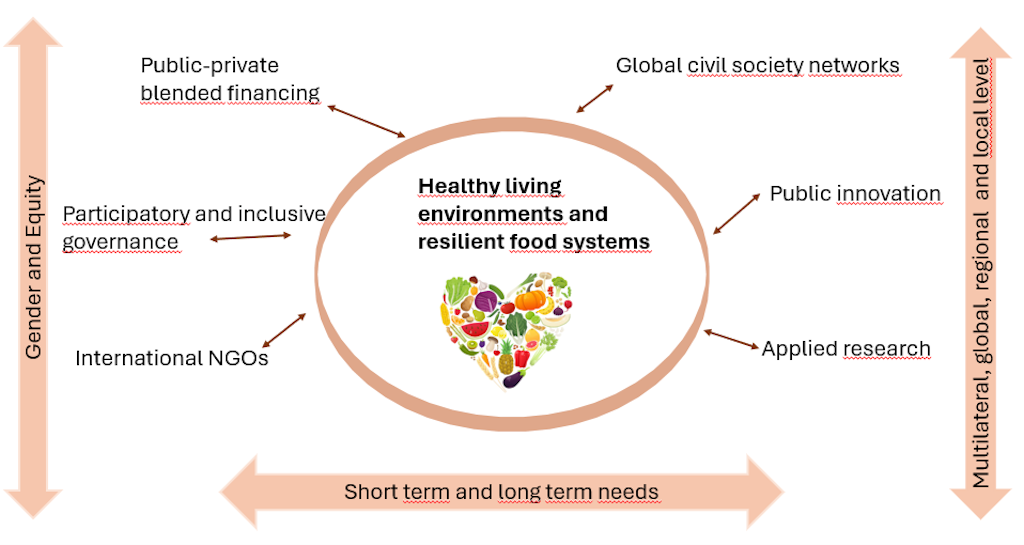
To promote the creation of healthy living environments and resilient food systems, the Health and Food Section supports public innovation and applied research, engages in public-private blended financing and encourages participatory and inclusive governance. It applies a gender equality and equity lens and supports global civil society networks and international NGOs. SDC works across the spectrum of short-term and long-term needs in its target regions. In response to short-term needs, thematic support is provided for humanitarian responses to health and food crises, and a “humanitarian-development-peace” nexus approach is used to ensure a continuum with long-term localised solutions. For long-term needs, the structural causes of ill health, hunger and malnutrition are addressed through policy dialogue and multi-country programmes, with a focus on the determinants of health and on agroecology to provide durable solutions.
The Section works from the local level up to the global level, linking in-country work supported by SDC country offices, with policy and advocacy efforts at the regional and global levels. For instance, mental health financing schemes were developed through a long-term collaboration with SDC bilateral programmes in Eastern Europe. This helped to expand regional and global initiatives to address advocacy and normative bottlenecks at the bilateral level, thus contributing to SDC's strategic, thematic and institutional coherence.
At the multilateral level, the Section seeks to influence and establish global standards and international normative frameworks. For example, it strengthens global health through its partnership with the Global Fund to Fight AIDS, Tuberculosis and Malaria and the World Health Organization. Switzerland sits in the governing bodies of specialized UN-agency and international finance institutions, such as the International Fund for Agricultural Development and the global research partnership for a food secure future. The Section contributes its thematic expertise, along with its experience and knowledge from bilateral programmes, to facilitate the transfer of innovative solutions from one country to another through global fora. It conducts its international policy dialogue in collaboration with the Swiss Missions in Rome, Geneva and in New York, with international institutions and in collaboration with other federal offices. This enables SDC to shape global dialogues on health and food. Switzerland demonstrates leadership in the fields of nutrition and agroecology by co-chairing the Group of Friends on “the Right to Food” and “Nutrition” for the UN agencies based in Rome.