
Traceability systems for sustainable coffee trade – Ethiopia
The “CARE for value and sustainability” project works on sustainable coffee trade in Ethiopia. It is a SOR4D research project led by Centre for Development and Environment (CDE), University of Bern, Water and Land Resource Centre (WLRC), and two Ethiopian public agencies. It seeks to demonstrate how the EU Regulation on Deforestation-free Products (EUDR) can be applied in a context-sensitive way by developing a locally adapted sustainable standard for deforestation-free forest and agroforestry coffee. The project works in two pilot areas, in Kaffa Zone, with forest and semi-forest coffee production systems, and in Gedeo Zone, with agroforestry-based and garden coffee systems. The project disseminates knowledge about the new EUDR regulation in both producer and consumer countries - including Switzerland.
AFS Newsletter - News by

Centre for Development and Environment (CDE), University of Bern
elisabeth.buergi@unibe.ch | LinkedIn


Centre for Development and Environment (CDE), University of Bern
isabelle.providoli@unibe.ch | LinkedIn
1. Context and relevance
The “CARE for value and sustainability” project is led by CDE, University of Bern and WLRC in collaboration with the Ethiopian Tea and Coffee Authority (ECTA) and the Ethiopian Forest Development (EFD). The project promotes deforestation-free supply chains that prioritize the creation of ecological, sociocultural and economic value in producing countries, focusing on the coffee sector in Ethiopia. The project aims to develop a locally adapted standard for ‘deforestation-free’ forest and agroforestry coffee. The new EU Regulation on Deforestation-free Products (EUDR) is used as an entry point because it sets out specific requirements for imported coffee, thereby promoting deforestation-free value chains. The EUDR requires importers to i) geolocate the coffee and maintain evidence of no deforestation, ii) provide a due diligence statement and iii) ensure legality of coffee production and trading. Despite these indications, details still need to be sorted out, not also sparking interest in coffee tracing schemes, but also causing confusion for those active in Ethiopia’s coffee value chain. The EUDR entered into force in June 2023 and was due to be applied as of 30 December 2024. However, the European Commission postponed the implementation period by 12 months as the initial period was found to be insufficient for many actors along commodity supply chains, including those in the coffee sector in Ethiopia. The announcement of the postponement triggered a wide range of reactions from stakeholder organisations, from approval to criticism.
2. Actions and recent progress
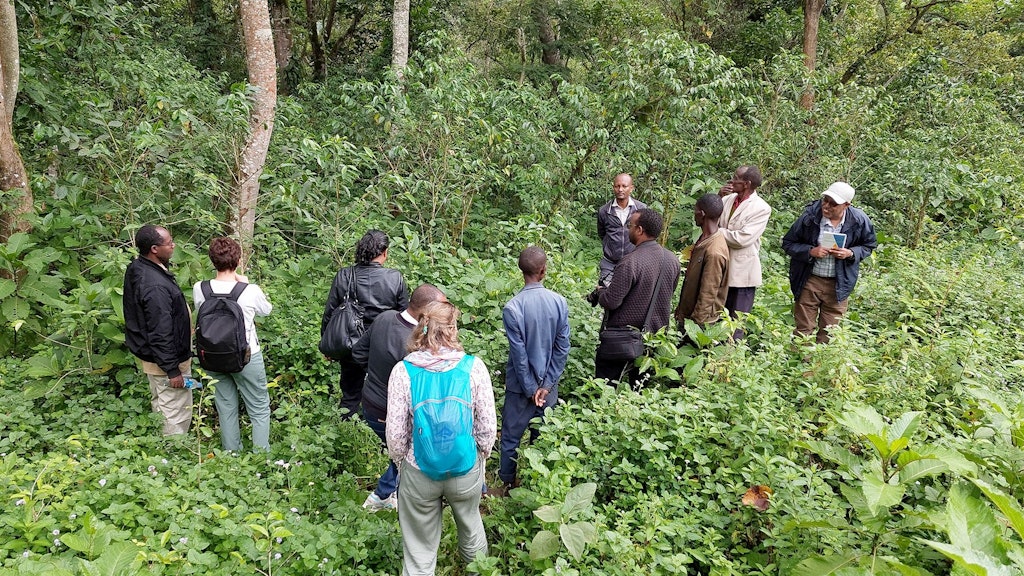
For the Ethiopian coffee sector, a context-sensitive implementation of the new EUDR is crucial, particularly in terms of maintaining and valuing forest and agroforestry coffee production. While Ethiopia's coffee sector may benefit both in the short and the long term, particularly the 5 million+ smallholder coffee farmers are also facing significant challenges due to the new regulation. Through this project, we aim to demonstrate how the EUDR can be implemented in a context-sensitive manner. The project works in two pilot areas, the Decha Woreda (district) in Kaffa Zone, with forest and semi-forest coffee production systems, and in Yirgachefe Woreda (district) in Gedeo Zone, with agroforestry-based and garden coffee systems. In the first year, the project raised awareness of EUDR and traceability issues and built related capacity in both Ethiopia and Switzerland. The seventeen project team members from Ethiopia and Switzerland engaged with affected stakeholders, established a robust traceability system and gathered information on EUDR related laws and governance schemes of Ethiopia, the EU, and Switzerland. They also engaged in a range of policy-oriented stakeholder discussions on how the EUDR could be implemented in a more context-sensitive and producer country friendly way. Examples include the Ethiopian Coffee Platform, Swiss Sustainable Coffee platform (SSCP), and workshops with Swiss policy actors (Zabel et al., 2025; Bürgi et al., 2025).
3. Lessons learned and future plans
Understanding the coffee value chain is challenging. The project partners began a thorough assessment of the highly complex and multifaceted Ethiopian coffee value chain, spanning farm-level production, local collection and processing, cooperative structures, export and the regulatory government body. Through these exchanges in the field with multiple actors, further insights on the complex value chain are gained and awareness on the EUDR is raised. These awareness-raising campaigns and collaborative processes, initiated among stakeholders from the pilot regions up to the national and international levels, have played a crucial role in preparing for the implementation of the EUDR and laid the basis for the elaboration of the locally adapted standard. The project is now seeking cooperation with key private actors in order to have the Ethiopian-based maps and traceability system applied. To this end, the project will further strengthen its collaboration with the Ethiopian Coffee Platform and the SSCP, while continuing to engage in EUDR implementation related debates at various levels of governance.