Pharmaceuticals: Organic Turnips for Medicinal Properties
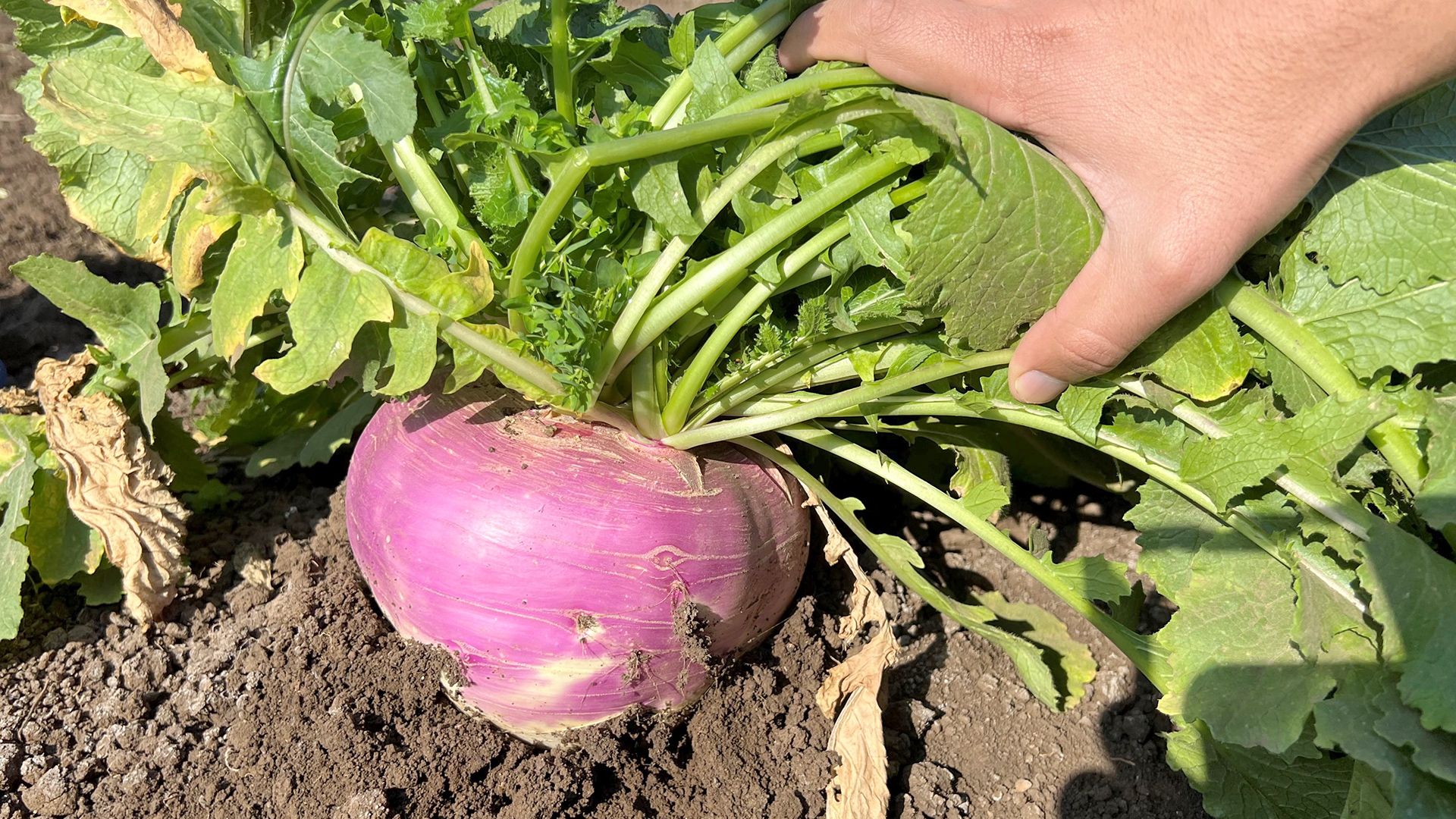
Turnips are more than just a root vegetable–they’re a powerhouse of health benefits, packed with antioxidants and cancer-fighting compounds. But can they be grown organically with minimal inputs? Bassem, a small-scale farmer in Egypt, took on the challenge despite missing the ideal planting window. With biofertilizers and a pesticide-free approach, he cultivated a thriving turnip crop. His journey proves that organic farming can be both sustainable and profitable. Discover his innovative approach and future plans!
AFS Newsletter - Article by
BioPyramids Biotech and Royal Green Technologies (RGT)
mohamed.salem@gebri.usc.edu.eg | LinkedIn
Turnips: A Nutritional Powerhouse
The turnip (Brassica rapa) has long been valued as both a dietary staple and a natural remedy. Recent research highlights its impressive nutritional profile, packed with bioactive compounds that offer a range of health benefits. Central to its medicinal properties are glucosinolates and isothiocyanates, compounds known for their strong anticancer potential. These substances help protect cells from oxidative stress and have been shown to inhibit the growth of certain cancer types. One particularly potent compound, 2-phenylethyl isothiocyanate, has demonstrated remarkable tumour-targeting capabilities. Beyond cancer prevention, turnips are rich in antioxidants, which neutralize free radicals and lower the risk of chronic diseases. Their benefits extend to liver and kidney health, where studies indicate that turnip extracts can help regulate liver enzymes and support kidney function. These effects are attributed to their unique combination of sulphur-containing compounds and flavonoids, which work together to enhance detoxification and reduce inflammation. Given their affordability and accessibility, turnips remain an excellent addition to a balanced diet, offering both preventive and therapeutic advantages.
A Quick Decision
Bassem, a farmer from Menoufia, Egypt, found himself at a crossroads when seeking ways to increase his income. After careful consideration, he decided to lease additional farmland and grow a crop he was familiar with: turnips. However, this time, he wanted to take a different approach, one that avoided synthetic pesticides altogether. Despite his enthusiasm, there was a challenge: he had missed the optimal planting window, which typically falls between late September and early October. Nonetheless, he proceeded with his plan, sowing his turnip crop in early November 2024 on approximately 40 Kirat (7,000 m²).
Fertilization was another hurdle. With organic matter and compost in short supply, Bassem opted for NovaPlus, a biofertilizer, as the sole nutrient source for his crop. It was a calculated risk, but he was determined to prove that turnips could be grown efficiently under organic conditions without excessive reliance on external inputs.
An Economical Organic System
Throughout the growing season, Bassem remained committed to his organic principles. Instead of chemical pesticides, he relied on organic fertilizers to enhance plant vigour, ensuring they could naturally resist pests and diseases. By eliminating harmful agrochemicals, he not only minimized environmental impact but also cut down on production costs. To address the soil’s nutrient limitations, he used a small amount of chemical fertilizers as a supplement. Despite the late planting, the turnips showed impressive growth by day 65, boasting healthy foliage and high biomass weight. Bassem planned his harvest at 90 days, aiming for an economically viable yield with promising returns. The results exceeded his expectations, reinforcing his belief in organic farming as a sustainable and profitable practice. In the future, he intends to incorporate compost into his system, further reducing dependence on external inputs while promoting soil health. His experience underscores the potential of organic agriculture, demonstrating that with careful planning and adaptation, sustainable farming can be both practical and financially rewarding.
Produce Quality
To validate the quality and safety of his produce, Bassem sent samples of his turnips to the Central Lab of Residue Analysis of Pesticides and Heavy Metals in Food (QCAP) for testing. The results confirmed that no pesticide residues were detected, verifying the integrity of his organic farming approach. This certification not only reinforced consumer confidence but also positioned his turnips as a premium product in the market, further proving that organic cultivation can yield high-quality, contaminant-free produce. Plant growth measurements further validated the success of Bassem’s organic system. On average, the turnip plants had 16.7 leaves, a shoot length of 55.4 cm, and a root length of 41.7 cm. The total plant length averaged 97 cm, while the root circumference was 49.7 cm. Yield parameters were also impressive, with an average shoot weight of 433.4 g and an average root weight of 1,603.4 g per plant. This resulted in a total plant weight of approximately 2,036.7 g, demonstrating that organic turnip cultivation can achieve robust growth and high biomass production under well-managed conditions.
Bassem’s successful organic cultivation of turnips highlights the intersection between sustainable agriculture and human health. By eliminating chemical pesticides and relying on biofertilizers, he produced a nutrient-dense crop free from harmful residues. This not only benefits the environment but also enhances the medicinal potential of turnips, preserving their bioactive compounds essential for disease prevention. With their rich profile of antioxidants, glucosinolates, and isothiocyanates, turnips grown organically can serve as both a nutritious food source and a natural remedy, reinforcing the value of sustainable farming in promoting health and food security.
More information: