
UNFSS+4 stocktake: A momentum for network action
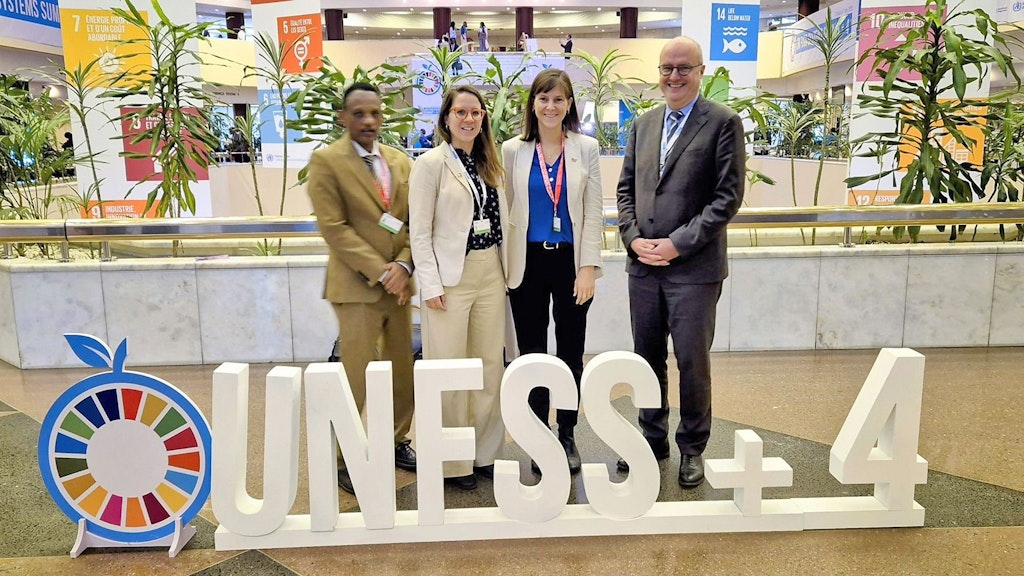
The UN Food Systems Summit +4 (UNFSS+4), held in Addis Ababa in July 2025, brought together governments, organizations, and partners to assess progress on food systems transformation. The summit highlighted concrete advances from national pathways to billions mobilized for food systems financing. Beyond plenary sessions, side events and bilateral meetings offered valuable opportunities for partners to exchange, build alliances, and link local realities with global agendas. The event also exposed gaps, including limited civil society participation, power imbalances as well as implementation gaps. Looking ahead, the main lesson is: high-level summits are not just about declarations, but key opportunities for increased A&FS Network collaboration, proactive preparation, and collective action.
AFS Newsletter - News by
Selina Bezzola
SDC Addis Ababa
selina.bezzola@eda.admin.ch | LinkedIn
Amsalu Andarge
SDC Addis Ababa
amsaluandarge.abate@eda.admin.ch | LinkedIn
Vivien Osele
SDC Addis Ababa
vivien.osele@eda.admin.ch | LinkedIn
1. Context and relevance
The UNFSS+4 took place in Addis Ababa in July 2025, co-hosted by Ethiopia and Italy. It is the first of its kind conducted in Africa. The gathering was a key moment to assess progress, renew global solidarity, and mobilize action. The gathering showcased the “Africa momentum,” recognizing the continent’s immense potential and urgent challenges, while calling for more global solidarity and investments to unlock and accelerate transformation at scale. Across the debates, it became clear that food systems transformation is now firmly recognized as central to tackling climate change, nutrition, biodiversity, and equity, making collaboration across regions and sectors more important than ever. For Switzerland, the event provided an opportunity to present our progress on cross-sectoral collaboration and coherence across public policy areas to advance the food systems agenda in domestic politics, as well as international cooperation.
2. Actions and recent progress
UNFSS+4 showcased concrete advances: 128 countries have developed food systems pathways, 169 now deliver school meal programmes, and over USD 17 billion in financing has been mobilized since 2021. Side events and bilateral meetings created spaces to exchange experiences, build alliances, and link local realities with global agendas. Beyond the plenary stage, participants showcased practical solutions from agroecology and nutrition governance to traceability in coffee value chains. For many, the summit was less about declarations and more about identifying what works on the ground, and how we can accelerate and scale it up together. The Stocktake also highlighted ongoing challenges: limited civil society participation, persistent power imbalances, financing gaps and the need to focus on concrete action and examples, not just commitments. Switzerland/SDC reaffirmed its commitment to agroecology, biodiversity, sustainable and healthy diets and nutrition, and rights-to food governance in line with its 2025–2028 International Cooperation Strategy. For the Swiss delegation this event was also an opportunity to organize invaluable in-person bilateral meetings with different partners of the A&FS Network.
3. Lessons learned and future plans
One strong takeaway is that high-level events such as the UNFSS+4 are invaluable moments for the A&FS Network members to meet in person, aligning strategies, and organizing joint initiatives with ministries, donors, and partners. To maximize impact in future events, we plan to leverage the Network more actively and therefore invite Network members to reach out before attending events, to enhance coordination and speak with stronger, collective voices. Another important takeaway is the importance of sharing and making the many practical solutions, handbooks, and country experiences shared at the summit accessible to everyone. Therefore, the A&FS Network stays a crucial platform on which those documents can be published, shared and discussed among members (e.g. AFS CUG member Contribution: Practical examples of national food systems transformation). Looking ahead, the lessons from Addis will feed directly into upcoming milestones such as the UN General Assembly, the Committee on World Food Security, and COP30, where Network collaboration and timely coordination will be key to ensuring food systems stay high on the agenda. Continuous efforts to advance food systems transformation and empowering smallholder farmers will be key topics guiding these processes.