People approach food systems in many different ways, and depending on how they do this, might arrive at different definitions. Nevertheless, there is a broad consensus that food systems represent the physical flow of food from production to consumption (“from farm to fork”). This means consideration of how food evolves through the stages of production, processing, distribution, retail, consumption and in some measure waste. Beyond this, they also describe the social, natural and regulatory environments (or systems) in which this is taking place, as are the drivers of certain behavioural patterns and the resulting outcomes.
In an effort to capture this, the following text adopted by SDC’s Food Systems Section was designed to capture the concurrent pursuit of three complementary outcomes, (1) food security and healthy nutrition, (2) sustainable environmental stewardship, (3) economic and social well-being:
"A food system is a complex network of activities, processes, and actors involved in the production, distribution, consumption, and waste management of food. It encompasses all the steps and interactions from the cultivation or harvesting of crops and animal breeding to the consumption of food by individuals or communities. This includes agricultural production, processing, packaging, transportation, marketing, retailing, and food service. Additionally, it involves aspects such as food safety, food security, nutrition, sustainability, and socio-economic dynamics, and partially entails the management and stewardship of natural resources. Food systems can vary greatly depending on geographic, cultural, and economic factors, and they play a crucial role in determining food availability, accessibility, affordability and quality for populations worldwide."
Food systems are arguably a subsystem of a much larger, global system which encompasses the complex and interlinked processes of water resource management, governance, economics, to name but a few. It is with this in mind that the Scientific Group of the UN Food Systems Summit argues that any definition of a food system should (1) «be suitable for the purpose at hand» and (2) «sufficiently accurate to define the domains for policy and programmatic priorities». In these terms, the definition should be determined by its adequacy in relationship to the purpose that it is to serve.
The relationships outlined in the definition are best illustrated through a food system map, which can embody a simpler or more complex set of relationships. The Scientific Group of the UN FSS in 2020 warned that «Food systems maps that try to be fully comprehensive tend to collapse under the density and complexity of the interactions to be described and analysed. At the other extreme, food systems maps and models that focus too narrowly on a reduced set of phenomena gain apparent explanatory power at the price of realism, adequacy or, most importantly, the exclusion of important economic, social or environmental forces».
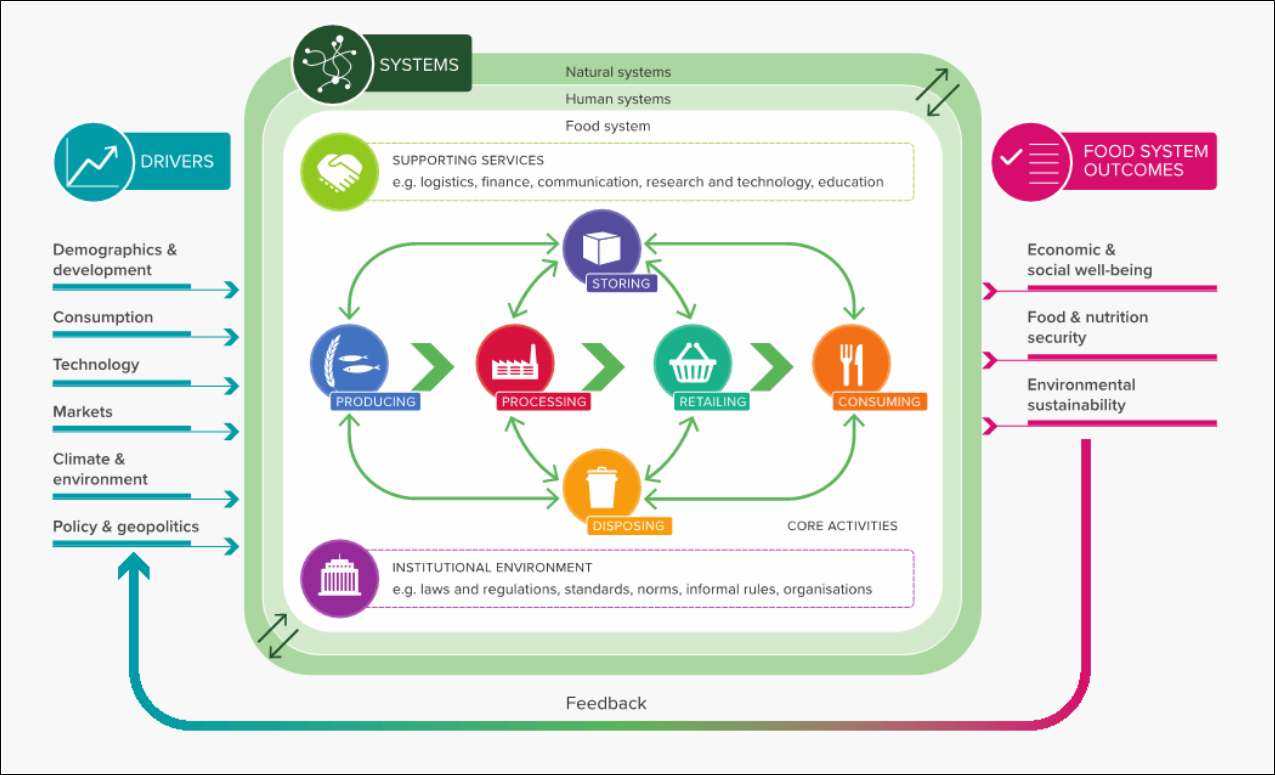
In an effort to chart the relatively narrow ground between the two pitfalls, SDC adopted the Foresight4Food food system map as illustrated below:
The food system scheme presents at its core the process between production and consumption in their relational interdependencies. These are directly conditioned by the available supporting services and the institutional environment in which they are taking place - regarded as the immediate limits of the food system. However, the food system is positioned within the human socio-economic systems with their customs, values, politics, laws, etc. Additionally, the natural systems determined by climate and geography condition how food is produced and consumed. The system is not static or stable, but is subject to change and regulation through so-called drivers which as a group influence one another. At the other end of the diagram are the three intended food systems outcomes which should be concurrently optimised by regulating the drivers through a feedback mechanism.
Production The process of growing crops, raising livestock, or harvesting fish and other food resources. This includes agricultural practices, farming techniques, and fishing methods.
Processing The transformation of raw agricultural products into consumable food items. Processing can involve various activities such as cleaning, sorting, milling, canning, freezing, and packaging.
Distribution The movement of food products from producers to consumers. Distribution involves transportation, logistics, storage facilities, and supply chain management to ensure that food reaches its intended markets efficiently and safely.
Storage The action or method of storing processed or unprocessed food for future use in a way that maintains quality, freshness and safety for a specified period of time, be it for consumption, or be it as input for further food production, e.g., seeds.
Waste Management / Disposal The handling and disposal of food waste generated at different stages of the food system. This includes strategies to reduce food waste, such as composting, recycling, and energy recovery, as well as managing by-products and food scraps.
Consumption The acquisition, preparation, and consumption of food by individuals or communities. This includes dietary choices, cooking practices, cultural preferences, and eating habits.
Regulatory and Policy Framework The set of laws, regulations, standards, and policies that govern various aspects of the food system. This includes food safety regulations, agricultural policies, trade agreements, environmental regulations, and initiatives to promote sustainability and equity within the food system.
Agents The actual individuals and organisations working across food systems. These various agents respond to prevalent incentives and values. The behaviour of actors will depend on education, laws, religion, access to resources and perceived risks and opportunities. It must be borne in mind that thr vast majority of agents across food systems are private sector actors, be that as firms, smallholders, vendors or consumers.
These elementary features interact with each other and with external factors such as environmental conditions, technological advancements, socio-economic dynamics, and cultural factors to shape the overall functioning and outcomes of the food system. Understanding and addressing these features are essential for promoting food security, sustainability, and resilience within the food system.
The dynamic features of a food systems approach
The relational interactions between the elementary features of a food system are governed the way food system is defined and governed. These can be described in dependency of «dynamic» features, i.e. features which are subject to constant change. They include:
Frames, Boundaries, Drivers, Activities and Actors, Outcomes, Feedbacks
Frames In systems thinking, frames are the lenses through which we perceive and make sense of complex issues. They shape our understanding by defining the boundaries, relationships, and perspectives within a system. Choosing the right frame when dealing with complex problems is crucial as it influences the analysis, decisions, and potential solutions we consider for addressing systemic challenges. For example, do we see the situation through an agricultural or a nutrition lens, or more of a food system lens?
Boundaries Boundaries in systems thinking refer to the limits or scope set around a system or its components. They define what is included or excluded from the analysis or intervention. Establishing clear boundaries helps in understanding system dynamics, interactions, and dependencies, enabling effective decision-making and problem-solving within the defined context. Boundaries can be physical (e.g., catchment areas), jurisdictional (county or nation-state), temporal (near-term or long-term), or conceptual (e.g., a productionist view).
Drivers
Drivers refer to the forces that influence and shape the behaviour and outcomes of the system. They can be categorised as either endogenous or exogenous.
Endogenous drivers arise from within the food system itself and include factors such as production practices, supply chain dynamics, market mechanisms, and consumer behaviours.
Exogenous drivers originate from external factors outside the immediate control of the food system, such as climate change, economic conditions, political decisions, technological advancements, and societal trends
Activities and Actors Activities in a food system encompass the various processes and actions involved in producing, processing, distributing, retailing, and consuming food (‘doing’ words). All these activities collectively shape the functioning, and hence the outcomes of, the food system. Activities are carried out by sets of ‹actors›, i.e., people.
Outcomes The activities of a food system result in a set of outcomes in food and nutrition security (e.g., childhood stunting or diet-related disease), environment (e.g., biodiversity, or GHG emissions), society (e.g., equity or political stability), and economy (e.g., livelihoods, or profit). These outcomes can be desirable and otherwise and must be managed to achieve a better balance across them all.
Feedbacks Feedback loops are fundamental to systems. They represent the cyclical flow of information, actions, and outcomes within a system. Feedback loops can have significant impacts on system dynamics, contributing to stability or change. Positive feedback loops amplify or reinforce a particular behaviour or trend, potentially leading to exponential growth or instability. Negative feedback loops dampen deviations and maintain stability and equilibrium within the system.
Outcomes
In the adopted food systems model, three outcomes are concurrently pursued:
Food security and healthy nutrition, Sustainable environmental stewardship, Economic and social well-being
Food security and healthy nutrition
From a consumer’s perspective, the characteristic of an ideal food system is to be able to acquire accessible, sufficient, convenient, nutritious, palatable and affordable food whenever it is needed.
Food security refers to the availability, accessibility, and affordability of nutritious food for all individuals within a population. A well-functioning food system ensures that people have consistent access to an adequate and diverse diet to meet their nutritional needs. Good nutrition refers to the quality of food available within a food system which directly impacts the nutritional status and health outcomes of individuals. A healthy food system provides access to a variety of nutrient-rich foods, promoting good health and reducing the risk of malnutrition and diet-related diseases.
Sustainable environmental stewardship
From a planetary perspective, a food system is sustainable only when the natural inputs it uses can be environmentally regenerated, and the ecosystems and its components (water, land, air, biodiversity) are preserved and not degraded.
Sustainable environmental stewardship refers to the responsible management and care of natural resources and ecosystems in a manner that ensures their longevity and health for current and future generations, and pertaining to food systems seeks to strike a balance between providing for human needs and maintaining ecological integrity. The concept seeks to consider the long-term ecological consequences of resource exploitation, preserve biodiversity and use natural resources economically, mitigate the environmental impact of exploitive measures and recognise the interconnectedness of planetary ecosystems, calling for global coordination and action.
Economic and social well-being
From a productive perspective, food systems must provide the prospect of a stable livelihood which ideally results in economic and social stability, and otherwise must provide better economic possibilities than other available alternatives.
Economic and social well-being refers to the overall health, prosperity, and quality of life of individuals and communities within a society. It encompasses various aspects of people's lives, including their economic security, access to resources and opportunities, social connections, and overall satisfaction with their living conditions. Indeed, the pursuit of economic and social well-being is arguably the defining incentive for most actors to become and remain involved in food systems, be that as producers, processors or distributors.
Activities and Actors
The major activities and actors within food systems can be categorised into several key groups:
Production Activities, Processing Activities, Distribution Activities, Consumption Activities, Waste Management Activities, Regulatory and Policy Actors, Research and Innovation Actors
Production Activities
Individuals, cooperatives and enterprises engaged in the original creation of foods, i.e.
Crop cultivation. Planting, growing, and harvesting crops such as grains, fruits, vegetables, and nuts.
Livestock raising. Rearing animals for meat, dairy, and other animal products.
Fishing and aquaculture. Harvesting fish and other aquatic organisms from natural water bodies or cultivating them in controlled environments.
Processing Activities
Appropriate handling, packaging and temperature control of agricultural products during picking, sorting and sorting in a way that prevents bruising and spoilage due to mechanical damage, heat or frost.
Harvest/post-harvest handing. Converting raw agricultural products into processed foods through activities like milling, grinding, canning, freezing, drying, and packaging.
Food processing. Converting raw agricultural products into processed foods through activities like milling, grinding, canning, freezing, drying, and packaging.
Manufacturing. Producing food-related products such as cooking oils, beverages, snacks, and condiments.
Distribution Activities
Individuals, cooperatives and enterprises engaged in the distribution and retails of foods between processors and from the final point of processing to consumers.
Transportation. Moving food products from production sites to processing facilities, distribution centers, markets, and retail outlets.
Logistics. Managing the flow of goods, including storage, inventory management, and shipping.
Retailing. Selling food products to consumers through supermarkets, grocery stores, farmers' markets, and online platforms.
Consumption Activities
Individuals and groups who ultimately consume the produced food either in part or in whole.
Meal preparation. Cooking, baking, and assembling food for consumption in households, restaurants, and food service establishments.
Dietary choices. Selecting foods based on taste preferences, nutritional needs, cultural traditions, and health considerations.
Eating habits. Patterns of food consumption, including meal times, portion sizes, and social customs related to eating.
Waste Management Activities
Organisations which deal with the unconsumed food which would be regarded as lost, spoilt or wasted by disposing or in some form recycling it.
Food waste reduction. Minimising waste through strategies such as composting, donation to food banks, and creative reuse of surplus food.
Recycling. Repurposing packaging materials and other food-related waste streams.
Disposal. Properly managing organic waste to prevent environmental pollution and promote resource recovery.
Regulatory and Policy Actors
Organisations and particularly (inter-)governmental bodies or quangos who have a public charter to set and enforce regulations and agreed norms on how food is dealt with at all stages of food production and processing upstream of the consumer.
Government agencies. Enforcing food safety regulations, setting agricultural policies, and monitoring compliance with food standards.
Non-governmental organisations (NGOs). Advocating for food security, nutrition, and sustainability initiatives, and providing support to vulnerable populations.
International organisations. Developing global food policies, coordinating responses to food crises, and promoting international trade agreements related to food and agriculture.
Research and Innovation Actors
Organisations, particularly academic research bodies, civil society organisations and enterprises who engage in the further development of food systems in a wide variety of ways.
Academic institutions. Conducting research on agricultural practices, food technologies, and nutritional science.
Private sector. Investing in innovation, developing new food products, and implementing technologies to improve food production, processing, and distribution.
Civil society. Engaging in advocacy, education, and community-based initiatives to address food system challenges and promote sustainable food practices.
These activities and actors interact within a complex network that shapes the functioning and outcomes of food systems, influencing factors such as food availability, accessibility, affordability, and quality for populations worldwide.