
Repository: Food system typologies
A brief overview of other appoaches to food system typologies
K-HUB > Dig Deeper: Concepts > Food system typologies > Repository
Typology of food systems according to spatial scale
By InTeGrate / SERC
A good way to understand the complexity of different types of food systems is to look for organizing principles to classify them. In the introductory food supply chain exercise at the beginning of this module, if you chose a product that was produced a long distance from where you consumed it, you are aware that the global food system today handles food at an enormous spatial scale. This example leads to one way to organize our understanding of food systems, which is the hierarchy global, regional, and local scales of food systems.
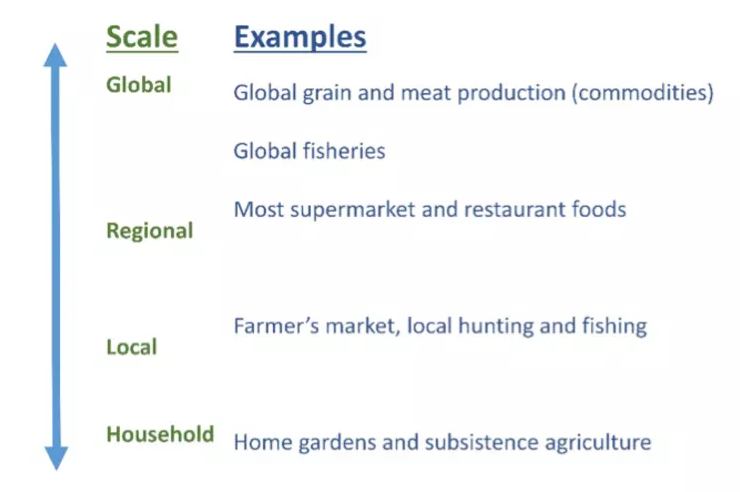
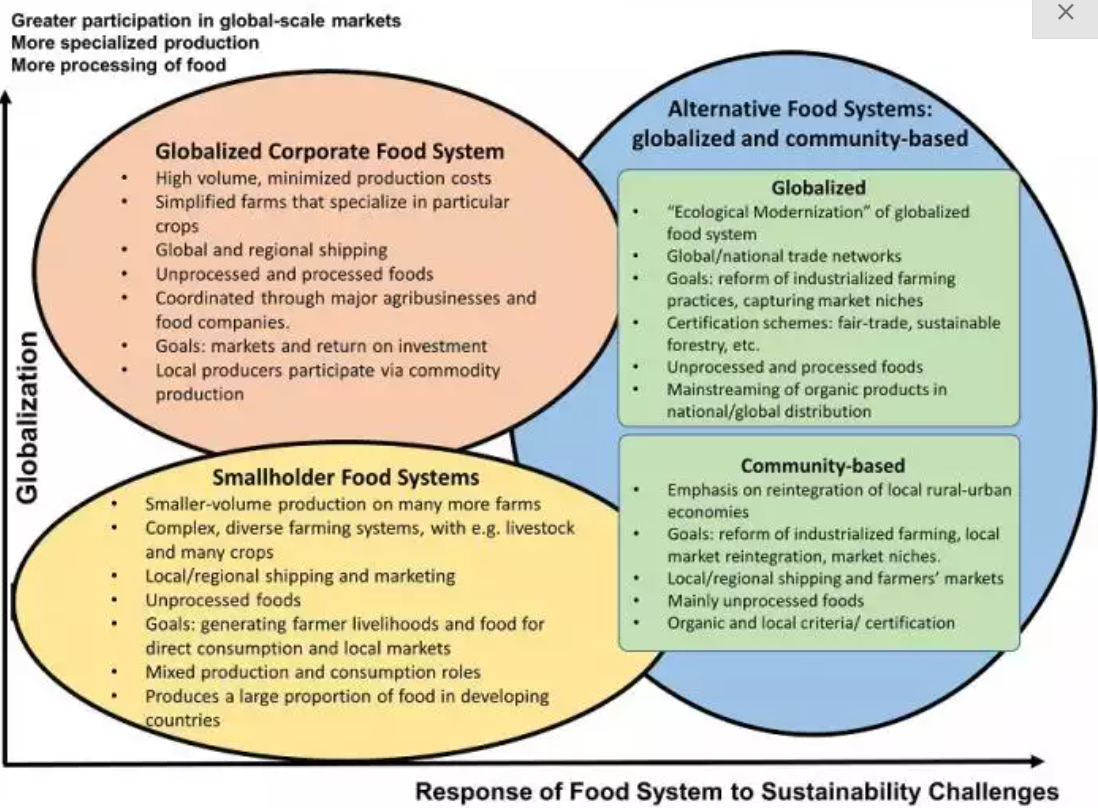
Another helpful way to classify food systems is to look for typologies of food systems. Building typologies is a somewhat subjective but often helpful process where we look for groups of systems or components that hang together in order to better understand their function, importance, or other attributes. For the typology of food systems we present here, we are thinking about classifying food systems based on how production occurs and at what scale, which portions of society are involved in production and distribution, and the rationale underlying production, distribution, and consumption. In this course, we use the scheme of three overlapping food systems that exist at global, regional, and local scales.
K-HUB > Dig Deeper: Concepts > Food system typologies > Repository