
Food system typologies
Typologies are a classification tool that can support researchers and policymakers in conceptualising and analysing food systems.

K-HUB > Dig Deeper: Concepts > Food system typologies
Food system typologies
Typologies are a classification tool that can support researchers and policymakers in conceptualising and analysing food systems. In their most basic sense, typologies allow the ordering and grouping of entities according to their similarities. (Bailey, 2017)
In the case of food systems, different typologies might be applied, depending on the purpose and the available data. These categorisations might be focussed on the following:
- comparative description of national food systems outcomes (food affordability, food consumption diversity, health and nutrition status, environmental sustainability; industrial, market, transitional, emerging, rural)
see: IFPRI/Nugent et al., 2015 - depending on the spatial lens (household, local, regional, national, global),
see: InTeGrate/SERC - in terms of intake adequacy (sufficient, insufficient or unreached ability to achieve average dietary energy supply adequacy for all inhabitants),
see: Baer-Nawrocka et al., 2019 - depending on the level of urbanisation (agriculture towns and cities < 1 million people, secondary cities 1-19 million, megacities and conurbations < 10 million, future food-smart cities and neighbourhoods),
see: Tefft et al., 2017
A digest of some of the other examples of food systems typologies is provided here: [link to 1c Examples of food systems typologies]
The typology discussed here is based on a paper by Marshall et al. that builds on a number of these approaches, and is a listed resource of the Food Systems Dashboard.
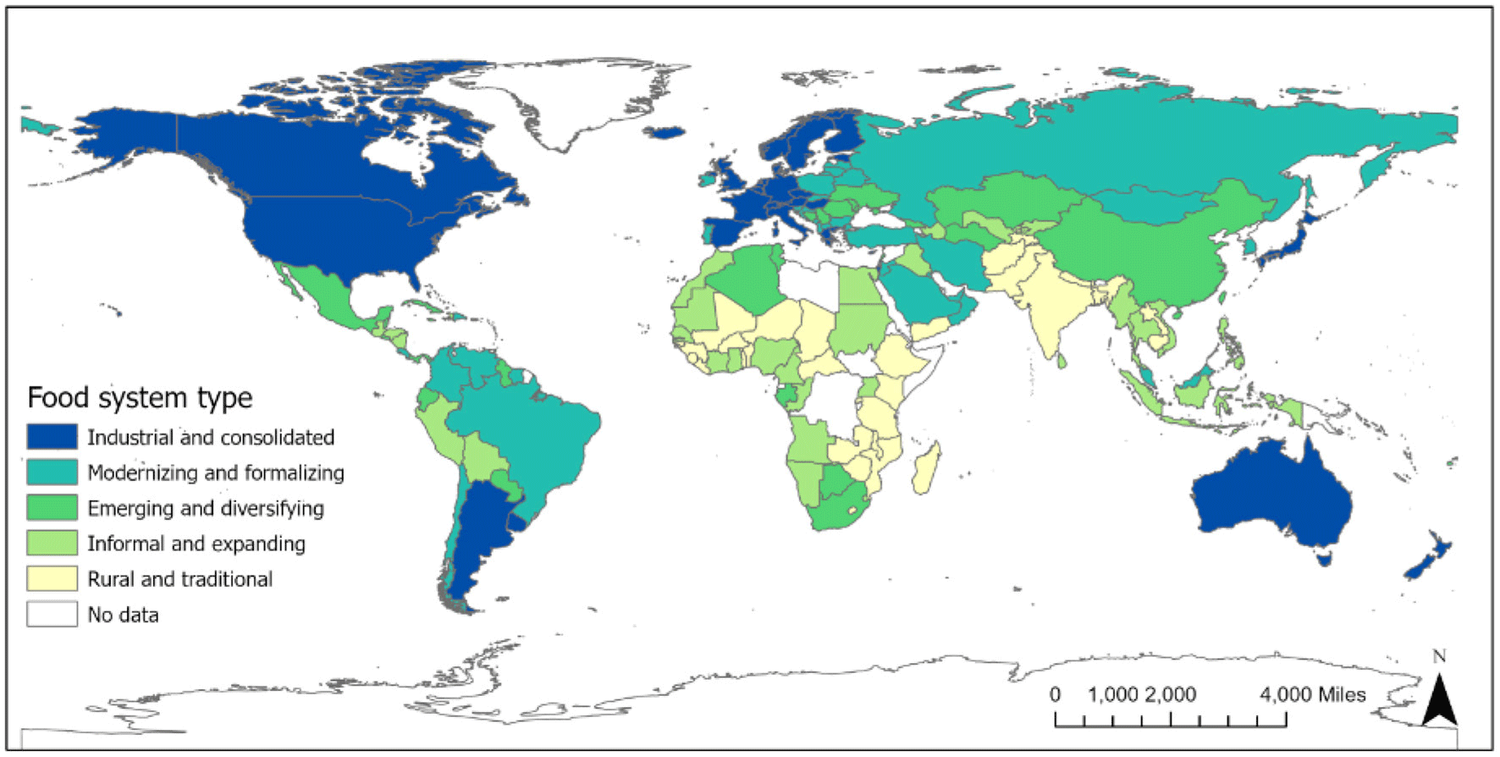
The particular food system typology is a general categorisation of national food systems, while recognising that different food system types can co-exist and spatially overlap. In this sense, the typology sits well with the objectives of the food systems dashboard and is designed to use a narrow (“parsimonious”) set of well-defined and widely assessed indicators as typology variables. In choosing them, the following criteria were applied:
- The selected variables should have explanatory power for different components of a food system.
- Research should attest the variable’s association with specific food system patterns and transitions
- Any used data must be available for a high number of the food systems being typified, and be of sufficient quality and consistency to make ultimate comparisons possible. The authors specified a high global coverage amounting to an availability for at least 100 countries with reasonably balanced representation across all regions.
The emerging four composite variables for the typology were the following:
- Agriculture value added per worker
- Share of dietary energy from staples
- Supermarkets per 100,000 inhabitants.
- Percent urban population
Each country was assigned a score based on the relative ranking of the four indicators across all variables. This meant that countries were ranked relative to each other rather than according to any absolute values derived from the variables. As a result, also the typology classes are relative to one another, and as a whole will not shift over time, although countries can move from one class to another relative to one another. Accordingly, the classifications must be described in relative terms. That this approach will not detect any absolute global shift in the nature of food system is probably the greatest methodological weakness. Nevertheless, as a snapshot, it is an easy-to-understand and useful comparative tool The following designations were chosen and lean on prior typology classifications:
- Industrial and consolidated
- Modernising and formalising
- Emerging and diversifying
- Informal and expanding
- Rural and traditional
K-HUB > Dig Deeper: Concepts > Food system typologies