
Seed sector development: significance, definitions and approaches
This introduction provides a general overview of what the seed sector represents, how it relates to food systems and what its key outcomes and functions are.

K-HUB > Design a Project > Seed systems > Seed sector development
Context: importance of quality seed
Population growth, climate stress, global conflicts and resource scarcity
The rapid growth of the global population is increasing demand for agricultural production, particularly in the Global South, where food security remains a critical challenge. At the same time, climate change is intensifying pressure on farming systems. Rising temperatures, extreme weather events—including floods, droughts, and heatwaves—and shifting rainfall patterns are threatening crop yields and agricultural stability.
These challenges are further compounded in fragile contexts affected by conflict or displacement. Pandemics such as COVID-19 have exposed vulnerabilities in global food systems. Meanwhile, growing competition for key resources like arable land and water is constraining agriculture’s ability to meet rising food demands sustainably.
In response, urgent adaptation strategies, technological innovation, and enabling policies are needed to build resilient and sustainable food systems. Protecting agrobiodiversity is also critical, as its continued loss poses a major risk to both food security and long-term resilience.
Use of quality seed enhancing agricultural productivity and resilience
One of the most effective ways to boost agricultural productivity is through the use of high-quality seed from improved and locally adapted varieties. A wide range of seed types is needed to support diverse cropping systems and farmer needs.
Seed lies at the foundation of agricultural production and food security. Without seed security, food security is not possible. High-quality seed contributes to better yields, climate resilience, and nutritional value—making it a central element of sustainable agriculture. (See below for definitions of “seed,” “variety,” and “quality seed”.)
Quality seed enhances crop resilience by enabling farmers to better cope with climate change and environmental stresses. For cash crops, investing in quality seed offers high returns, making it an attractive option for smallholders aiming to increase income. For food security crops, quality seed boosts both yield and nutritional value, improving household food supply.
Across the Global South, large yield gaps persist. Experts estimate that up to 50% of these gaps can be closed by adopting quality seed of improved and adapted varieties, while the remaining 50% depends on complementary practices such as fertiliser use, irrigation, and improved soil management. Addressing both seed and agronomic factors is essential to achieving sustainable agricultural development under increasing global pressures.
Physical seed quality
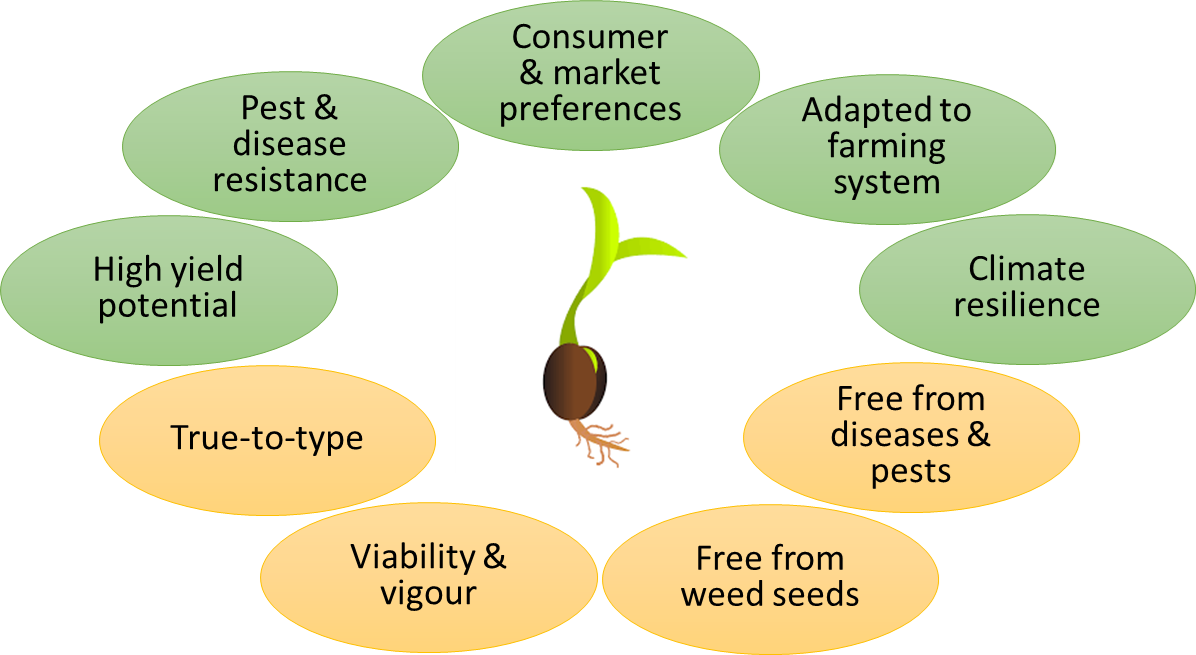
Seed quality encompasses two key aspects: physical and genetic quality; see Figure 1. Physical quality refers to the seed’s ability to germinate reliably, and its freedom from weed seeds, pests, and diseases. It also means the seed is “true to type”—matching the variety expected by the farmer.
Farmers often manage physical seed quality through their own informal practices. In formal seed systems, however, more rigorous internal quality control is applied, along with external quality assurance such as seed certification. Both farmer-managed and formal systems can produce high-quality seed when sound production and handling practices are followed. (See chapter 2.3 on seed service provision, and chapter 2.6 on seed sector regulation for more on quality assurance.)
Genetic seed quality
Genetic quality refers to the traits carried by the seed—such as yield potential, resistance to pests and diseases, and desirable processing or consumption qualities. These traits are determined by the variety and directly influence crop performance.
Developing and promoting improved, locally adapted varieties is essential for climate resilience and productivity, especially in rainfed systems. Agrobiodiversity is a vital resource in this process, providing the genetic foundation for ongoing crop improvement. Farmer-managed seed systems are key to conserving this diversity and must be recognised and supported as critical contributors to resilient, adaptive agriculture.
Supporting the development of a pluralistic seed sector
Quality seed through different seed systems
Beyond physical quality and varietal traits, seed must also be available at the right time, in the right place, in the right quantity, and at an affordable price. Meeting these conditions depends on well-functioning seed systems (see Box 1 for a definition).
Farmers have diverse seed needs across many crops and varieties—and they are not a homogeneous group. Farmers’ seed requirements vary based on agroecological conditions, cropping systems, gender, income, and market orientation. This diversity is served by a range of seed systems. For example, a single farmer might save part of its sorghum harvest for replanting, obtain bean seed from a community-based seed scheme, buy maize seed from a domestic company, and purchase tomato seed from an international supplier. These examples highlight how multiple seed systems often operate in parallel to meet a farmer’s needs.
Approaches such as pluralistic seed sector development (CROPS4HD, 2023), integrated seed sector development (Louwaars and de Boef, 2012), and development of resilient and inclusive seed systems (Westengen et al., 2023; AfricaSeeds, 2023) all build on the recognition of this seed system diversity. They emphasise that multiple systems coexist within the broader seed sector (see Box 1). A pluralistic approach acknowledges that each seed system—whether formal, intermediary, or farmer-managed—has its own strengths and limitations.
Rather than promoting a one-size-fits-all model, pluralistic seed sector development supports tailored interventions based on how seed is produced, exchanged, and used by different groups of farmers. This approach ensures that the seed sector can more effectively respond to diverse needs, while also supporting farmer adaptation to changing environments and evolving market opportunities.
Farmer-managed, formal and intermediary seed systems
Farmer-managed seed systems play a crucial role in providing access to seed for less market-oriented crops, particularly those that are self-pollinating or vegetatively propagated. Common crops include small grains, root and tuber crops, and local vegetables—many of which are well-suited to on-farm seed production. In these systems, farmers save, exchange, and sell seed from improved, recycled, or local varieties. For many smallholders, farm-saved or informally sourced seed remains the primary option, especially where formal seed systems are unaffordable or inaccessible. Across much of Africa and Asia, farmer-managed seed systems—including seed obtained from local markets—continue to serve as the dominant source of planting material (Sperling et al., 2020). These systems are also central to the concept of seed sovereignty, empowering communities to maintain control over their genetic resources, cultural practices, and food systems in the face of growing pressure from commercial and regulatory frameworks (AFSA et al., 2023).
Formal seed systems are typically structured and commercially oriented, providing access to certified seed—particularly for cross-pollinating crops and hybrid varieties. Crops such as hybrid maize and hybrid vegetables are commonly produced and distributed through these systems. Activities within formal seed systems are regulated and follow a clearly defined value chain, from variety development and seed production to certification and marketing. Official quality assurance mechanisms are in place to ensure seed meets established standards. These systems play a key role in commercial agriculture and in scaling access to improved varieties.
Intermediary seed systems operate between formal and farmer-managed systems, supplying quality seed for a range of crops, including legumes, rice, and vegetatively propagated crops. These systems typically have lower profit margins and often serve crops or regions not prioritised by commercial companies. They are commonly led by farmer groups, local entrepreneurs, or development organisations, often with support from public institutions. Quality assurance is typically organised at the local level, and linkages to formal structures—such as research institutes, regulatory bodies, seed inspection services, and financial institutions—are often limited, informal, or temporary. Intermediary systems play an essential role in increasing access to quality seed in underserved markets.
Principles that guide a pluralistic seed sector development approach
To support the design of interventions in a pluralistic seed sector, the team at Wageningen University & Research (WUR) and partners have developed eight guiding principles (see below). While originally formulated for the integrated seed sector development (ISSD) approach, these principles are equally relevant to other strategies promoting pluralism in seed sector development. The overarching goal is to meet the diverse needs of farmers in low- and middle-income countries across Africa, Asia, and Latin America—by expanding their access to a wider choice of crop varieties, seed quality levels, and price points.
Integrated seed sector and food systems framework
Integrating seed sectors into food systems
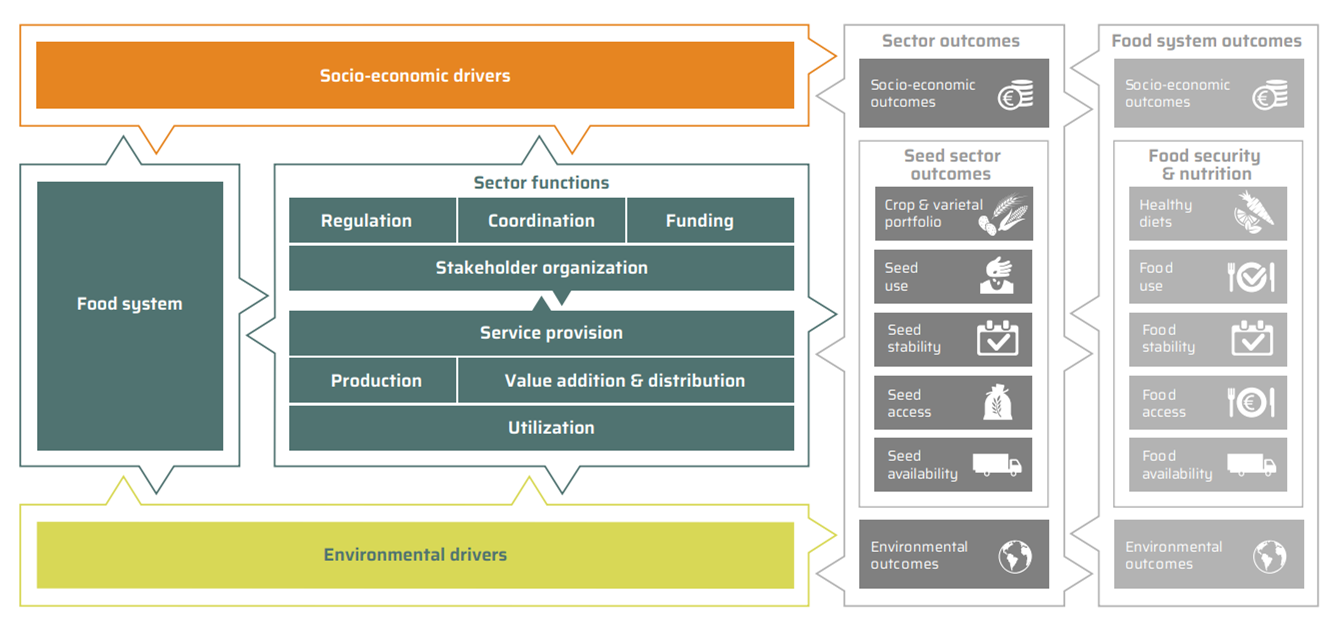
Improved seed systems and stronger seed sector performance can contribute significantly to more resilient and inclusive food systems. As the food systems approach gains traction, the integrated sector and food systems framework has emerged as a valuable tool for applying systems thinking (Borman et al., 2022). This framework builds on the traditional value chain concept but takes a broader perspective. It integrates governance, market dynamics, environmental conditions, and social dimensions—offering a more holistic lens. It provides a comprehensive approach to transforming individual agro-food sectors, including the seed sector, by embedding them within the wider food system context.
Seed sector and food system outcomes
Seed sector development aims to increase farmers’ use of quality seed, ensure a secure and timely seed supply, and expand access to a diverse range of crops and varieties. These outcomes contribute directly to food security and healthier diets. In addition, seed sector development can generate employment, support equitable income opportunities, and enhance socio-economic well-being. It also plays a role in climate change adaptation, biodiversity conservation and management, and overall system resilience. Together, these outcomes contribute to improved planetary health (see Figure 2). Aligning seed sector development with broader food system goals enables more purposeful and integrated transformation.
Ambition of seed sector functions
Within the integrated framework, the seed sector is organised around eight key functions, each of which plays a critical role in its overall performance. Table 1 presents these functions along with their corresponding ambitions, tailored specifically to the seed sector. When developing a national seed sector strategy or seed road map, these functions provide a comprehensive framework. They serve as a safeguard to ensure that all dimensions of seed production, distribution, and sector governance are addressed in the problem analysis and reflected in targeted solutions (De Boef and Thijssen, 2023). In this document, the eight functions also structure Chapter 2, which focuses on how to strengthen seed sector development to support broader food system outcomes.
Table 1: Ambition of seed sector functions
Specific interest of SDC in seed systems
The Swiss Agency for Development and Cooperation (SDC) has a strong interest in seed sector development, recognising the critical link between seed security, food security, and resilience—including the role of seed within the Humanitarian-Development-Peace (HDP) Nexus. As outlined in the sections above, supporting seed sector transformation contributes to poverty alleviation, food security, and improved nutrition for all—core elements of SDC’s mandate.
Seed sector development also intersects with major global challenges such as agrobiodiversity conservation and climate change adaptation. Smallholder farmers—who produce over 70% of the food consumed in Asia and sub-Saharan Africa—are among the most vulnerable to both agrobiodiversity loss and climate impacts.
This document is intended to equip SDC and its partners with concepts and frameworks for navigating the complexities of the seed sector. It offers guidance on designing and implementing effective interventions through various entry points, addressing key sector functions from seed production to seed sector regulation. It highlights good practices and provides resources for further exploration. The guide draws on examples from ISSD-inspired programmes in which WUR has played a role, and includes cases from SDC-supported initiatives.
References and additional resources:
- AfricaSeeds, 2023. Inclusive seed sector development for sustainable agricultural transformation in Africa. (Link)
- AFSA et al., 2023. Seed sovereignty: A viable option for food and nutritional security in Africa. (Link)
- Borman et al., 2022. Putting food systems thinking into practice: Integrating agricultural sectors into a multi-level analytical framework. (Link).
- CROPS4HD, 2023. Position paper on policies for pluralistic seed systems. (Link)
- De Boef et al., 2024. Special issue opening editorial: Designing, assessing and scaling approaches for integrated seed sector development. (Link)
- ISSD Africa. Short video on principles guiding integrated seed sector development. (Link)
- Louwaars and de Boef, 2012. Integrated seed sector development in Africa: A conceptual framework for creating coherence between practices, programmes and policies. (Link)
- Sperling et al., 2020. Informal seed traders: the backbone of seed business and African smallholder seed supply. (Link)
- Westengen et al., 2023. Navigating toward resilient and inclusive seed systems. (Link)
Index
K-HUB > Design a Project > Seed systems > Seed sector development